| # | Product | Our Rating | ||
|---|---|---|---|---|
| 1 | 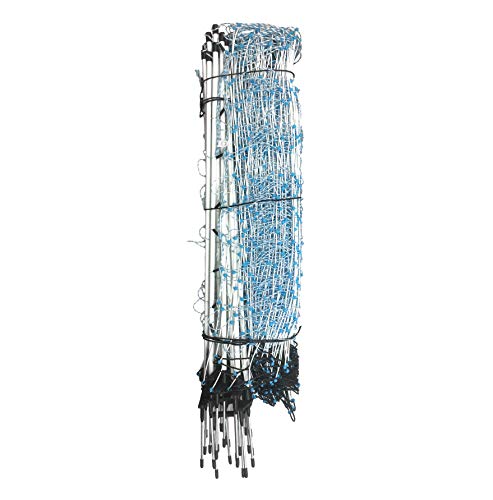 | Best OverallStarkline Electric Sheep & Goat Netting (164 ft) | ★★★★★ | Check Price |
| 2 |  | Loose Goat Mineral Supplement | ★★★★☆ | Check Price |
| 3 |  | ARS Professional Hoof Trimmer | ★★★★☆ | Check Price |
Every goat keeper you will ever meet started exactly where you are: standing at a fence, wondering if they could actually do this. The answer is almost certainly yes, because goats are among the most forgiving livestock a beginner can choose.
But the difference between a great first year and a miserable one is decided mostly before the goats arrive. Goats punish improvisation in two specific areas, fencing and parasites, and reward preparation everywhere else.
This guide walks the whole first year in order: the decisions, the setup, the feeding, the health routine, and the calendar, with links to our deep guides on every topic when you want the full detail.
Before You Buy Your First Goats
Three questions come before any cute kid photos. Answering them honestly saves the most common beginner heartbreak, which is rehoming goats six months in.
First: are goats legal where you live? Call your zoning office and ask specifically about livestock, not pets, because goats are classified differently town to town, and many suburbs allow does and wethers while banning bucks outright. Get the answer in writing, and talk to your neighbors before the goats do.
Rules can even vary within one city, as in Medford, Oregon, where it comes down to your lot’s zone.
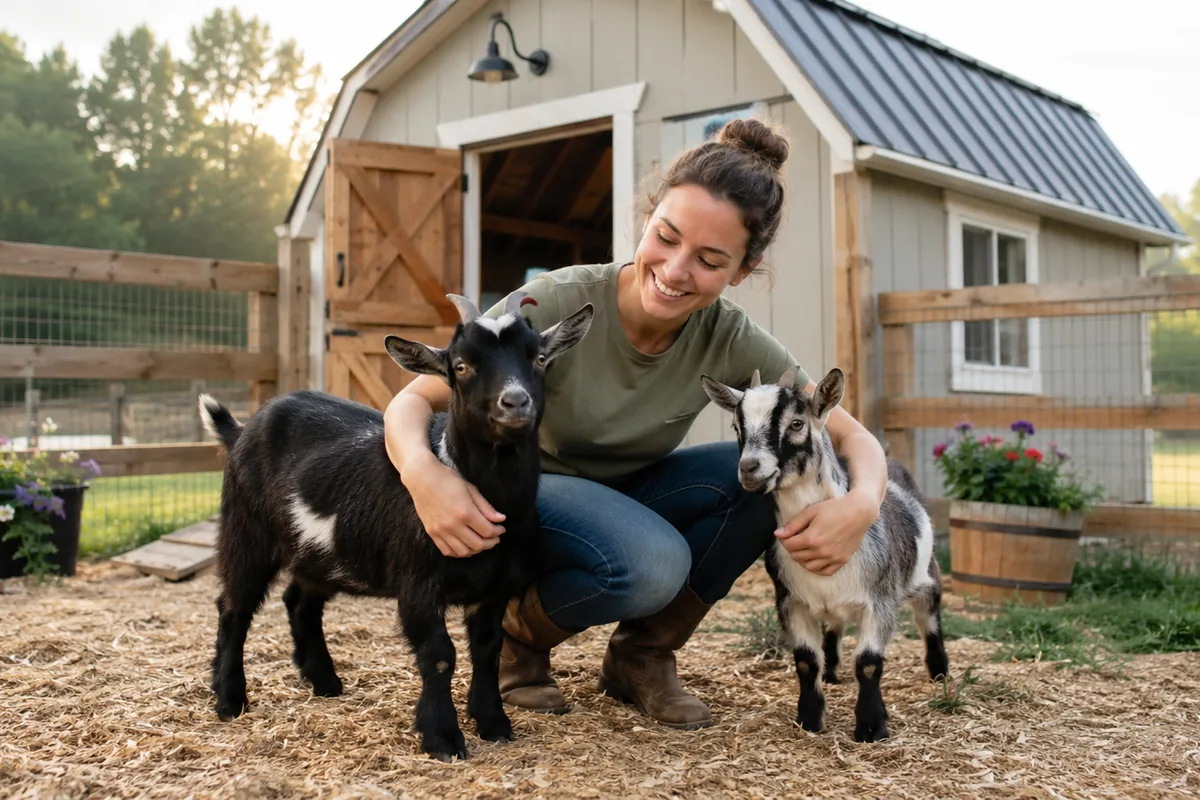
Second: can you commit to two? Goats are herd animals in the strictest sense, and a lone goat becomes a loud, fence-destroying, miserable animal no matter how much attention you give it. Two does, two wethers, or a doe-wether pair is the minimum viable herd.
Third: who will care for them when you travel? Goats need someone twice a day, every day, holidays included. Line up your goat-sitter before you need one, because “anyone can toss hay” stops being true the first time something goes wrong.
What Does It Cost to Raise Goats?
Goats are cheap compared to horses and expensive compared to chickens, and most of the money is spent before and around the goats rather than on them. Here is the honest budget for a starter pair.
| Expense | Typical Range | Notes |
|---|---|---|
| Two starter goats | $150-$600 | Wethers cheapest; registered doelings most |
| Fencing | $500-$1,500 | The real startup cost; do not skimp |
| Shelter | $0-$800 | Free if converting a shed; kits cost more |
| Feeders, buckets, supplies | $100-$250 | Hay feeder, mineral feeder, first-aid basics |
| Startup total | $1,200-$2,500 | For a prepared, fenced, sheltered pair |
| Hay (yearly) | $300-$700 | Biggest ongoing cost; varies by region |
| Minerals, bedding, care supplies | $150-$300/yr | Loose minerals, straw or shavings, hoof gear |
| Vet and health | $100-$300/yr | CDT, occasional fecal tests, one visit |
| Annual total | $600-$1,200 | For two goats, hay-fed |
The pattern to notice: fencing dwarfs the price of the goats. A free pair of Craigslist goats behind a $200 fence costs far more, in escapes and stress, than a $500 pair behind a $1,200 fence.
How Do You Choose Your First Goats?
Match the breed to your honest goal, and when in doubt, go small and friendly. The 12 best goat breeds cover milk, meat, and pets, but the beginner shortlist is mercifully short.
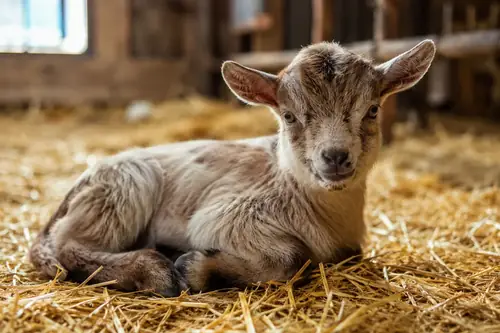
For most first-timers, two Nigerian Dwarf does or wethers are the answer. They are compact, personable, cheap to feed, and they keep the milk option open, since Nigerians are genuine dairy goats with the richest milk of any breed.
Pygmies are the equal pets-only pick, and a pair of calm standard-breed wethers suits people who want bigger brush-clearers. What beginners should avoid is just as clear: no bucks the first year, no single goats ever, and no high-production dairy doe until you have a routine.
Minis are welcome in more towns, since some cities that ban standard goats allow Nigerian Dwarfs and Pygmies.
Buy from a breeder who tests for CAE, CL, and Johne’s disease and will show results, and expect clean, alert animals on trimmed hooves.
A few dollars saved on untested stock is the most expensive discount in goats. Most goats live 10 to 12 years, and a diseased start follows them all the way.
Plan a brief quarantine anyway. New arrivals spend two to four weeks in a separate pen while you watch, deworm if fecals say to, and let everyone meet through a fence.
Set Up Housing and Fencing Before the Goats Arrive
The setup rule is simple: build for goats, not for the animals you wish goats were. They climb, lean, chew, and test everything, and they hate rain with a passion.
Shelter is the easy half. Each goat needs about 15 to 25 square feet of dry, draft-free, ventilated space, which a converted shed or a simple three-sided run-in covers beautifully, bedded with straw or pine shavings.
Pen space comes next: plan around 200 to 250 square feet per goat for the dry lot or sacrifice area, plus whatever grazing you have. If pasture is part of your plan, the right stocking rate per acre and regular rotation keep parasite pressure down.
Fencing is the hard half, and the place beginners most regret economizing. The standard that works is 4-foot woven wire with openings heads cannot fit through, stretched tight on solid posts.
Electric netting is one of the goat fencing options worth knowing, since it makes pasture rotation possible.
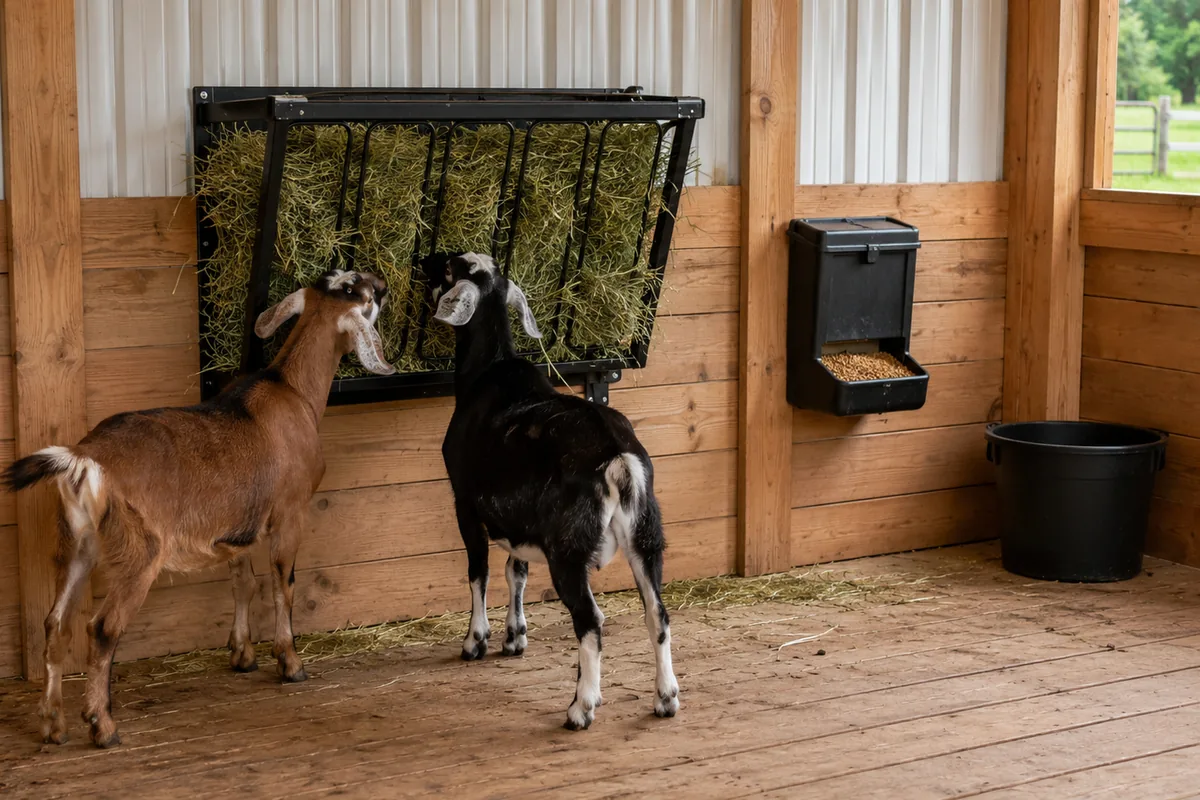
Finish the setup with the unglamorous details: a hay feeder so hay stays off the ground, a mineral feeder under cover, water buckets you can scrub, and gate latches a clever goat cannot work open. Assume any latch you can open in two seconds, a goat will eventually open too.
One predator note before moving on: night belongs to dogs and coyotes nearly everywhere. Lockable night quarters inside the fence give you cheap predator protection from day one.
What Do Goats Actually Eat?
Forget the tin-can cartoon: goats are picky browsers with sensitive stomachs, and the feeding program that works is almost boringly simple. Hay, browse, minerals, water, done.
Quality grass hay is the foundation, fed free-choice from a feeder, and choosing the right hay is the single biggest feeding decision you will make. A standard goat runs through roughly 4 to 5 pounds a day when pasture is not contributing, about two square bales a week for the pair.
The second non-negotiable is a loose goat mineral, offered free-choice year-round. Goats run short on copper and selenium across most of the country, and a proper goat mineral program quietly prevents the faded coats, fertility problems, and immune weakness that show up without one.
Now the surprise for most beginners: your goats probably do not need grain. Grain is for milking does, growing kids, and thin animals, and overfeeding it causes obesity, deadly urinary stones in wethers and bucks, and rumen disasters, so pets and maintenance goats get hay and minerals, full stop.
Treats are fine in moderation, and the safe list is long.
The dangerous list matters more, so walk your property for plants poisonous to goats before they arrive. Never let anyone dump yard clippings in the pen, and keep the grain bin behind a latch goats cannot defeat.
Round it out with fresh water always, a dish of baking soda free-choice as cheap rumen insurance, and slow transitions any time feed changes. Sudden diet changes are how beginners meet bloat, and you would rather read about it than treat it.
The Health Basics That Keep Goats Alive
Goat health in year one is four habits and one phone number. Build these into the routine and you will skip most of the disasters that fill goat forums.
Habit one: parasite checks by eyelid, not calendar. The barber pole worm is the number one killer of goats, and the modern approach is checking lower eyelid color (the FAMACHA method) every couple of weeks and deworming only the goats that need it, which keeps dewormers working.
Habit two: the annual CDT vaccine. One cheap shot protects against tetanus and enterotoxemia, and the goat vaccine schedule stays simple, even with the extra booster for pregnant does.
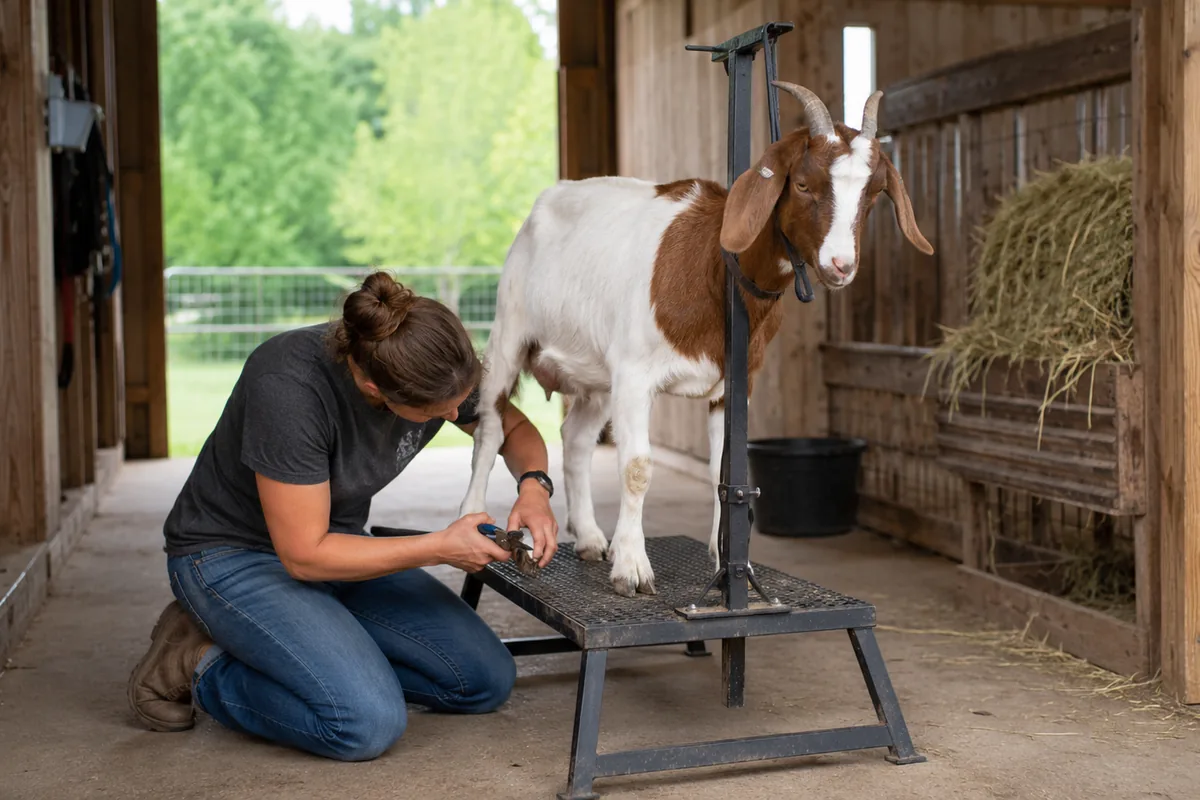
Habit three: hooves every 6 to 8 weeks. Overgrown hooves become lameness, and trimming is a ten-minute job per goat once you have done it twice. Put it on the calendar with the date of the next trim written down.
Habit four: know your goats’ normal. A goat’s normal temperature is 101.5 to 103.5, and normal means eating and chewing cud. The most valuable early warning you will ever get is simply a goat that does not come to feed.
Loose, runny manure means goat scours, while a cough with a fever can mean goat pneumonia. When you treat, the medication dosage chart gives doses by body weight.
The phone number: find the vet who sees goats before you need one, because many small-animal clinics do not. Ask the breeder you buy from who they use, and keep that number posted in the barn.
What Does the Daily Routine Look Like?
Here is the part that should reassure you: a settled pair of goats needs 15 to 20 minutes a day. The routine is the easy part of goat keeping once the setup is right.
| Frequency | Tasks |
|---|---|
| Twice daily | Hay topped up, water checked and clean, head-count and eyeball every goat |
| Daily | Quick scan: everyone eating, moving sound, behaving normally |
| Weekly | Scrub buckets, check mineral feeder, walk the fence line |
| Every 2 weeks | FAMACHA eyelid checks, body condition feel through the coat |
| Every 6-8 weeks | Hoof trims |
| Yearly | CDT boosters, deep-clean the shelter, fecal test with the vet |
The two-minute eyeball at feeding time is the most important line on that table. Goats hide illness until they cannot, and the keeper who knows every goat’s normal catches problems days before they get expensive.
Everything else is rhythm. Goats thrive on routine, learn feeding times to the minute, and will train you to theirs if you let them.
Your First-Year Calendar
Assuming spring goats, here is how the first year actually unfolds. Shift the seasons to match your start date.
| Season | What Happens |
|---|---|
| Spring (arrival) | Quarantine, settle in, establish routine; first hoof trim; baseline fecal test |
| Summer | Peak parasite season: FAMACHA every 2 weeks without fail; shade and clean water |
| Fall | Buy winter hay early (cheaper, better); breeding season if and when you choose it |
| Winter | More hay (cold burns calories), windproof shelter, water kept ice-free |
| Spring (year 2) | CDT boosters, spring shots of the barn, and you officially have a herd |
Two calendar notes earn special mention. Buy your full winter hay supply in late summer when it is cheap and available, because winter hay shopping is a seller’s market, and treat late summer as parasite high season with extra vigilance.
The fall breeding window is a choice, not an obligation. There is no rule that says year-one goats must be bred, and most beginners do better waiting for year two.
The Beginner Mistakes to Skip
Every one of these is common, and every one is avoidable. Consider this the list of lessons you get to skip the hard version of.
Buying one goat because two seemed like too many. Skimping on fencing and spending the savings on escape recovery. Feeding grain to everything because the goats vote for it, then meeting urinary calculi or obesity.
Skipping loose minerals because the goats “seem fine,” and deworming everyone monthly until nothing works anymore. Accepting yard clippings from a kind neighbor, which is how poisonings actually happen.
And the quiet one: not handling your goats until something is wrong. Goats handled a few minutes daily stand for hoof trims, load into vehicles, and tolerate treatment, while goats handled twice a year become rodeo stock exactly when you need cooperation most.
When You’re Ready to Breed
Sooner or later, most goat keepers get curious about kids, and the breeding journey is its own rewarding chapter. The short version: it is very doable, and it deserves a season of homework first.
The sequence runs from recognizing a doe in heat, through confirming she is pregnant, counting 150 days with the gestation calculator, reading the signs of labor, and being ready to bottle feed if a kid needs you. Each link is the deep guide for that stage, in order.
Until then, enjoy the goats you have. A bonded pair of backyard goats, healthy and ridiculous, is the whole point, and everything else is optional extra credit.
Sources and Further Reading
Compiled and cross-checked against established references:
- Langston University, Meat Goat Production Handbook
- University extension beginner livestock guides (Penn State, Oklahoma State, Maryland)
- Merck Veterinary Manual, goat management and husbandry chapters
- American Dairy Goat Association (ADGA) new-owner resources
Start with two friendly goats, a real fence, good hay, and the four health habits, and the first year mostly takes care of itself. The goats will handle the part where you fall for them.
Frequently Asked Questions
Start with exactly two, and make them a compatible pair: two does, two wethers, or a doe and a wether. A single goat is miserable, loud, and escape-prone because goats are obligate herd animals, while three or more multiplies cost and chores before you have the routine down. Two Nigerian Dwarf does or wethers is the classic, forgiving starter setup.
Nigerian Dwarfs are the most recommended first breed: small enough to handle easily, friendly, hardy, and capable of producing rich milk if you ever want it. Pygmies are an equally manageable pets-only pick, and calm wethers of almost any breed make great starters. Save bucks, large breeds, and high-production dairy does for after your first year.
Two things surprise beginners most: fencing and parasites. Goats test, climb, and lean on fences like it is their job, so containment costs more time and money than the goats themselves. And internal parasites, especially the barber pole worm, are the number one killer of goats, which is why learning FAMACHA eyelid checks matters more than any other single skill.
Goats should be locked into a secure shelter or pen at night in most areas, because night is when dogs and coyotes hunt. They do not need a sealed barn, just a draft-free, dry shelter inside predator-proof fencing. In low-predator areas with strong perimeter fencing, free access between pen and shelter is fine, and the goats will put themselves to bed.
After startup, plan on roughly $600 to $1,200 per year for a pair of goats, with hay as the biggest line item, plus minerals, bedding, hoof and health supplies, and a vet visit or two. Startup runs about $1,200 to $2,500 for the pair, fencing, and shelter if you are converting an existing structure. Costs scale down in mild climates with good pasture and up wherever hay is expensive.