 guide
guide Can Goats Climb 92 Degrees? The Geometry the Viral Meme Ignores
Can goats climb 92 degrees? We run the geometry, list the slope angles wild and domestic goats actually handle, and explain why the viral photos mislead you.

Goat training comes down to patience, food rewards, and consistency. They can learn their names, walk on leashes, pull carts, and even find truffles. From taming a skittish rescue to teaching a kid to stand calmly for hoof trimming, it all starts with understanding how goats think.
We may earn a small commission through links on this page, at no extra cost to you. As an Amazon Associate, we earn from qualifying purchases. Ratings reflect our own editorial evaluation.
Goats communicate primarily through ear position, tail movement, vocalizations, and body posture. Reading these cues gives you a major edge in training.
Before you can train a goat, you need to understand how they think. Goats are herd animals with a rigid social hierarchy, and every interaction, between goats or between goat and human, gets filtered through that pecking order.
They communicate through body language, vocalizations, and physical contact. Learning to read these signals makes goat training dramatically more effective.
Watch the ears first. They're the easiest to read.
Forward and alert means curiosity or focus.
Ears pinned flat against the skull signal fear or aggression. One ear forward, one back means the goat is tracking two things at once.
Tails tell you a lot, too. Rapid side-to-side wagging usually means excitement or contentment.
A tail tucked tight against the body signals fear, pain, or submission. Does in heat flag their tails rapidly, which looks different from a happy wag.
Short, low bleats are conversational. Goats greeting herd mates or their owner.
Loud, sustained crying usually signals distress, hunger, or separation anxiety.
Bucks make a distinctive low, blubbering sound during rut to attract does. You'll know it when you hear it.
Body posture ties everything together. A goat standing tall with hackles raised and head lowered is getting ready to charge.
A relaxed goat rests with legs tucked underneath, chewing cud with half-closed eyes. One turning sideways to you is trying to look bigger.
That's a dominance display.
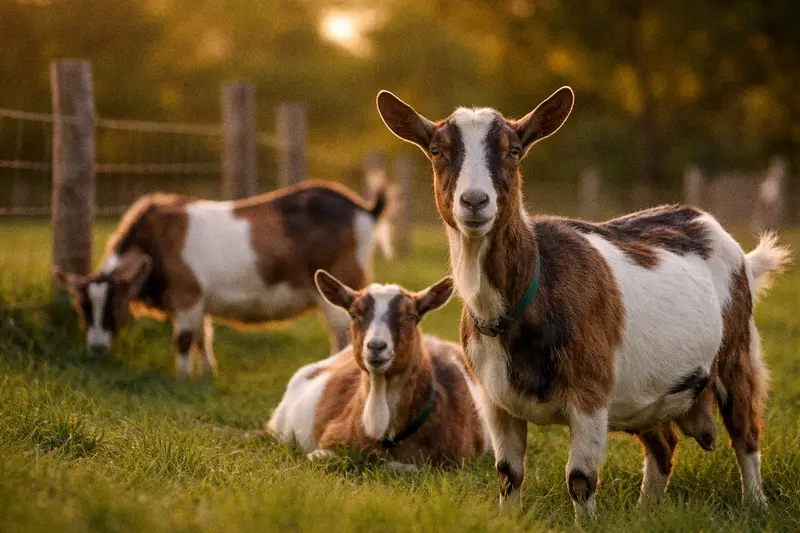
The herd hierarchy determines everything. A dominant doe (the herd queen) controls access to food, water, and resting spots, while lower-ranking goats defer by stepping aside or waiting to eat.
The best trainers position themselves as the provider of all good things: food, scratches, safety. Goats that see you as a threat become fearful and much harder to work with.
Research from Queen Mary University of London confirmed that goats distinguish between happy and angry human facial expressions. They actually prefer approaching people who are smiling.
They also make eye contact and look to humans for help with problems they can't solve, much like dogs. So your mood in the pen directly affects how training goes.
Goats communicate through scent as well. Bucks have scent glands near their horns that produce a strong musky odor during rut, while does leave scent trails through glands between their toes.
They also have excellent long-term memory. Research shows goats remember solutions to complex tasks for at least 10 months without any retraining.
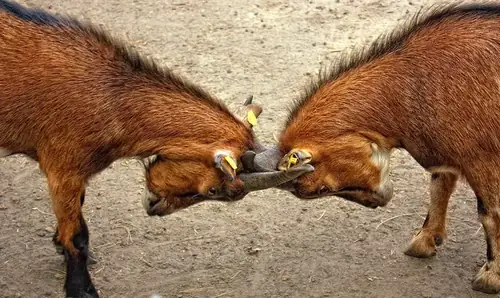
Reading goat behavior accurately is critical for safety. Young goats play by rearing up, bouncing sideways, and gently butting heads.
All normal and healthy.
Aggression looks different: lowered head aimed directly at the target, ears pinned, stiff legs, and a hard charge without the playful bounce. Knowing the difference tells you when to step in.
New owners often misread playful behavior as aggression. Kids that hop, spin, and head-butt each other are just building social skills they'll need as adults.
Intervene only when one goat is clearly being bullied, repeatedly targeted, unable to eat, or showing stress. Otherwise, let goats be goats.
Spend at least a week watching your herd before you start formal training. Note who leads to pasture, who eats first, which goats pair up, and which ones hang back.
This helps you tailor your approach to each animal.
The short answer: let the goat come to you, reward every approach with food, and never rush physical contact.
The first step in goat training is building trust. For kids handled since birth, this happens naturally through bottle feeding, gentle touching, and daily interaction.
But what about goats that weren't socialized as kids, or semi-wild animals with little human contact? Taming them takes longer, but it's absolutely doable.
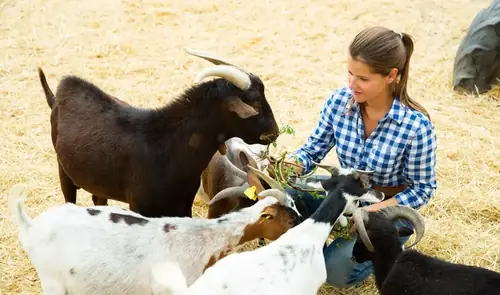
What works is letting the goat come to you on its own terms. Sit in the goat's space without trying to touch or chase it.
Bring a handful of raisins, animal crackers, or grain. Curiosity and hunger will eventually win, and the goat will approach.
This might take days or weeks with truly wild animals.
Rushing only sets you back. Every time you grab or corner a frightened goat, you undo days of trust-building work.
Once a goat comfortably approaches for food, start gentle touching. Begin with the chest and shoulders, not the head.
Goats are naturally defensive about their heads because head-butting is how they establish dominance. Scratching the chest and under the chin builds trust without triggering that instinct.
Gradually work up to the neck, back, legs, and eventually hooves. The progression matters more than the speed.
A goat that panics when you grab its hooves on day one may never trust your hands again. But one that learned to enjoy chest scratches over several weeks will tolerate hoof handling because your touch already means comfort.
Domestication and taming are different things. Domestic goats have been selectively bred for thousands of years to live with humans.
They're wired to tolerate and even seek out human contact.
Wild and feral goats lack that programming. Spanish goats running semi-feral on large ranches fall somewhere in between.
Domestic genetics, minimal handling.
The younger you start, the easier everything goes. Kids handled daily from birth grow into adults that stand quietly for vet work, hop onto milking stands willingly, and walk calmly on a lead.
Kids not handled until several months old can still be tamed, but the window for easy socialization starts closing around 8–10 weeks. After that, every step takes more patience.
A small pen works better than a large pasture for taming feral goats. In a big pasture, the goat just runs.
In a 10-by-10-foot pen, it can move away but can't flee. This forces closer proximity and faster habituation.
Pair the taming goat with a calm, friendly herd mate whenever you can. Goats learn by watching.
A fearful goat that sees a buddy eating from your hand will try it much sooner.
Some owners sit in the pen reading a book, completely ignoring the goat. This teaches the goat that your presence is boring and non-threatening, which often works faster than actively approaching.
The timeline varies a lot. Some goats warm up in three days, others take three months.
Dairy breeds with centuries of close human contact tend to tame faster than meat breeds raised on open range. But the only approach that always fails is giving up too soon.
Consistency is what gets you there. Visit at the same time every day, use the same treats, move the same way.
Goats are creatures of routine.
Once the goat approaches willingly and allows chest scratches, you've laid the groundwork for halter training, milking, hoof trimming, and everything else.
Carry a small bag of raisins every time you visit your goats. Within a week, even the shyest goat will start walking toward you the moment you open the gate.
Put simply, food rewards and clicker training work because goats are driven by their stomachs, not a desire to please you.
Positive reinforcement is the most effective way to train goats, hands down. Unlike dogs, goats don't have a built-in desire to please.
They're motivated almost entirely by food.
That makes punishment-based training counterproductive. A goat that gets yelled at or smacked learns to fear the handler, not to change the behavior.
This is where clicker training comes in. The clicker makes a distinct, consistent sound that bridges the gap between the exact moment of good behavior and the food reward.
Start by "loading" the clicker: click, then immediately give a treat. Repeat 20–30 times until the goat perks up at the click because it knows food is coming.
Once the clicker is loaded, use it to mark any behavior you want.
Goat steps forward on the lead? Click and treat.
Goat puts a foot on the milking stand? Click and treat.
Stands still for hoof handling? Same deal.
Pretty soon, the goat starts actively offering behaviors because it's trying to earn that click. That's when training really takes off.
Shaping is how you teach anything complicated. You break the final behavior into small steps and reward each one.
You wouldn't teach a goat to jump through a hoop in one session. First you reward approaching the hoop, then touching it, then putting a head through, then stepping through.
Targeting works a bit differently. You use a cue stick or wand with a distinct tip, like a ball or piece of colored tape.
Teach the goat to touch its nose to the target by clicking when it makes contact. Once the goat reliably follows the target, you can guide it anywhere: onto a stand, through a gate, into a trailer.
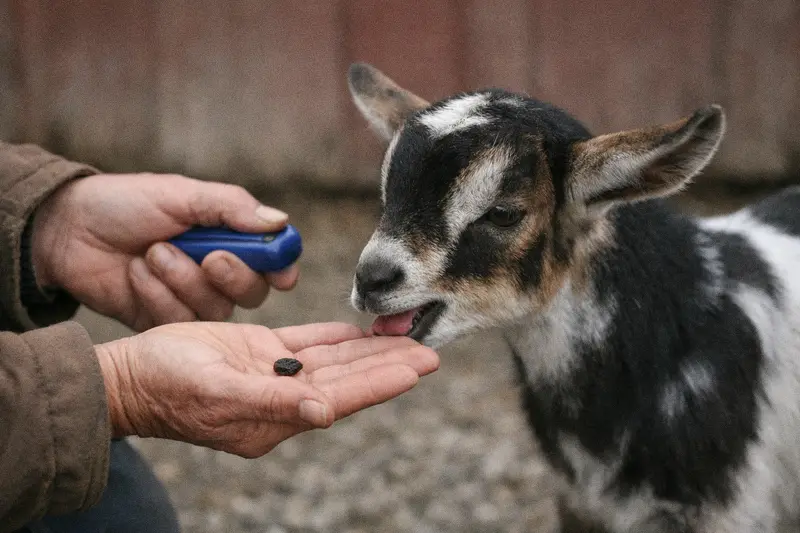
Targeting is especially handy for moving goats without grabbing or pulling. It keeps the whole experience stress-free.
Treat selection matters more than most people realize. Raisins, animal crackers, and small banana pieces get the strongest response.
But too many concentrate-based treats can upset rumen balance and cause digestive problems. Keep treats pea-sized and limit sessions to 10–15 minutes.
Some trainers use portions of the goat's regular grain ration. That keeps the diet balanced while still providing motivation.
Timing is the most underrated part of training. The reward needs to come within 2–3 seconds of the desired behavior, or the goat won't connect the two.
That's exactly why the clicker matters. It buys you a few extra seconds because the goat already knows click means treat.
Reward too late and you reinforce whatever the goat happened to be doing at that moment.
Consistency across all handlers is just as important. If you teach the goat not to jump on people but your kids think it's cute, the goat jumps on everyone.
Verbal cues work alongside the clicker as the goat progresses. Pair a word like "stand" or "step" with the behavior you're clicking.
Over time, the word alone triggers the behavior. You can phase out the clicker for trained skills while reserving it for teaching new ones.
Start each session with a warm-up of known behaviors before introducing anything new. Easy wins put the goat in a learning mindset.
Know when to quit, too. If the goat gets frustrated or starts ignoring you, the session has gone on too long.
End on the last thing that went right. That way the goat walks away feeling successful and shows up eager next time.
Here's a practical breakdown of what to teach at each age, from the first days of life through 6 months and beyond.
Start from birth. The earlier you begin handling a goat kid, the easier every aspect of training becomes for the rest of its life.
Birth to 2 weeks is the habituation window. Pick up kids daily, even if only for a minute, and handle their ears, mouth, legs, and hooves.
Introduce novel objects and sounds: the clang of a feed bucket, the hum of clippers, different surfaces underfoot. Kids exposed to variety in these first two weeks grow into calmer, more adaptable adults.
Bottle-fed kids naturally get more handling. Dam-raised kids need deliberate daily interaction, or they'll bond exclusively with mom and be harder to work with later.
At 2 to 4 weeks, fit a soft kid collar. Let the kid wear it during supervised play until it forgets the collar is there.
Around 3–4 weeks, add a lightweight halter for short sessions during feeding. Don't try to lead yet.
The goal is just comfort with equipment.
From 4 to 8 weeks, start teaching name recognition by saying the kid's name every time you offer food. Most kids learn their name within a week.
Introduce the lead by applying light pressure and releasing the instant the kid takes a step forward. Keep sessions under 5 minutes.
At 8 to 12 weeks, kids should walk on a lead without panicking. Gradually add distractions: other goats, new environments, unfamiliar people.
Teach tying by securing the kid to a fence post for short, supervised periods with something to eat. Start with 2–3 minutes and build to 10–15.
From 3 to 6 months, introduce the milking stand or stanchion, even for bucklings and wethers. Every goat benefits from standing calmly on an elevated platform.
Begin hoof trimming desensitization: pick up feet, tap hooves, and mimic trimmer movements. A kid that stands calmly now makes real trims easy for life.
| # | Product | Our Rating | ||
|---|---|---|---|---|
| 1 |  | Best OverallARS 140DXR Hoof Trimming Shears | ★★★★★ | Check Price |
| 2 | 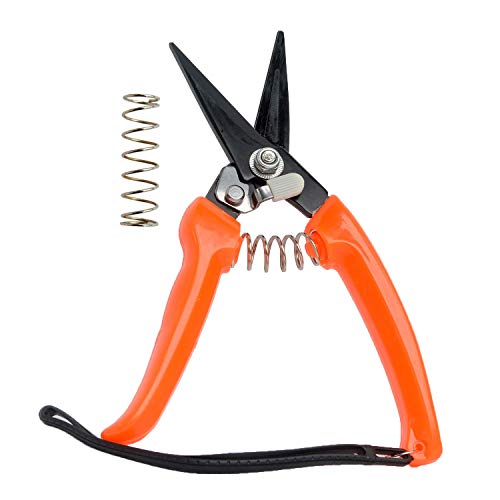 | Carbon Steel Goat Hoof Trimmers | ★★★★☆ | Check Price |
| 3 |  | 8-Inch Goat Hoof Trimming Scissors | ★★★★☆ | Check Price |
After 6 months, keep reinforcing foundational skills while adding purpose-specific training: dairy, pack, show, therapy, or companion. Monthly refreshers on lead walking and hoof handling keep everything sharp.
One stage flows naturally into the next. A kid that accepted a collar at 2 weeks doesn't need to relearn it at 4.
It just builds on existing comfort.
Skip a stage and you'll often need to go back. A 6-month-old encountering a halter for the first time reacts a lot more dramatically than a 2-week-old.
Keep a training log for each goat. Note what you worked on, how the goat responded, and what to try next.
This tracks progress and reveals patterns, like which goats learn best in morning sessions versus evening ones. With a multi-goat herd, separate one for a 10-minute session while the rest eat hay.
Bottle-raised kids bond intensely with humans, which makes early training easier but can create dominance issues as the goat matures. They often see humans as peers and test boundaries with pushy behavior.
Dam-raised kids are more independent and sometimes harder to catch at first. But they tend to develop healthier respect for human boundaries because they learned social rules from mom and the herd.
If you miss the early window entirely, say you bought a 6-month-old that was never handled, you're not out of luck. The process just takes longer and requires the same patience you'd use with an adult.
Work through each stage in order. Skipping ahead because the goat seems "old enough" creates gaps that cause problems later.
| Age | Training Focus | Goal | Session Length |
|---|---|---|---|
| 0–2 weeks | Handling and habituation | Accept human touch on all body parts | 1–2 min daily |
| 2–4 weeks | Collar and halter introduction | Ignore equipment while eating | 5 min |
| 4–8 weeks | Name, basic commands, lead intro | Respond to name, take one step on lead | 5 min |
| 8–12 weeks | Leash walking, tying, surfaces | Walk on lead, stand tied calmly | 10 min |
| 3–6 months | Stand training, hoof handling | Stand on platform, tolerate hoof touching | 10–15 min |
| 6+ months | Specialization and refinement | Breed-specific or purpose-specific skills | 10–15 min |
Start with a fitted rope halter around 2–4 weeks of age, then use pressure-release combined with food rewards to teach leading.
Halter and leash training is one of the most practical things you can teach a goat. A halter-trained goat is easier to handle for vet visits, hoof trimming, transport, and showing.
It also opens the door to pack goat and cart work.
Start as young as possible, ideally 2–4 weeks old. Young kids are small enough to manage easily and adapt fast.
Use a properly fitted rope halter made for goats or small livestock. The noseband should sit about halfway between the eyes and nostrils.
Too low and it interferes with breathing. Too high and it slides right off.
The first few sessions are about comfort, not walking. Let the kid wear the halter for 10–15 minutes while eating or playing.
Once the goat ignores the halter, attach a lightweight lead and let it drag under supervision. This gets the goat used to slight pressure on its head.
When you start leading, never pull a goat forward by the halter. They respond to forward pressure by planting their feet and pulling backward.
That's the exact opposite of what you want.
Instead, walk beside the goat and offer a treat from your hand to draw it forward. Apply light, steady pressure on the lead at the same time.
Release pressure the instant the goat steps forward. This teaches the goat that moving with you removes the uncomfortable feeling and earns a treat.
The release is the real reward. The treat just speeds things up.
Most goats figure out the concept within 3–5 short sessions.
For adult goats that have never worn a halter, the process is identical but takes more patience. Spend extra time on desensitization and keep sessions under 15 minutes.
If a goat rears up when you apply pressure, it needs more desensitization time. Go back to just wearing the halter with no lead pressure, and pair it with food.
A goat that plants its feet and won't budge is usually overwhelmed. Ask for just one step, reward that, and build from there.
A goat that lunges and drags you needs to learn pulling doesn't work. Stop walking when the goat pulls and only resume when there's slack in the lead.
For show or 4-H goats, add distractions gradually: other animals, crowds, unfamiliar surfaces. Show-ring confidence comes from exposure, not last-minute cramming.
Practice on gravel, pavement, grass, rubber mats, and wooden ramps. A goat that only trains on pasture will balk at the first hard surface at a show or vet clinic.
Rope halters with a chin knot work well because they apply pressure to specific points and release cleanly. Nylon web halters are comfier for long wear but give less precise feedback.
For Nigerian Dwarfs and Pygmies, get halters sized for miniature goats. A standard goat halter is way too big and slides off constantly.
Once halter training is solid, trailer loading comes easily. Practice walking up ramps and into enclosed spaces, rewarding each step.
Most goats that walk calmly on a lead pick up trailer loading in just a few sessions.
For routine work, stick with cotton or nylon leads. Chain leads are too harsh except for strong bucks in rut.
Never drag a goat forward by the halter. Apply gentle steady pressure and reward the instant it takes one step. They learn pressure release much faster than force.
The key to both: introduce equipment gradually, pair every session with grain, and never force a goat through a bad experience.
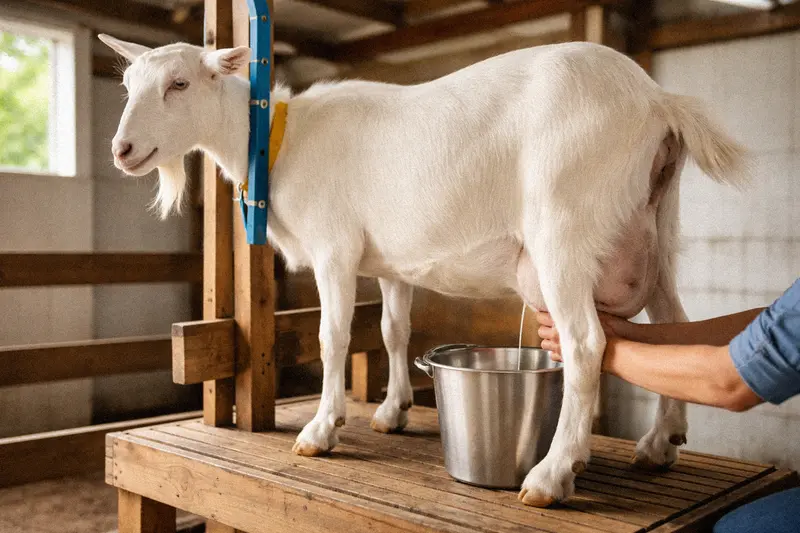
Getting a goat comfortable on a milking stand and with hoof handling are two of the most valuable things you'll teach. Both require the goat to stand still while you work on its body, and both are skills it needs for life.
Start introducing the stanchion or milking stand weeks before you actually need it. Set it up in a familiar spot and let goats investigate on their own.
Put grain in the feed bowl on the stand and let the goat eat without closing the head catch. Do this for 3–5 days until the goat hops up eagerly.
Then start closing the head catch gently while the goat eats. Open it as soon as feeding finishes.
Repeat until the catch causes zero reaction. At that point, begin touching the udder area (for does) or belly (for any goat).
Use a warm, gentle hand and pair each touch with grain access. Gradually increase duration and add movements that mimic milking: squeezing, pulling, wiping with a warm cloth.
By the time a doe freshens, she should see the stand as the place where she gets grain and a relaxing routine. Not confinement.
With first fresheners, patience is non-negotiable. A doe that panics and kicks over the bucket on day one will be a headache for months.
Taking an extra week to desensitize properly saves you months of wrestling. It's always worth the time.
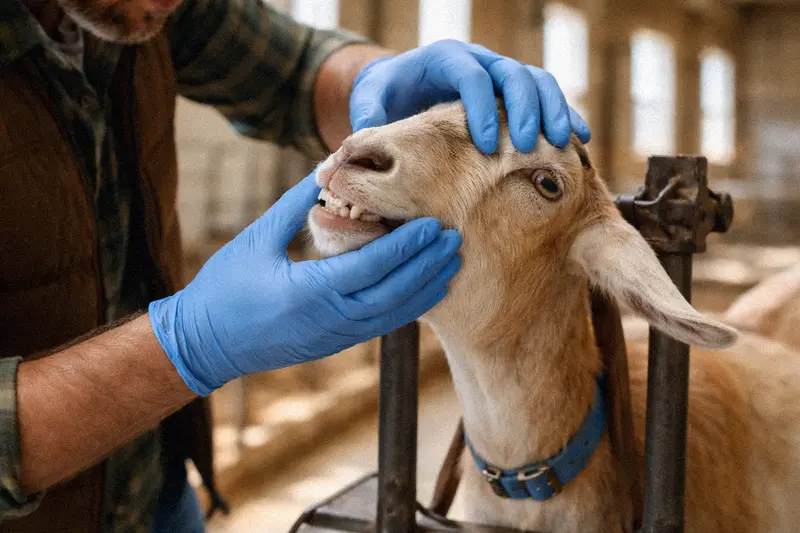
Hoof trimming works the same way, just with feet instead of udders. Goats need trims every 4–8 weeks, so they need to tolerate the process regularly.
With kids, pick up each foot daily during normal handling. Hold for 2–3 seconds, release, and reward.
Gradually increase hold time and add gentle manipulation: flexing the joint, pressing the sole, tapping the hoof wall. Make it boring, not scary.
For older goats that panic at foot touching, work in tiny steps. Touch the shoulder and reward, then the elbow, then the knee.
Then the fetlock, then briefly lift the foot. This progression might take a week per leg.
That's perfectly fine.
During actual trimming sessions, have a helper feed grain while you work. Move quickly but calmly.
If the goat panics, stop and let it settle before continuing. Finishing one hoof calmly beats traumatizing the goat by forcing all four.
The milking stand doubles as a great hoof-trimming platform. The height saves your back, the head catch provides security, and grain keeps the goat distracted.
Some owners teach goats to present their feet on command using a target stick and clicker. Tap the target near the leg, click and treat when the goat shifts weight or lifts up.
Over time, hoof trimming becomes a cooperative effort rather than a wrestling match.
For both milking and trimming, keep early sessions to 2–3 minutes. Always end on a positive note.
Never use the stand as punishment. Build the equation: stand equals grain equals gentle handling equals release.
For dairy goats, add udder washing and teat dipping to the routine well before the doe freshens. A warm cloth wiped daily during the last month of pregnancy prepares her for the real thing.
First-time milkers often kick or fidget on the stand. A helper holding one hind leg steady while you milk prevents spills and stops a kicking habit before it starts.
Most goat aggression traces back to hormones, fear, or learned habits. Each type requires a different fix.
Aggression in goats is one of the toughest behavioral issues to deal with, but it's almost never random. Figure out why the goat is aggressive and you're halfway to fixing it.
The usual suspects are hormones, fear, pain, poor socialization, and, this one surprises people, the owner accidentally rewarding bad behavior.
Intact bucks are the most commonly aggressive goats, especially during rut. Testosterone drives the charging, head-butting, and dominance displays.
Wethering (castrating) dramatically reduces hormone-driven aggression. The earlier you do it, the more completely the aggression resolves.
Bucks that stayed intact for years may keep some aggressive habits as learned behavior even after castration. They need behavior modification on top of the surgery.
During rut, even friendly bucks become unpredictable. Blubbering, tongue-flapping, urinating on their own faces.
Never turn your back on a buck in rut.
Bottle-raised bucks are a special case. They grow up seeing humans as peers, not authority figures.
As hormones kick in, they start testing their strength against their human "herd mates" through head-butting and charging. What was cute at 10 pounds is genuinely dangerous at 200.
This is why many experienced owners dam-raise bucks whenever possible. If bottle-raising is the only option, never allow rough play with bucklings.
No head-pushing, no wrestling, no letting them jump on you.
Fear-based aggression looks different from dominance. The goat tries to escape first and only strikes when cornered.
It responds well to patient trust-building: food luring, gradual approach, chest scratching. Progress takes weeks but is usually permanent.
A goat that becomes aggressive suddenly may be in pain. Injuries, hoof problems, urinary calculi, dental issues, and parasites all change behavior.
Rule out medical causes with a vet exam before assuming the problem is purely behavioral. Pain relief often resolves the aggression entirely.
For dominant goats, never head-butt back or push them in the forehead. This reinforces the behavior as a game.
Effective corrections include a firm "no" and immediately leaving the pen, a spray bottle aimed at the face, or redirecting with food to an incompatible behavior. The goal is making aggression unrewarding without creating fear.
Aggression also follows seasonal patterns. Bucks peak during fall rut (September through December), while does may get territorial during late pregnancy and early lactation.
Overcrowding and insufficient feeder space drive herd-wide tension. Provide multiple feeding stations spaced at least 10 feet apart.
One station per 3–4 goats is the rule of thumb.
Introducing new goats to an established herd always triggers temporary aggression as the hierarchy gets renegotiated. Introduce through a fence line for 3–7 days before allowing physical contact.
Adding new goats in pairs reduces bullying because they have an ally during integration. Never put a single small or young goat in with established adults alone.
Does can be aggressive too, though less often. Newly kidded does protecting their babies may charge anyone who gets close.
This maternal aggression is normal and temporary. Respect the doe's space for the first few days and it resolves once she's confident her kids are safe.
Consistency across all handlers is essential. If one family member tolerates pushing while another corrects it, the goat just learns who it can push around.
When nothing works, consult a livestock behaviorist. Large bucks with years of aggressive history often need professional guidance.
If you wouldn't want a 200-pound adult goat doing it, don't let your 10-pound baby goat do it. Bad habits that seem harmless in kids become dangerous fast.
| Aggression Type | Common Cause | Best Solution | Timeline |
|---|---|---|---|
| Hormonal (bucks) | Testosterone during rut | Wethering (castration) | 2–4 weeks to calm |
| Bottle-baby dominance | Sees humans as peers | Boundary training, no rough play | Ongoing management |
| Fear-based | Lack of socialization or trauma | Patient trust-building with treats | Days to weeks |
| Pain-related | Injury, illness, or parasites | Veterinary exam and treatment | Resolves with pain relief |
| Maternal (does) | Protecting newborn kids | Give space, don't intervene | 3–7 days postpartum |
Biting, jumping on people, headbutting handlers, and escaping fences. These are the behaviors goat owners complain about most.
Every one of them has a specific cause and a targeted fix.
Goats explore the world with their mouths. Kids nip at everything, your fingers, clothes, hair, and it's normal exploratory behavior, not aggression.
The problem starts when owners let kids nibble because it's cute, then wonder why their adult goat bites. Prevention is simple: the moment teeth touch skin, redirect with a treat in an open palm.
For adults that already bite, a spray bottle of water works well. One quick spray the instant teeth make contact teaches the goat that biting creates an unpleasant result.
Goats jump on people for attention and food. Like biting, this usually gets reinforced during the cute baby stage and turns dangerous as the goat grows.
The fix: turn your back and walk away the instant the goat jumps. Give zero attention.
No eye contact, no words, no pushing it down (pushing is attention).
When all four feet are on the ground, turn back and offer treats. The contrast teaches the goat that feet down earns rewards and jumping earns nothing.
Everyone who interacts with the goat must follow the same rules. One person encouraging it undoes everyone else's work.
Goats headbutt each other constantly. It's just part of goat life.
The issue is when they direct it at you.
A goat headbutting your legs while you carry grain is demanding food. A goat rearing up and charging your thigh is asserting dominance.
Both are dangerous with an adult, especially one with horns. For food-demanding headbutts, set grain down only when the goat stands calmly at a distance.
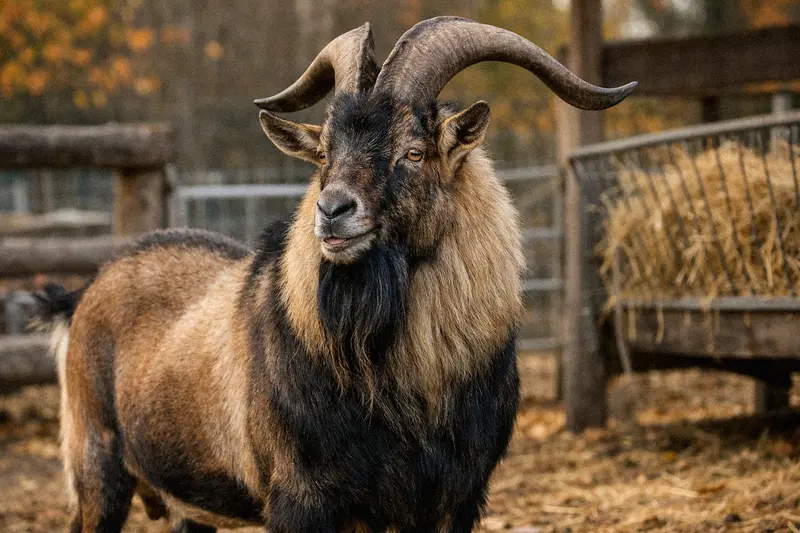
If it charges, pick up the bucket and walk away. Food arrives only when the goat is polite.
For dominance headbutting, never engage physically. Don't push back, grab horns, or wrestle.
Any physical contest reinforces the behavior.
Use the withdrawal technique instead: leave the pen immediately. Come back a few minutes later and reward calm behavior.
Goats that jump fences are usually bored, hungry, or both. Before any training fix, address the root cause.
Improve pasture, add enrichment, make sure hay and minerals are always available.
For confirmed escape artists, hot wire along the top of existing fencing is the single most effective solution. One or two mild shocks teach most goats that the fence is non-negotiable.
Goats that climb rather than jump need structural fixes. Get rid of horizontal rails they can use as steps, and switch to cattle panels or welded wire.
Chewing and general destruction are especially common with young goats. They'll go after wiring, rubber hoses, clothing, anything within reach.
This isn't spite. It's browsing instinct redirected at whatever's available.
Remove tempting objects and provide real browse: tree branches, brush piles, hay in racks. All corrections must happen within 2–3 seconds of the unwanted behavior.
Correct a goat five minutes later and it has no idea what you're upset about. If you miss the window, let it go and set things up to prevent it next time.
With multiple goats, bad behavior can spread through the herd. If one goat learns that charging the grain bucket gets fed first, the others will start doing it too.
Address behavior issues in the dominant goats first. Once the leaders behave, the rest of the herd usually follows.
All behavior corrections have a 2–3 second window. If you miss it, don't punish. Just set up the environment to prevent it next time.
Here's the honest answer about house-training goats: they can pick up some indoor manners, but they'll never be reliably house-trained like a dog or cat.
Baby goats being bottle-raised often spend their first few weeks inside, especially in cold weather. Some owners use diapers or puppy pads with limited success.
The key word is limited. Goats urinate and defecate frequently, often while walking, and they don't have the instinct to keep their living space clean the way den animals do.
If you're keeping kids indoors temporarily, stick to washable floors. Confine them with baby gates and lay down puppy pads or a tarp with bedding.
Clean accidents immediately. Goat urine has a strong ammonia smell that gets worse over time and is brutal to remove from porous surfaces.
Some owners report limited success getting kids to use a designated corner by placing soiled bedding there. Kids sometimes return out of habit, but that's not real house training.
Enzymatic cleaners designed for pet urine work best on goat accidents. Standard cleaners just mask the smell.
Enzymatic formulas break down the uric acid crystals that cause lingering odor.
For porous materials like unsealed wood or carpet pad, replacement is usually easier than cleaning. Prevention through confinement beats cleanup every time.
Once kids are old enough to wean at 8–12 weeks, they belong outside with their herd. They need space to run, climb, and play.
Goats raised entirely indoors without herd contact often develop anxiety and behavioral problems. Social interaction with other goats is essential for normal development.
Nigerian Dwarf and Pygmy kids are the breeds most commonly kept indoors because of their size. But even miniature breeds grow fast and turn destructive within months.
They chew furniture, climb counters, knocking things over.
If you diaper indoor kids, change them every 2–3 hours. Commercial goat diapers are available, or modify small dog diapers with a tail hole.
If you must keep a kid indoors for medical reasons, give it supervised outdoor time every day. Even 20 minutes of sunshine and fresh air helps.
Keep a companion nearby: another kid, a stuffed animal, or even a mirror. Isolated kids without herd contact become stressed and difficult to manage.
The transition from indoors to outdoors should happen gradually. Start with short outdoor sessions in a secure area and extend the time over a week or two.
By 8 weeks, most kids are ready for full-time outdoor living with their herd. Don't delay the move.
The longer kids stay indoors, the harder the adjustment.
Plan for indoor time to be a bridge, not a destination.
Expect everything to take longer with adult goats, and lean heavily on food motivation. Force simply doesn't work.
Training an adult goat that's never been handled is a completely different game than training a kid. They're stronger, more set in their ways, and may have negative associations with people.
Rescue goats that were neglected or abused bring additional challenges. They may flinch at raised hands, panic in small spaces, or lash out when cornered.
That's a trauma response, not a training problem.
The first step with any untrained adult is a decompression period. For 1–2 weeks, don't attempt any training at all.
Just provide food, water, shelter, and safety. Let the goat observe your routine and learn that your presence means good things.
Establish a predictable schedule during decompression. Feed at the same times daily, move at the same pace, speak in the same calm tone.
Predictability reduces anxiety faster than anything else. Once the goat seems settled, begin trust-building with the same approach used for taming: food luring, gradual approach, chest scratching.
Every step takes longer with adults. Where a kid might accept a halter in a week, an adult may need a month.
The critical difference: you can't physically overpower an adult goat without destroying the relationship. A 150-pound Nubian that doesn't want to move isn't going anywhere no matter how hard you pull.
This makes positive reinforcement even more essential. Force escalates the conflict; food and patience resolve it.
Not every rescue goat becomes a cuddly pet. Some will tolerate handling but never seek it out.
Others warm up completely and become the most devoted animals you'll ever own. The transformation often happens suddenly.
After weeks of slow progress, a rescue walks up and puts its head in your lap.
Set process goals, not outcome goals. "I'll spend 15 minutes in the pen every day" is achievable.
"This goat will be friendly by next month" is out of your control. A well-trained mentor goat in the pen speeds everything up.
The rescue watches a herd mate approach you for treats and decides to try it much sooner than it would alone.
Before you start any formal training, get a vet exam done.
Many rescues arrive with untreated parasites, overgrown hooves, or nutritional deficiencies. A goat in pain won't respond to training until the pain is addressed.
Run a fecal egg count, trim hooves, and assess body condition score. Starved goats may be food-aggressive during early training.
Hand-feed small amounts frequently to rebuild a healthy relationship with food. Quarantine all new arrivals for at least 30 days before herd introduction to prevent disease spread.
When introducing the rescue to your existing herd, do it through a fence line first. Let them see and smell each other for 3–7 days before sharing space.
Adding the rescue alongside a calm, low-ranking herd mate reduces bullying during integration. Watch for signs of excessive aggression during the first week.
Some rescues do best in a small group of 2–3 rather than a large herd. That's a perfectly fine outcome.
Here's a breed-by-breed breakdown of what to expect in terms of temperament, training strengths, and typical challenges.
Every goat is an individual, but breeds have general temperament tendencies that shape how training goes. Knowing what to expect helps you pick the right approach.
Nigerian Dwarfs are smart, curious, and wildly food-motivated. That makes them great training candidates.
They're also stubborn and athletic enough to squeeze through gaps and jump heights that seem impossible for their size.
Clicker training works exceptionally well with this breed. But they bore easily with repetition, so mix up your exercises.
Nubians are the drama queens of the goat world, and the loudest. They'll scream when separated, hungry, bored, or just wanting attention.
They bond deeply with owners and respond well to praise alongside food rewards. Many owners call them the golden retrievers of the goat world.
The volume can be tough during training. A Nubian upset about being separated will let your whole neighborhood know about it.
Boer goats are large, calm, and food-driven. Basic handling comes easy, but their size, up to 300 pounds for a mature buck, magnifies every behavior problem.
Establish boundaries early because you physically cannot push an adult Boer anywhere. Their calm demeanor sometimes reads as stubbornness.
A Boer that doesn't want to move simply stops.
Alpines and Saanens are athletic, intelligent, and independent. Alpines especially are famous for figuring out gate latches, climbing things they shouldn't, and generally outsmarting their owners.
These breeds need mental stimulation. Enrichment activities, obstacle courses, and trick training channel that intelligence productively.
Without it, Alpines get destructive. Pygmies are social, energetic, and playful.
They learn quickly but can develop small-dog syndrome. Pushy, demanding behavior that owners tolerate because of the cute factor.
Apply the same standards you would to a full-size breed.
No jumping on humans, no headbutting handlers, no food demanding. Pygmies are also notorious escape artists.
LaManchas are about as laid-back as goats get. They're among the easiest breeds to train for milking and handling, making them ideal for first-time owners.
Kikos come from feral New Zealand stock, and they act like it. Hardy, independent, and not immediately trusting.
Once trust is established though, they're intelligent and food-motivated.
Oberhaslis are the introverts of the dairy world. Quiet, gentle, and steady.
They rarely test boundaries and take well to routine, making them excellent pack goat candidates.
Myotonics, the fainting goats, are surprisingly easy to contain since their stiffening response limits jumping. They're calm and friendly but startle at sudden movements, so use slow, predictable handling.
For any breed, individual variation matters as much as breed tendency. A calm Nigerian Dwarf and a wild Nubian both exist.
Use breed traits as a starting point, then adjust for the animal in front of you.
Mixed-breed goats are common and often combine traits from multiple breeds in unpredictable ways. A Boer-Nubian cross might have the Boer's size with the Nubian's vocal personality.
With crosses, watch the individual for a week. The goat will show you which parent's temperament it inherited.
| Breed | Temperament | Training Strength | Common Challenge |
|---|---|---|---|
| Nigerian Dwarf | Smart, curious, stubborn | Excellent clicker response | Bores easily, escape artist |
| Nubian | Vocal, affectionate, dramatic | Bonds deeply with handler | Loud when separated or frustrated |
| Boer | Calm, food-driven, large | Easy basic handling | Size makes corrections difficult |
| Alpine | Athletic, independent, clever | Loves mental challenges | Figures out latches, escapes |
| Pygmy | Social, energetic, playful | Learns tricks quickly | Small-dog syndrome, escaping |
| LaMancha | Calm, gentle, cooperative | Easiest milking training | Can be too docile for pack work |
Both cart and pack training build on solid halter work, and neither should start until the goat is at least 2 years old and fully grown.
Goats have been pulling carts and carrying packs for centuries. Cart work is practical and fun, while pack goat hiking has blown up in popularity over the last decade.
Before starting cart training, your goat needs to be halter-trained, comfortable with handling, and physically mature. Wait until at least 2 years old.
Starting younger risks joint and skeletal damage.
Cart training builds on halter work in a gradual progression. Start by letting the goat wear a harness during normal activities until it completely ignores the gear.
Next, attach traces and let the goat drag lightweight objects: a small log, a plastic sled, or an empty crate on a rope. This gets it used to something following behind without panicking.
Introduce the actual cart empty on flat ground. Walk beside the goat, guiding with the lead while it pulls.
Keep sessions short and always end with food. Gradually add weight over weeks, not days.
A healthy adult goat can safely pull about 1.5 times its body weight on flat ground. A 200-pound Boer handles around 300 pounds under good conditions.
Some homesteaders train goats for small garden plow work. A team of large goats can pull a single-bottom plow through soft soil.
That's a genuinely sustainable approach for small plots.
Pack goats carry supplies on trail hikes, and the sport has a dedicated community with clubs, organized rides, and competitions. The best pack goats are wethers from large dairy breeds.
Alpines, Oberhaslis, and Saanens top the list.
Pack training starts with leash work, then trail exposure, then empty panniers, then gradual weight loading. Each phase needs to be solid before moving to the next.
Begin trail exposure on easy terrain: flat paths, quiet roads, gentle hills. Gradually introduce obstacles: creek crossings, log steps, steep sections, narrow trails.
Once the goat handles varied terrain confidently, introduce empty panniers for a week before adding weight. Start at 10% of body weight and increase by 5% weekly.
A conditioned pack goat carries 20–25% of its body weight over long distances. Some experienced animals handle 30%, but that requires serious fitness.
Pack goats need to be comfortable around dogs, horses, bikes, and other trail users. Socialize extensively before hitting busy trails.
Working goats need to be conditioned the same way you'd train for a long hike yourself. Start with short, easy walks and build up distance, elevation, and weight over months.
Monitor feet, breathing, and energy during work sessions. A goat lagging behind or lying down is being overworked.
Cut the session and reduce intensity next time.
Get the harness fit right. An ill-fitting harness causes rubs, pressure sores, and behavioral resistance.
The breast strap should sit across the chest without riding up onto the windpipe. The girth should be snug but allow two fingers between strap and body.
For pack goats, pannier balance matters as much as total weight. Uneven loads force the goat to compensate by leaning, leading to fatigue and back problems.
Weigh each side separately and keep the difference under half a pound. Regular hoof trimming is especially important for working goats.
Uneven hooves cause discomfort under load.
Start young goats with an empty pack saddle months before adding any weight. Let them wear it on daily walks until the equipment becomes invisible.
Check harness fit as seasons change. What worked in summer may be too tight once winter coat comes in.
Always end cart training on a success. If the goat balks, back up to an easier task, let it succeed, reward, and stop for the day.
| Breed | Avg Weight (lbs) | Max Pull Load (lbs) | Pack/Draft Suitability |
|---|---|---|---|
| Boer | 200–300 | 300–450 | Excellent draft, good pack |
| Nubian | 150–250 | 225–375 | Very good for both |
| Alpine | 150–200 | 225–300 | Excellent pack goat |
| Saanen | 150–200 | 225–300 | Good endurance, both uses |
| Oberhasli | 120–150 | 180–225 | Top-tier pack goat |
| Nigerian Dwarf | 60–80 | 90–120 | Light duty only |
Goats are born climbers and jumpers. Understanding what they can do helps you build better fencing, housing, and enrichment.
Most domestic goats clear 4–5 feet from a standing position. Athletic breeds manage even higher with a running start.
Pygmies are surprisingly powerful jumpers despite their small size. Nigerian Dwarfs are particularly agile and scale things that seem way too tall for their compact frames.
This is why goat fencing needs to be at least 4 feet for most breeds and 5 feet or more for Nubians, Alpines, and other athletes.
Climbing is even more impressive than jumping. Goats scramble up nearly vertical surfaces if there's anything to grip: trees, rock walls, hay bales, vehicles, rooftops, you name it.
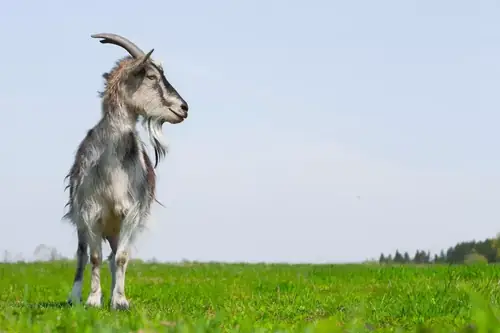
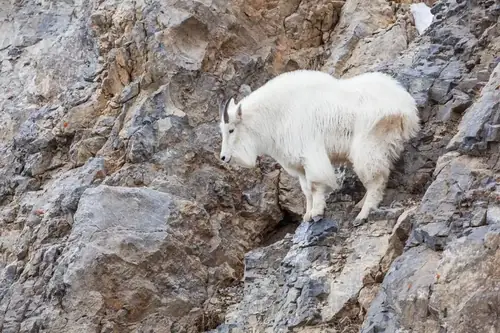
Wild mountain goats navigate grades steeper than 90 degrees using ledges and crevices that look impossibly small. Domestic goats retain a lot of that ability.
For owners, this means thinking vertically when designing pens. Keep structures, vehicles, and woodpiles away from fence lines.
Goats use them as launching pads.
A 5-foot fence becomes a 3-foot fence when there's a stack of pallets on the goat side. Move climbable objects at least 6 feet from any fence.
Providing climbing structures inside the pen is one of the best things you can do for your goats. Cable spools, large rocks, sturdy platforms at different heights, and playground equipment all satisfy the instinct.
Bored goats with nothing to climb are the ones that test fences. Goats with good enrichment tend to stay where the fun is.
Cattle panels with 4-by-4-inch openings make great goat fence because they're strong, tall, and have no horizontal climbing rails. Adding a strand of electric wire at the top and bottom dramatically improves containment.
Board fencing works but needs close spacing. If a goat's head fits through an opening, the body usually follows.
When building a goat playground, create multiple routes between high points so no single goat can hog the best spot. The dominant goat will claim the highest platform, so give subordinates alternative paths.
Vary the surface materials. Rough-sawn lumber, smooth logs, rubber mats, and natural rock give different sensory experiences.
Goats prefer rough surfaces that grip their hooves.
Raise sleeping platforms above ground level. Goats instinctively want elevated sleeping spots for predator protection.
A raised platform with a roof doubles as enrichment and shelter.
All climbing structures must be stable. An unanchored cable spool that tips can cause serious injury.
Bolt things down or use enough weight to prevent movement. Check regularly for sharp edges, protruding nails, and gaps where hooves or heads could get stuck.
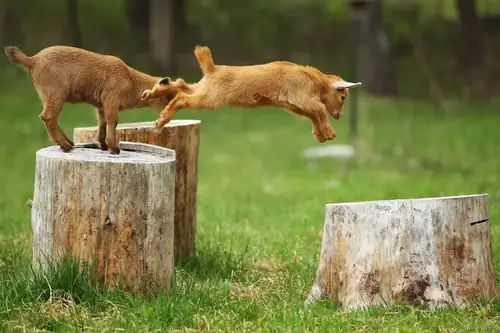
Kids are the most acrobatic members of any herd. They start climbing on day one and do aerial twists off elevated surfaces by week two.
Provide age-appropriate structures, low platforms, small ramps, gentle slopes, so they build strength and confidence safely.
Goats that grow up with climbing enrichment develop better coordination and stronger muscles. This natural athleticism pays off during hoof trimming, vet visits, and any handling that requires the goat to balance on a stand.
A well-designed pen keeps your herd entertained and drastically cuts down on fence testing. Spend a weekend building a good playground and you'll spend far fewer mornings chasing escapees.
Rotate enrichment items occasionally to keep things fresh. A new object in the pen generates days of investigation and play.
| Breed | Jump Height | Climbing Ability | Min Fence Height |
|---|---|---|---|
| Nigerian Dwarf | 3–4 ft | Very High | 4 ft |
| Pygmy | 3–4 ft | High | 4 ft |
| Nubian | 4–5 ft | High | 5 ft |
| Alpine | 4–5 ft | Very High | 5 ft |
| Boer | 3–4 ft | Moderate | 4 ft |
| Saanen | 4–5 ft | High | 5 ft |
Most people don't expect it, but goats can swim. They're not water lovers by any stretch, but virtually all goats are competent swimmers when they have to be.
Wild mountain goats cross rivers and streams during migration. Domestic goats near water sometimes swim across ponds or creeks if there's better forage on the other side.
That said, most domestic goats actively hate getting wet. They dodge puddles, refuse to go out in rain, and stand at the edge of shallow water rather than walk through.
This aversion is instinctive. Wet fur loses its insulating ability, making goats vulnerable to hypothermia.
Cashmere and Angora goats are especially water-averse because their dense coats take forever to dry.
The hatred of water runs so deep that many owners use a shallow trough across a gateway as an effective goat barrier. It actually works.
If you live near ponds, streams, or rivers, your goats probably won't drown under normal circumstances. They swim competently and avoid deep water on their own.
But steep-sided ponds, swimming pools, and stock tanks are genuinely dangerous if a goat falls in and can't climb out. Make sure any water feature in your goat area has a gradual slope or exit ramp.
A kid or elderly goat trapped in a steep-walled tank can exhaust itself and drown. This is one of those situations where a simple fix prevents a tragedy.
Pack goats need to cross creeks and shallow rivers on the trail. Start with a shallow crossing on familiar terrain and let the goat investigate at its own pace.
Use treats to lure it forward. Some trainers bring a confident lead goat to demonstrate.
The pack goat sees its buddy walk through without issues and usually follows.
Most goats never love water, but they can learn to tolerate crossings without panicking. Start ankle-deep and work up gradually.
Rain is a separate management challenge. Goats that refuse to go outside when it's wet can be frustrating in rainy climates.
Covered outdoor areas and rain shelters along pathways help, but some goats just wait indoors until it stops. You can't really train stubbornness out of a goat.
Goats are also picky about their drinking water. They want it clean and fresh, and they'll refuse anything dirty, stagnant, or contaminated with feed.
This pickiness actually protects them from waterborne parasites. Use elevated troughs that are hard to contaminate and scrub them regularly.
In winter, frozen water is a serious concern. Goats won't eat snow as a substitute the way cattle sometimes will.
Heated buckets or tank deicers keep water accessible. Check for ice on pathways, too.
Goats are sure-footed on rock and dirt but slip on ice, and a goat that falls at the water source may refuse to go back.
In hot weather, goats drink significantly more, up to a gallon or more per day for a large breed in summer. Make sure water supply keeps up with demand.
Goats with access to browse and wet forage get some moisture from their food. But this doesn't replace fresh drinking water, especially for lactating does.
Goats can learn tricks, agility courses, scent detection, and even therapy work. All using the same clicker and shaping methods from basic obedience training.
Beyond basic handling, goats can learn some genuinely impressive things. Trick training isn't just for show.
It builds communication between you and the goat and keeps smart animals mentally engaged.
Most goats learn their names within a week when you consistently say it while offering food. Within days, they'll turn at the sound even without seeing a treat.
Pick names with hard consonant sounds that carry across a pasture. Avoid names that rhyme with other goats' names or sound like commands.
Once a goat knows its name, recall training is straightforward. Call from increasing distances, 10 feet, then 20, then 50, rewarding every response.
Practice in quiet environments first. A goat that comes when called in an empty pen may completely ignore you when it's out browsing with the herd.
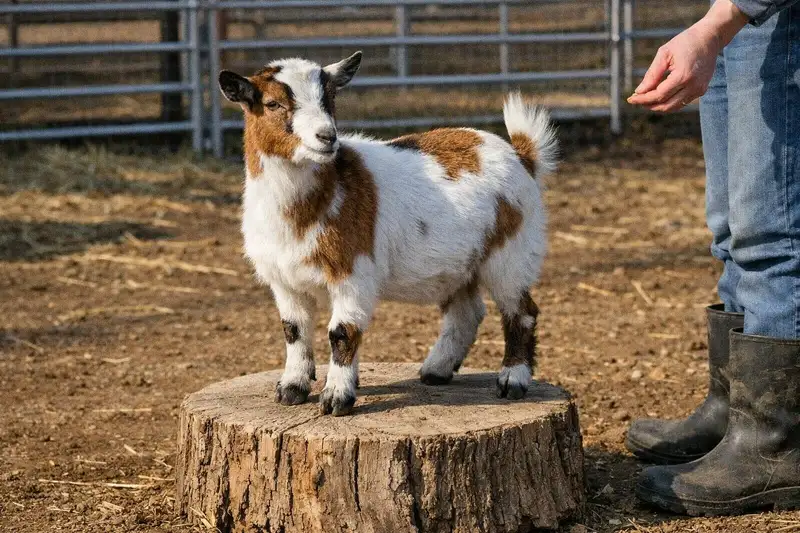
Pedestal training is one of the most versatile tricks. Teaching a goat to stand on an elevated platform works for vet exams, photos, shows, and as a default behavior when the goat is confused during training.
Lure the goat onto a low, stable platform with a treat. Click and reward when all four feet are on, then gradually increase height and phase out the lure.
A goat with a reliable pedestal command has a "go-to" behavior that prevents frustration. When confused, it defaults to the pedestal and waits for direction.
Other popular tricks include shaking hands, bowing, ringing a bell, weaving between your legs, and jumping through hoops. Each gets built through shaping.
Breaking the final behavior into small, rewardable steps.
Keep trick sessions to 5–10 minutes and always end on a win. If the goat is struggling with a new step, back up to something it knows, reward that, and stop.
Agility courses are an excellent challenge for athletic goats. Set up jumps, tunnels, weave poles, and a teeter-totter, then guide the goat through with a target stick.
Master each obstacle individually before chaining them together. Most goats that enjoy tricks take to agility naturally.
Goat yoga classes typically use calm, well-socialized kids or small-breed adults. The goats wander freely while people do yoga poses.
Training these animals focuses on comfort with strangers, being picked up, and handling unpredictable environments. It's really about socialization, not tricks.
While dogs and pigs are the traditional truffle-hunting animals, goats have shown detection ability thanks to their sharp sense of smell and browsing instincts. A few European truffle hunters have experimented with goats.
Training follows standard scent-detection protocols: associate the truffle scent with food, then gradually increase detection difficulty. It's niche, but it works.
Goat therapy programs have also grown fast. Therapy goats need rock-solid socialization.
They must be comfortable with strangers, novel settings, loud noises, and unpredictable handling.
Start socializing therapy candidates early and expose them to as many people, places, and situations as you can. The best therapy goats genuinely enjoy human contact, not just tolerate it.
Research confirms goats read human facial expressions, prefer smiling people, and seek eye contact. They look to humans for help with problems they can't solve, just like dogs.
That emotional intelligence is why the human-goat bond runs so deep.
When training multiple goats for tricks, work with each one individually first. Goats get jealous, and a goat that watches its herd mate get treats will try to push in.
Once each goat has its foundation skills solid, you can start working them together. Pair goats with complementary temperaments.
A bold goat and a shy one often balance each other nicely.
Teach a "go-to" trick early, like standing on a pedestal. When the goat gets confused during training, it defaults to the pedestal instead of getting frustrated.
Start from birth. Kids handled daily from day one become the friendliest, most trainable adults. Halter introduction can begin at 2–4 weeks, basic commands at 4–8 weeks, and leash walking by 8–12 weeks. Adult goats can still be trained, but the process takes longer. Starting late is always better than not starting at all. The most important thing is daily consistency, not starting at a specific age.
Baby goats can stay indoors temporarily for bottle feeding, but goats aren't reliable house pets. They can't be house-trained consistently, they chew everything, and they need outdoor space plus herd companions for normal development. Invest in proper outdoor shelter and secure fencing for a happy goat companion instead.
Patience and food are the keys. Spend time in the goat's space without trying to touch it, offer treats like raisins or grain, and let the goat approach you. Start touching the chest and shoulders, not the head. A small pen with a calm companion goat speeds the process. Taming takes anywhere from a few days to several months depending on the animal. Dairy breeds generally tame faster than meat breeds or feral goats.
Most kids grasp leash walking within 3–5 short sessions spread over a week or two. Adults that have never worn a halter may need 2–4 weeks of gradual desensitization. The key is never pulling forward. Use pressure-and-release paired with food rewards. Show goats and 4-H animals benefit from daily practice on varied surfaces and in unfamiliar environments to build ring confidence.
It depends on the cause. Hormonal aggression in intact bucks is best solved by wethering. Fear-based aggression responds to patient trust-building. Dominance aggression requires clear boundaries without physical contests. Never push a goat in the forehead or head-butt back. That reinforces the behavior. Pain-related aggression resolves once the medical issue is treated. For bucks with long-standing aggression, wethering combined with behavior modification gives the best results.
Raisins, animal crackers, small banana pieces, and Cheerios all work well. Keep treats pea-sized to avoid overfeeding, and limit sessions to 10–15 minutes so total treat intake stays manageable. Some trainers use the goat's daily grain ration. Avoid chocolate, avocado, and nightshade plants. These are toxic to goats. Fresh vegetables like carrot slices also work well and are healthier for the rumen than grain-based treats.
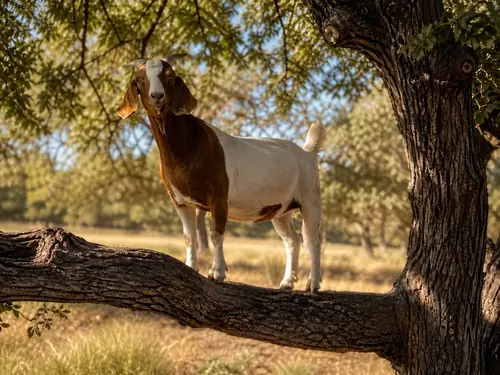
Yes. Goats climb trees with low or angled branches regularly. In Morocco, they famously scale argan trees for the fruit. Domestic goats will climb any accessible tree, making them entertaining but sometimes destructive in orchards. Their split hooves and rubbery sole pads give them remarkable grip on uneven surfaces, including bark and rough stone.
Most domestic goats clear 4–5 feet from a standing position. Athletic breeds like Nubians and Alpines go higher with a running start. Fencing should be at least 4–5 feet tall, and any climbable objects near fences need to be moved at least 6 feet away to prevent climbing-assisted escapes. Electric fence along the top adds an extra layer of security for known jumpers.
Yes. Large breeds like Boers, Nubians, and Alpines pull about 1.5 times their body weight in a cart. Pack goats, typically wethered Alpines, Oberhaslis, or Saanens, carry 20–25% of their body weight on trail hikes. Don't start cart or pack training until the goat is at least 2 years old to protect its joints. Conditioning should be gradual, building fitness over months rather than weeks.
Most goats actively hate water and avoid getting wet whenever possible. But all goats can swim when they need to. Their aversion is instinctive, not physical. Pack goats can be trained to cross creeks through gradual exposure and food rewards. In wet climates, covered pathways between barn and pasture help get reluctant goats outside. Most goats tolerate light drizzle more than heavy downpours, so partial shelter often solves the problem.
guide Can goats climb 92 degrees? We run the geometry, list the slope angles wild and domestic goats actually handle, and explain why the viral photos mislead you.
 guide
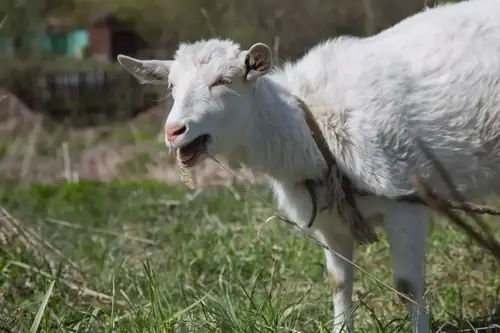
guide Yes, goats can be tamed. They're social animals that naturally bond with humans given enough time and treats. Here's how to build trust with goats at any age.
 guide
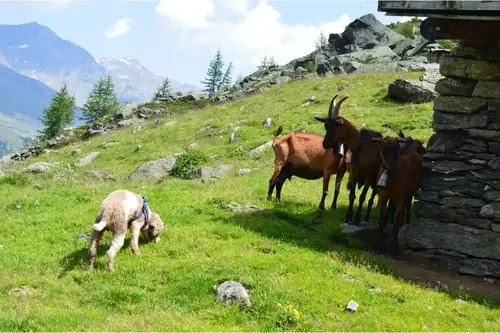
guide That viral goat 'scream' sounds disturbingly human. Here is what goats are really doing when they let out that long, loud cry, and why some do it more.
 guide
guide Some dogs guard goats for life while others see them as prey. We break down which breeds bond with goats, the real risks, and how to introduce them safely.
 guide
guide Mountain goats carry razor-sharp horns and enough force to kill a grizzly bear. One hiker has died from a mountain goat attack, and multiple dogs have been gored on popular trails across the western United States.
 guide
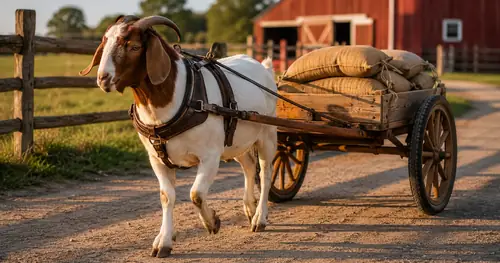
guide Everything you need to know about goat carting, from breed selection and weight limits to step-by-step training and essential equipment.
 guide
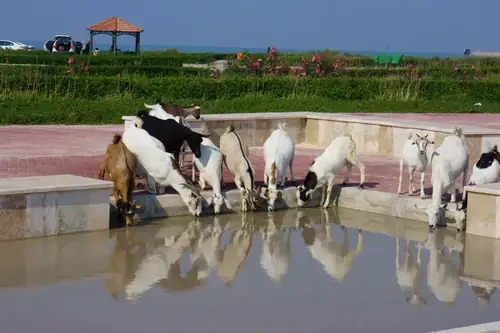
guide Most goats will dodge a puddle yet carry a swimming reflex inherited from wild ancestors. This guide breaks down the physiology, breed differences, real health dangers, and what every owner should do around open water.
 guide
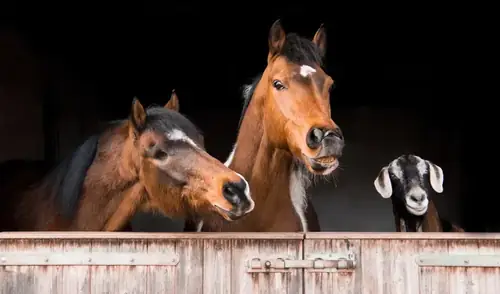
guide Horses form genuine emotional bonds with goats. Learn the behavioral signs of attachment, how long bonding takes, best goat breeds, and safe introduction steps.
 guide
guide Goats climb trees using split hooves with rubber-like inner pads that grip bark and branches. From Morocco's argan-climbing herds to backyard Pygmies, the behavior is natural and widespread.
 guide
guide Goats are interesting animals with many unique behaviors.
 guide
guide There are a few important things to consider here. We break down the pros, cons, and best approaches.
 guide
guide If this question has crossed your mind, you'll want to read what we found. The answer has some important nuances.