| # | Product | Our Rating | ||
|---|---|---|---|---|
| 1 |  | Best OverallLamb & Goat Bottle with Pritchard Teat | ★★★★★ | Check Price |
| 2 |  | Vetericyn Super 7 Ultra Navel Care Spray | ★★★★☆ | Check Price |
| 3 |  | Goat & Sheep Nutri-Drench (1 Quart) | ★★★★☆ | Check Price |
Knowing your doe’s due date changes everything about how a kidding season goes. It tells you when to give her CDT booster, when to start watching around the clock, and when to have the kidding kit ready by the door.
After more than a decade of kidding seasons, I have learned that a doe rarely reads the calendar exactly, but a good due-date estimate gets you watching at the right time instead of being caught off guard at 2 a.m.
Use the calculator to get her estimated due date, then read on for the breed chart, the stages of pregnancy, and the signs that tell you kidding is hours away.
Goat Gestation Calculator
The calculator counts 150 days (or 148 for the small breeds) from the breeding date and gives a 10-day window, because a healthy doe can kid a few days on either side of the estimate.
If you’re new to breeding goats, write down every breeding date the day it happens.
How Long Are Goats Pregnant?
Goats are pregnant for about 150 days, or roughly 5 months. The normal range runs from 145 to 155 days.
Most does kid within a few days of the 150-day mark, but first fresheners and does carrying a single large kid sometimes go a little over.
Two things shift the number slightly. Smaller breeds tend to kid a touch earlier, and does carrying triplets or quads often kid a day or two sooner than does carrying a single.
Neither is something to worry about on its own, but both are reasons to start watching from day 145 rather than waiting for day 150.
Goat Gestation Chart by Breed
Gestation is remarkably consistent across goats, but the small breeds run a hair shorter. Use this as your at-a-glance reference.
| Breed | Average gestation | Typical range |
|---|---|---|
| Standard dairy (Nubian, Alpine, Saanen, LaMancha, Toggenburg) | 150 days | 145 to 155 days |
| Boer and meat breeds | 150 days | 148 to 153 days |
| Nigerian Dwarf | 148 days | 145 to 153 days |
| Pygmy | 148 days | 143 to 153 days |
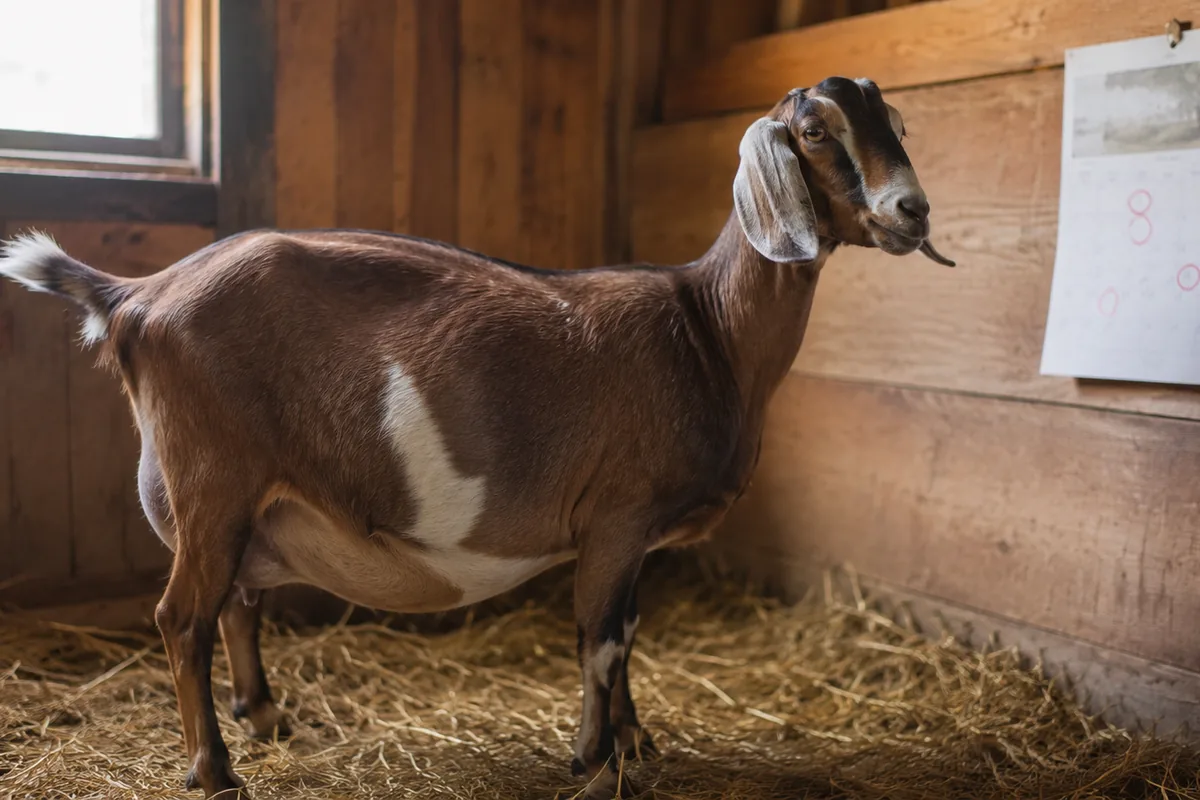
If you did not catch the exact breeding date, count back from the signs instead. Once the udder fills hard and the tailhead ligaments go soft, kidding is usually within 24 hours regardless of what the calendar says.
The Three Stages of Goat Pregnancy
Early (days 0 to 50). The embryos implant and the pregnancy is fragile.
Keep stress low, avoid unnecessary handling, and do not use dewormers like albendazole that can cause abortion in this window. Most does will not look pregnant yet.
Middle (days 50 to 100). The pregnancy is stable and the kids do most of their early growing.
Keep her on good forage and a steady mineral program. This is the easiest stretch, and a good time to confirm numbers with an ultrasound if you want a kid count.
Late (days 100 to 150). The kids gain most of their weight now, so her nutrition needs climb.
Increase her feed gradually, give her CDT booster about 4 weeks before her due date so the kids get protection through her colostrum, and watch for pregnancy toxemia in does carrying multiples.
Signs Your Doe Is About to Kid
The calendar gets you close, but the doe’s body tells you when it is actually happening. In the final day or two, watch for:
- Softening tailhead ligaments. The two cords on either side of the tailhead go from firm like a pencil to soft like jelly. This is the most reliable sign, and it usually means kidding within 12 to 24 hours.
- A full, tight udder that fills out and sometimes shines.
- A long string of discharge, amber or white, hanging from the vulva.
- Restlessness and nesting: pawing the bedding, lying down and getting up, and “talking” quietly to her side.
- A temperature drop below about 101 degrees, often 12 to 24 hours before labor.
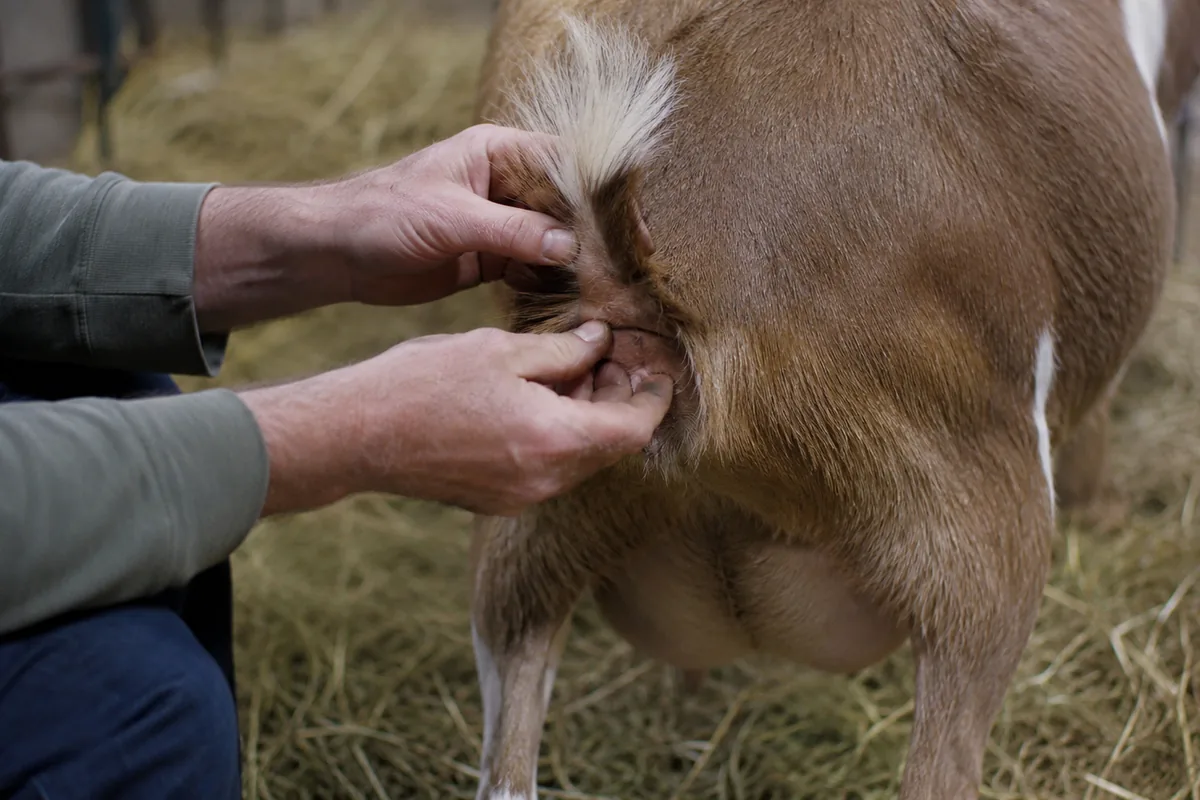
Once active labor starts, a doe usually delivers within 30 minutes to an hour. If she pushes hard for more than 30 minutes with no progress, call your vet.
Two other timing worries come up often: a doe that goes overdue and may need inducing, and one that delivers kids hours apart.
The three stages of labor run from hours of restless nesting to active pushing, then the afterbirth.
How to Prepare for Kidding
Have everything ready by day 145, because the one year you are not ready is the year she kids early. A basic kidding kit includes clean towels, iodine for dipping navels, a bulb syringe, dental floss and scissors for cords, disposable gloves, and a bottle and nipple with colostrum replacer in case a kid needs help.
Know your numbers ahead of time too. Twins or triplets are the norm for most does, and a doe with more kids than working teats will need you to step in.
Keep your vet’s number where you can reach it, and keep the kidding kit stocked alongside the rest of your goat medicine cabinet.
Add This Calculator to Your Site
Run a goat, homestead, or farm website? You are welcome to embed this calculator for free, so your readers can find their doe’s due date without leaving your page.
Copy the code below and paste it where you want the calculator to appear. It updates automatically, so there is nothing to maintain on your end.
Sources and Further Reading
Gestation figures cross-checked against established veterinary and breed references:
- The Merck Veterinary Manual, management of the goat doe and gestation length
- American Dairy Goat Association (ADGA) breed references
- University extension publications on goat reproduction and kidding
Gestation is an estimate, not a guarantee. Always watch for the physical signs of labor and confirm any concerns with your veterinarian.
Frequently Asked Questions
About 150 days, or roughly 5 months. The normal range is 145 to 155 days. Smaller breeds like Nigerian Dwarf and Pygmy goats average a little shorter, around 145 to 150 days, while standard dairy and Boer goats sit right around 150.
Count 150 days forward from the day she was bred (148 days for Nigerian Dwarf and Pygmy). The calculator on this page does it instantly and gives you a likely 10-day window, since few does kid exactly on day 150.
Nigerian Dwarf does usually kid around 145 to 150 days, slightly earlier than standard breeds. Using 148 days as your estimate works well, but watch for the physical signs of labor from day 145 on, especially with first fresheners.
There is no reliable at-home urine test like there is for humans. The practical home methods are watching whether she returns to heat about 3 weeks after breeding (a doe that does not cycle again is likely bred), and after about 30 days a vet can confirm with ultrasound or a blood test (BioPRYN).
In the last day or two, the tailhead ligaments soften from firm to jelly-like, the udder fills tight, you may see a long string of amber or white discharge, and the doe becomes restless, paws at her bedding, and talks to her side. A temperature drop below about 101 degrees often comes 12 to 24 hours before kidding.