| # | Product | Our Rating | ||
|---|---|---|---|---|
| 1 |  | Best Overall3ml Luer-Lock Syringes with Needles | ★★★★★ | Check Price |
| 2 |  | 20-Gauge 1-inch Needles (100 Pack) | ★★★★☆ | Check Price |
| 3 |  | Adjustable Livestock Repeater Syringe | ★★★★☆ | Check Price |
Vaccinating goats sounds intimidating, but for most owners it comes down to one shot given on a simple schedule. Get the CDT vaccine right and you have covered the diseases most likely to kill your goats.
Vaccines are some of the cheapest and most effective insurance in goat keeping. A few dollars of vaccine prevents diseases that are almost always fatal once they take hold.
This guide explains which vaccines goats actually need, the full schedule for kids and adults, the optional shots to consider, and how to give a goat a vaccine yourself.
Do Goats Need Vaccines?
Yes, goats need vaccines, and the case for the core one is overwhelming. The diseases vaccines prevent are fast, deadly, and heartbreaking, while the shots themselves are cheap and easy.
The single non-negotiable vaccine is CDT. It protects against enterotoxemia and tetanus, two clostridial diseases that can take a healthy goat from normal to dead in a matter of hours.
Beyond CDT, the picture gets more flexible. A handful of other vaccines exist for diseases like pneumonia and rabies, but whether your herd needs them depends entirely on your region, your management, and your vet’s advice.
Think of CDT as the foundation that every goat gets, with the optional vaccines layered on only when your specific situation calls for them. When in doubt, your local vet or extension office knows your area’s risks better than any general guide can.
The CDT Vaccine Explained
CDT is the most important three letters in goat health. They stand for Clostridium perfringens types C and D, plus tetanus.
The C and D portion prevents enterotoxemia, often called overeating disease. It strikes when bacteria normally present in the gut suddenly overgrow, usually after a sudden change in feed or a rich grain meal, releasing toxins that kill quickly.
The T portion prevents tetanus, a fatal disease caused by bacteria that enter through wounds, disbudding, and banding. Both diseases are far easier to prevent than to treat, and treatment usually fails.
CDT comes as a single combined shot, which is why it is so convenient. One affordable vaccine on a regular schedule protects against the two clostridial killers that account for a huge share of preventable goat deaths.
Goat Vaccination Schedule
The schedule is built around getting kids protected early, then keeping every goat boosted for life. Here is the standard CDT timeline most vets recommend.
| Goat | When to give CDT |
|---|---|
| Kids (dam was vaccinated) | First shot at 6 to 8 weeks, booster 3 to 4 weeks later |
| Kids (dam not vaccinated) | First shot as early as 1 to 4 weeks, plus tetanus antitoxin at disbudding or banding |
| Adult goats | One annual booster, every year for life |
| Pregnant does | Booster 4 to 6 weeks before kidding |
The pregnant-doe booster is the clever part of the system. A doe vaccinated late in pregnancy passes strong antibodies to her kids through colostrum, protecting newborns until they are old enough for their own shots.
If you ever lose track of an adult goat’s history, it is safe to restart with two doses three to four weeks apart, then resume annual boosters. There is no harm in being thorough.
Other Goat Vaccines to Consider
Beyond CDT, several optional vaccines exist for specific situations. None of these are universal, and most goats never need them.
Pneumonia vaccines target the bacteria behind respiratory disease, a leading killer in goats. They can help in herds with recurring outbreaks, which makes them worth discussing if you have battled goat pneumonia before.
Rabies vaccination is recommended or required in regions where rabies is present, especially for goats that have contact with the public. CL (caseous lymphadenitis) vaccines exist but are used selectively, because they can interfere with testing and are not right for every herd.
Rabies in goats is rare but always fatal once symptoms start, so ask your vet about the shot.
Multi-way clostridial vaccines (7-way, 8-way) extend protection to diseases like blackleg, but plain CDT is enough for most goats. Each of these decisions should be made with your vet, who can weigh your region’s risks against the downsides of over-vaccinating.
How to Give a Goat a Vaccine
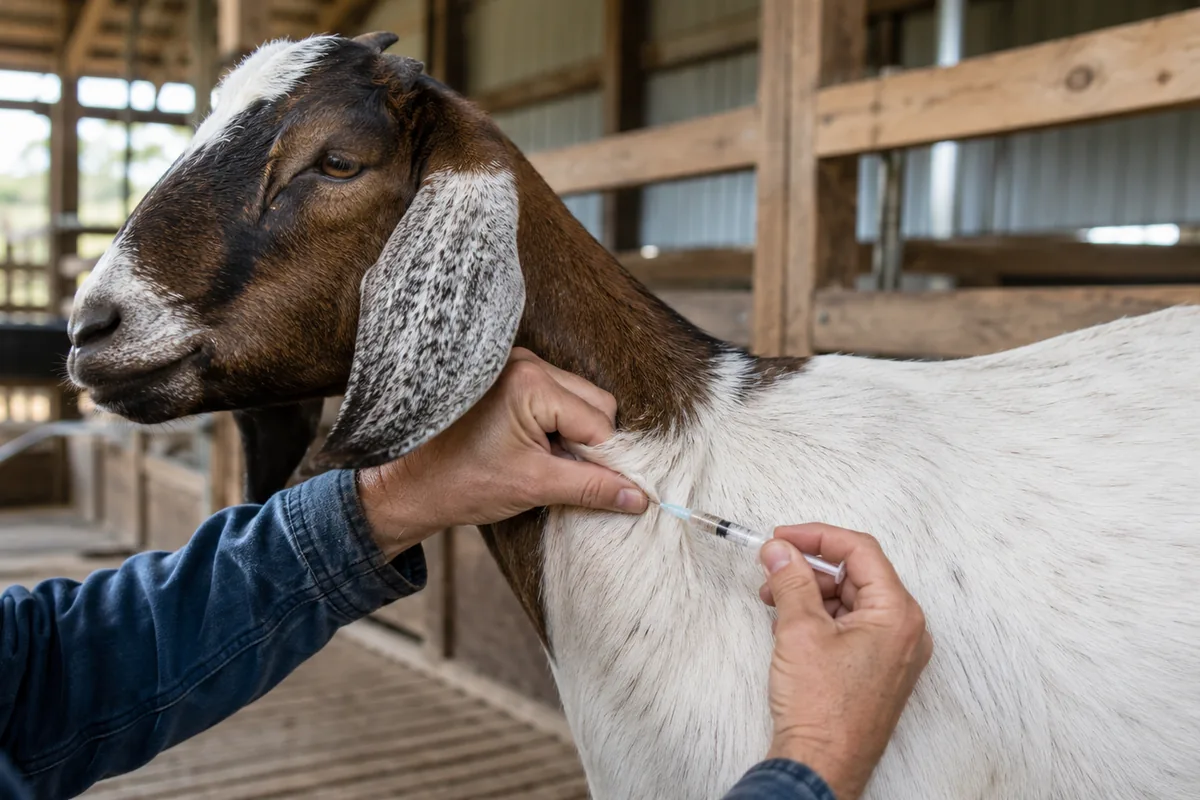
Most CDT vaccines are given subcutaneously, meaning just under the skin rather than into muscle. With a little practice it takes seconds, though your vet can show you the first time.
Pick a spot with loose skin, usually over the ribs or in the hairless armpit area behind a front leg. Tent the skin between your fingers, slide a clean 20 to 22 gauge needle under it at a shallow angle, draw back slightly to be sure you are not in a vein, and inject the labeled dose, which is usually 2 ml.
Use a fresh needle for the injection, keep the vaccine refrigerated until you use it, and never vaccinate a sick goat without veterinary advice. Proper handling keeps the vaccine effective and the injection clean.
Afterward, watch the goat for a few minutes. A small lump at the site is normal and fades over weeks, but a sudden allergic reaction called anaphylaxis, though rare, needs immediate epinephrine, so many owners keep some on hand and ask their vet about it in advance.
Sources and Further Reading
Compiled and cross-checked against established veterinary and extension references:
- University extension publications (Penn State, Oklahoma State, Maryland) on goat vaccination programs
- American Association of Small Ruminant Practitioners (AASRP) guidance
- Merck Veterinary Manual, clostridial diseases and vaccination in small ruminants
- Langston University, Meat Goat Production Handbook, herd health
Vaccine choices, timing, and doses vary by region and product, so treat this as a framework and confirm the specifics with your veterinarian. The one constant for nearly every herd is simple: keep every goat current on CDT.
Frequently Asked Questions
The one vaccine every goat needs is CDT, which covers enterotoxemia types C and D and tetanus. Kids get a first dose at 6 to 8 weeks and a booster 3 to 4 weeks later, then every goat gets an annual booster for life. Pregnant does should be boosted 4 to 6 weeks before kidding so antibodies pass to the kids through colostrum. Other vaccines such as pneumonia, rabies, or CL are optional and depend on your region, so confirm with your vet.
CDT stands for Clostridium perfringens types C and D plus tetanus. The C and D portion prevents enterotoxemia, also called overeating disease, which kills goats quickly when their gut bacteria overgrow after a feed change. The T portion prevents tetanus, a fatal infection that enters through wounds, disbudding, and banding. CDT is a single combined shot and is the core vaccine for goats of every breed and age.
A 7-way or 8-way vaccine covers additional clostridial diseases beyond the three in CDT, such as blackleg and malignant edema. Most backyard and dairy goats do well on plain CDT, and the multi-way clostridial vaccines are mainly used where those extra diseases are a known regional risk. Talk to your local vet or extension agent about whether your area justifies the broader vaccine, because for most herds CDT alone is enough.
CDT is given subcutaneously, meaning just under the skin, not into the muscle. Most owners tent the loose skin over the ribs or in the hairless armpit area behind the front leg, slide a clean 20 to 22 gauge needle under it, and inject the labeled dose, usually 2 ml. Use a fresh needle, keep the vaccine cold until use, and watch for a small lump at the site, which is normal. Always follow the product label and your vet's guidance.
Serious reactions to the CDT vaccine are rare, and the protection it gives far outweighs the small risks. A pea-sized lump at the injection site is common and harmless, and some goats are briefly sore or quiet for a day. The main danger to watch for is anaphylaxis, a sudden allergic reaction in the minutes after the shot, which is why having epinephrine on hand is wise.