| # | Product | Our Rating | ||
|---|---|---|---|---|
| 1 |  | Best Overall3ml Luer-Lock Syringes with Needles | ★★★★★ | Check Price |
| 2 |  | Adjustable Drench Syringe Set (20ml) | ★★★★☆ | Check Price |
| 3 |  | 20-Gauge 1-inch Needles (100 Pack) | ★★★★☆ | Check Price |
A goat that is sick, injured, or wormy almost always needs the right medicine at the right dose, fast, and the single most common mistake new owners make is guessing. After years of scribbling doses on barn whiteboards and the backs of feed sacks during 2 a.m. emergencies, I built the weight-based reference I wish I’d had on day one.
Goats are not small cattle: they clear many drugs from their system quicker, so the doses and withdrawal times are different, and almost every medication on this page is used extra-label (not officially approved for goats).
This chart pulls together the doses most commonly cited by veterinary and breeder sources, with the meat and milk withdrawal times that most quick-reference charts leave out. Read the safety section first, weigh your goat, and confirm anything you are unsure about with your vet before you draw up a syringe.
Important: This article is an educational reference, not veterinary advice or a prescription. Because these drugs are extra-label in goats, U.S. law requires a valid veterinarian-client-patient relationship (VCPR) for your vet to set the legal dose and withdrawal time. Doses below are commonly published figures and can vary by product strength, illness severity, and individual goat.
How to Use This Dosage Chart
Every dose on this page depends on three numbers you must confirm yourself:
- Your goat’s weight, every dose is per pound or per kilogram. A guess of “about average” can mean a 40% error. See how to find your goat’s weight below.
- The product’s concentration, the same drug comes in different strengths. “Oxytetracycline 200” means 200 mg/mL; a 100 mg/mL bottle needs double the volume for the same dose. Always read the label.
- The withdrawal time, how long after the last dose before the milk or meat is safe for people. Extra-label use almost always extends the label withdrawal, so your vet must set it.
To convert weight: 1 kg = 2.2 lb. So a 10 mg/kg dose for a 110 lb (50 kg) goat is 500 mg of active drug.
How Goat Medication Dosing Works
Extra-label is the rule, not the exception. Only a handful of products are FDA-approved for goats.
Everything else, most antibiotics, dewormers, and pain relievers, is borrowed from cattle, sheep, or even human medicine and used off-label. That is legal only through your veterinarian, who is also the only person who can legally tell you the correct withdrawal time for an extra-label drug.
Goats burn through drugs fast. Their rumen and liver metabolize many compounds more quickly than cattle do.
That is why several goat dewormers are dosed at roughly double the cattle label, and why short-acting drugs may need more frequent dosing. Never assume the cattle label is correct for a goat.
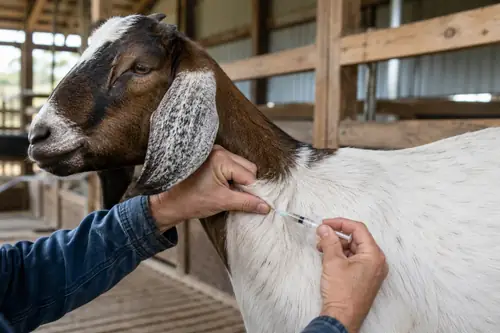
Route matters. Most goat injections are given SQ (subcutaneous, under the skin) rather than IM (into the muscle), because IM injections can cause muscle damage and abscesses and ruin meat.
A few drugs are still given IM or IV, the charts note which.
How to Find Your Goat’s Weight
You cannot dose safely without a weight. Three reliable options, best first:
- Digital livestock scale, most accurate. A platform scale or a hanging scale with a sling for kids.
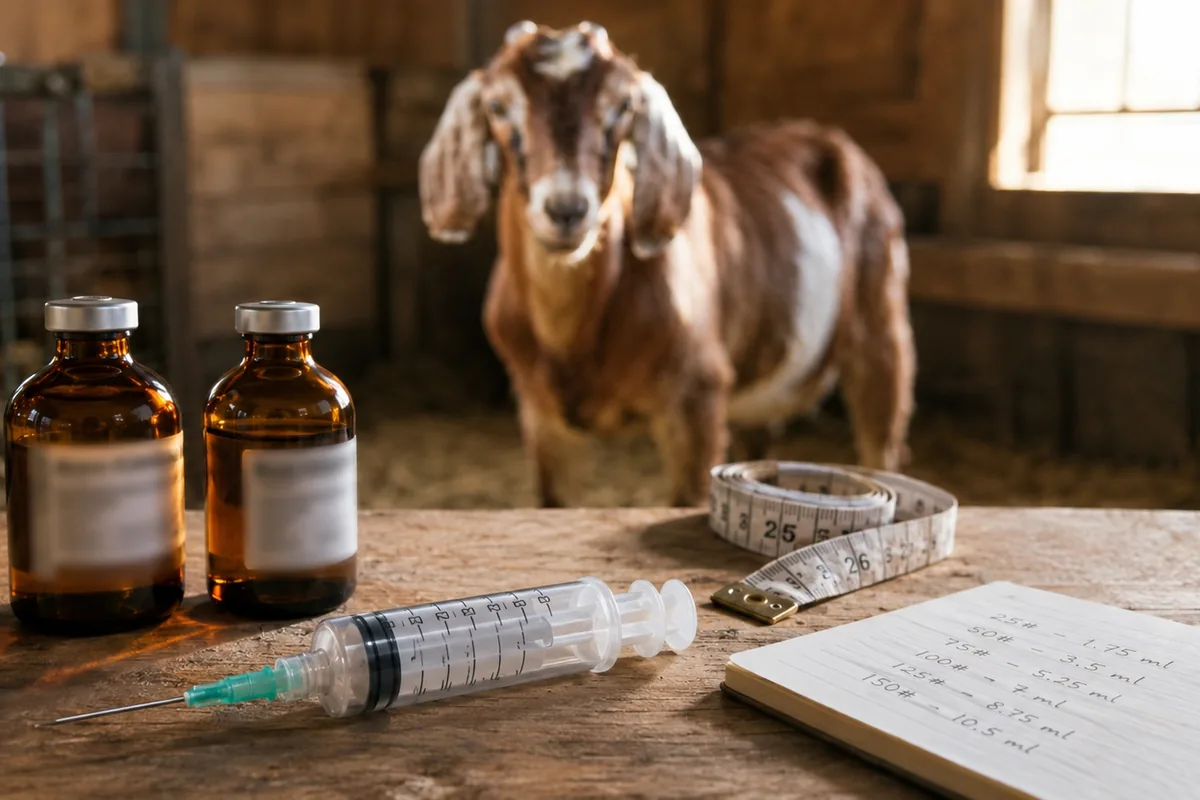
- Weigh tape (goat-specific), a cloth tape you wrap around the heart girth (just behind the front legs). Quick and cheap; accurate to within about 5 to 10%.
- Heart-girth formula, measure the heart girth in inches, square it, multiply by the body length (point of shoulder to pin bone), and divide by 300. It is rough but better than guessing.
For kids and bottle babies, a kitchen or luggage scale works in a pinch. Re-check weight before every treatment course, a wormy or scouring goat can lose weight fast.
Goat Dewormer Dosage Chart
Goat dewormers are dosed orally and almost always above the cattle/sheep label. Resistance is widespread, so deworm based on a fecal egg count and FAMACHA score rather than on a calendar, and rotate classes only on your vet’s advice.
Doses below follow Cornell University’s dewormer chart for goats.
| Dewormer (brand) | Class | Oral dose | Meat withdrawal | Milk withdrawal | Notes |
|---|---|---|---|---|---|
| Fenbendazole (Safe-Guard, Panacur) | Benzimidazole | 10 mg/kg | 16 days | 4 days | Often resistant; add 1 withdrawal day per extra treatment day |
| Albendazole (Valbazen) | Benzimidazole | 20 mg/kg | 9 days | 7 days | Do not use in the first trimester of pregnancy |
| Ivermectin (Ivomec sheep drench) | Macrocyclic lactone | 0.4 mg/kg | 14 days | 9 days | Use the oral drench, not the pour-on |
| Moxidectin (Cydectin sheep drench) | Macrocyclic lactone | 0.4 mg/kg | 17 days | 8 days | Use the sheep oral drench, not cattle |
| Levamisole (Prohibit, LevaMed) | Imidazothiazole | 12 mg/kg | 4 days | 3 days | Narrow safety margin, weigh accurately |
| Morantel (Rumatel) | Tetrahydropyrimidine | 10 mg/kg (in feed) | 30 days | 0 days | Feed pre-mix |
If you are using a pour-on or a cattle dewormer block, stop and confirm the goat dose first, those are common sources of under-dosing and resistance.
Goat Antibiotic Dosage Chart
All goat antibiotics are extra-label and must be prescribed. Doses vary by source and by infection, and milk withdrawals are long.
The figures below are commonly cited references, your vet sets the legal dose and withdrawal. Between them, these drugs cover everyday problems like goat pink eye, pneumonia, and infected wounds.
| Antibiotic (brand) | Used for | Commonly cited dose | Route | Milk withdrawal* |
|---|---|---|---|---|
| Procaine penicillin G (300k IU/mL) | Strep, listeriosis, wounds, tetanus support | ~1 mL per 15-20 lb, 1-2× daily | SQ | 14-20 days |
| Oxytetracycline 200 (LA-200, Biomycin) | Pinkeye, pneumonia, chlamydial abortion | ~1 mL per 20 lb daily ×5 (some cite 3 mL/100 lb) | SQ | 12-18 days |
| Ceftiofur (Excenel, Naxcel) | Respiratory disease, foot rot | Per vet (e.g., ~1 mL/25 lb) | SQ | Short / per vet |
| Tylosin (Tylan 200) | Mycoplasma, respiratory | ~1 mL per 20 lb daily ×5 | SQ | ~8 days |
| Sulfadimethoxine (Albon) | Coccidia, scours, secondary infection | Day 1: 1 mL/5 lb; days 2-5: 1 mL/10 lb | Oral | Per vet |
| Trimethoprim-sulfa (Tribrissen) | Scours, pneumonia | ~30 mg/kg, twice daily | Oral | ~8 days |
*Withdrawal times for extra-label use are estimates only; your veterinarian must set the legal withdrawal. Procaine penicillin is generally safe for pregnant does, but weigh young kids carefully, because a penicillin overdose can kill them.
Pain and Anti-Inflammatory Medications
| Drug | Use | Commonly cited dose | Route | Notes |
|---|---|---|---|---|
| Flunixin meglumine (Banamine, 50 mg/mL) | Pain, fever, inflammation | ~1 mL per 100 lb, once daily, ≤3 days | SQ (IV by vet) | NSAID; ulcer and kidney risk; milk withdrawal ~3-4 days |
| Meloxicam | Longer-acting pain control | ~0.5 mg/kg orally, per vet | Oral | Vet-preferred modern NSAID |
| Aspirin (325 mg) | Mild, short-term pain or fever | ~1 tablet per 10 lb | Oral | Very short-acting in goats |
Treat Banamine in goats as a short course of three days at most, because of that ulcer and kidney risk. Never stack two NSAIDs, and never use Banamine IM (it causes severe tissue damage).
For digestive upset, see Pepto-Bismol for goats and avoid human painkillers unless your vet directs.
Coccidiosis Treatment
Coccidiosis is a leading killer of kids 3 weeks to 5 months old. Treat at the first sign of scours and dehydration.
Amprolium blocks thiamine, so pair a long Corid course with vitamin B1 to head off goat polio.
| Drug | Dose | Route | Notes |
|---|---|---|---|
| Sulfadimethoxine (Albon 12.5%) | Day 1: 1 mL/5 lb; days 2-5: 1 mL/10 lb | Oral | Standard 5-day course |
| Amprolium (Corid) | Per label, 5-day course | Oral / in water | Thiamine antagonist, watch for goat polio; pair with B1 if prolonged |
| Toltrazuril / Ponazuril (Baycox) | Per vet | Oral | Single-dose option |
Vitamins, Minerals, and Vaccines
| Product | Use | Dose | Route | Notes |
|---|---|---|---|---|
| Bo-Se (selenium + vitamin E) | White muscle disease, selenium deficiency | 1 mL per 40 lb | SQ | Prescription; milk withdrawal ~24 h; do not over-supplement selenium |
| Vitamin B12 | Appetite, anemia recovery | ~1 mL per 100 lb | SQ | Often paired with B-complex |
| Thiamine (vitamin B1) | Goat polio (PEM), emergency | High dose, per vet | SQ / IM / IV | Time-critical; call your vet immediately |
| CD&T vaccine | Prevents enterotoxemia + tetanus | 2 mL, booster in 3-4 weeks, then annual | SQ | Prevention only, not a treatment. See CDT shot safety |
| CD antitoxin | Treats active enterotoxemia | Per label / vet | SQ | Different product from the vaccine |
Emergency Medications to Stock
Some problems move too fast to wait for a vet visit. Keep these on hand and know the dose before you need it:
- Epinephrine (1 mL per 100 lb, IM), for anaphylactic shock. Keep it within reach every time you give an injection, especially CD&T or penicillin, which can trigger a fatal reaction within minutes.
- CD antitoxin, for suspected enterotoxemia (overeating disease).
- Propylene glycol, for pregnancy toxemia and ketosis.
- CMPK / calcium drench, for milk fever (hypocalcemia) in late-pregnant or fresh does.
- Activated charcoal, for many plant and chemical poisonings.
- Baking soda (free choice or drenched), for early frothy bloat; know when bloat needs a vet, not baking soda.
- Electrolytes + probiotics, for any scouring or off-feed goat.
How to Give a Goat an Injection
Most goat injections are SQ (under the skin):
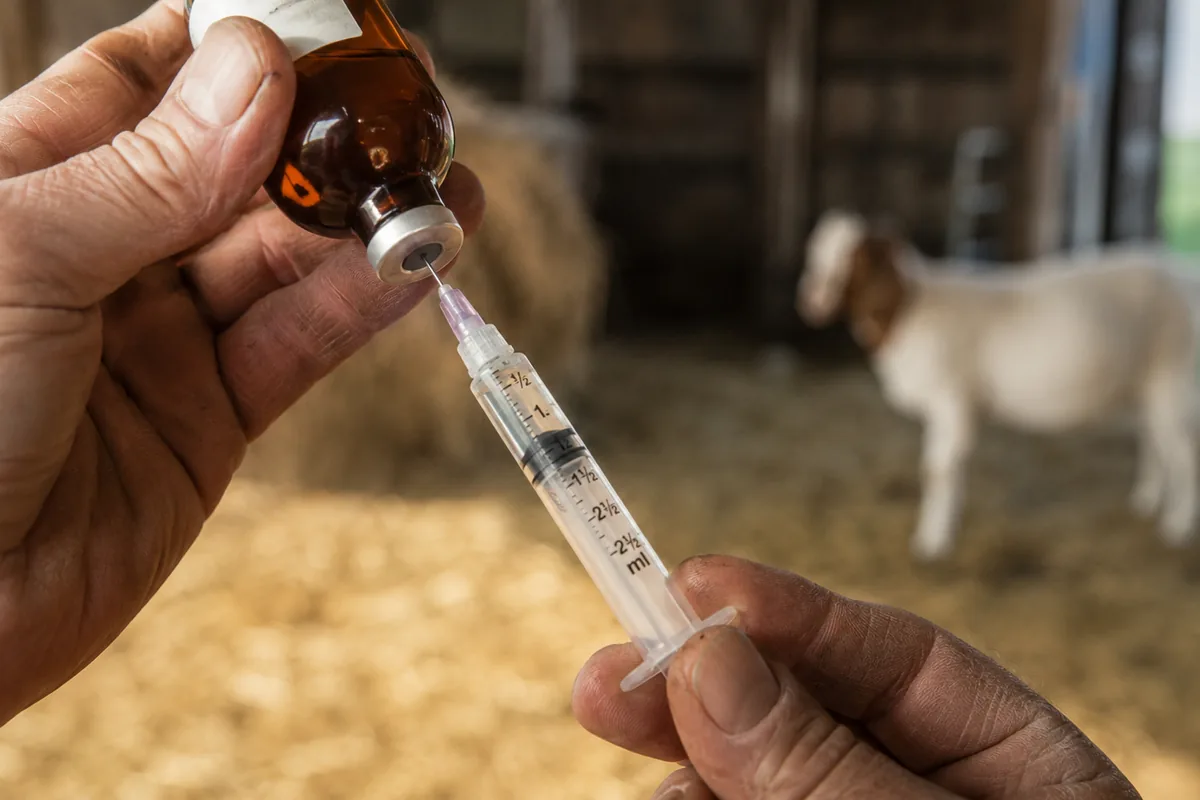
- Draw up the correct dose for your goat’s weight using a luer-lock syringe and an 18 to 20 gauge, 3/4 to 1 inch needle.
- “Tent” a fold of loose skin over the ribs or behind the front leg.
- Insert the needle into the tent (parallel to the body, not into muscle), pull back slightly to check you are not in a blood vessel, and inject.
- Rub the site. Use a fresh needle per goat to avoid spreading infection.
For IM injections (only when a drug requires it), use the muscle of the neck or hindquarters and never exceed about 5 mL per site. When in doubt, default to SQ unless the label or your vet says otherwise.
Meat and Milk Withdrawal Times
Withdrawal time is how long after the last dose you must wait before milk or meat is safe for people. It exists to keep drug residues out of the food supply, and ignoring it is both unsafe and illegal for animals entering the food chain.
Two rules to live by:
- Extra-label use extends withdrawal. The label time on a cattle or sheep product is not valid when the drug is used off-label in a goat. Your vet must assign the goat withdrawal.
- When in doubt, dump and wait longer. If you cannot confirm a withdrawal time, discard the milk and do not slaughter until your vet clears it.
Goat Medicine Cabinet Essentials
If you keep goats, stock these before an emergency forces a 2 a.m. supply run:
- Digital thermometer (normal goat temp is about 101.5-103.5°F)
- Goat-specific weigh tape or a livestock scale
- Luer-lock syringes (3, 6, and 12 mL) and 18-20 gauge needles
- A drench syringe for oral meds and electrolytes
- A current dewormer matched to your fecal results
- CD antitoxin and epinephrine (vaccine-reaction rescue)
- Electrolytes, probiotic paste, and baking soda
- Vet wrap, iodine, and a sharps container
A small, well-labeled kit with a printed copy of this chart taped inside the lid will save you in the moments that matter.
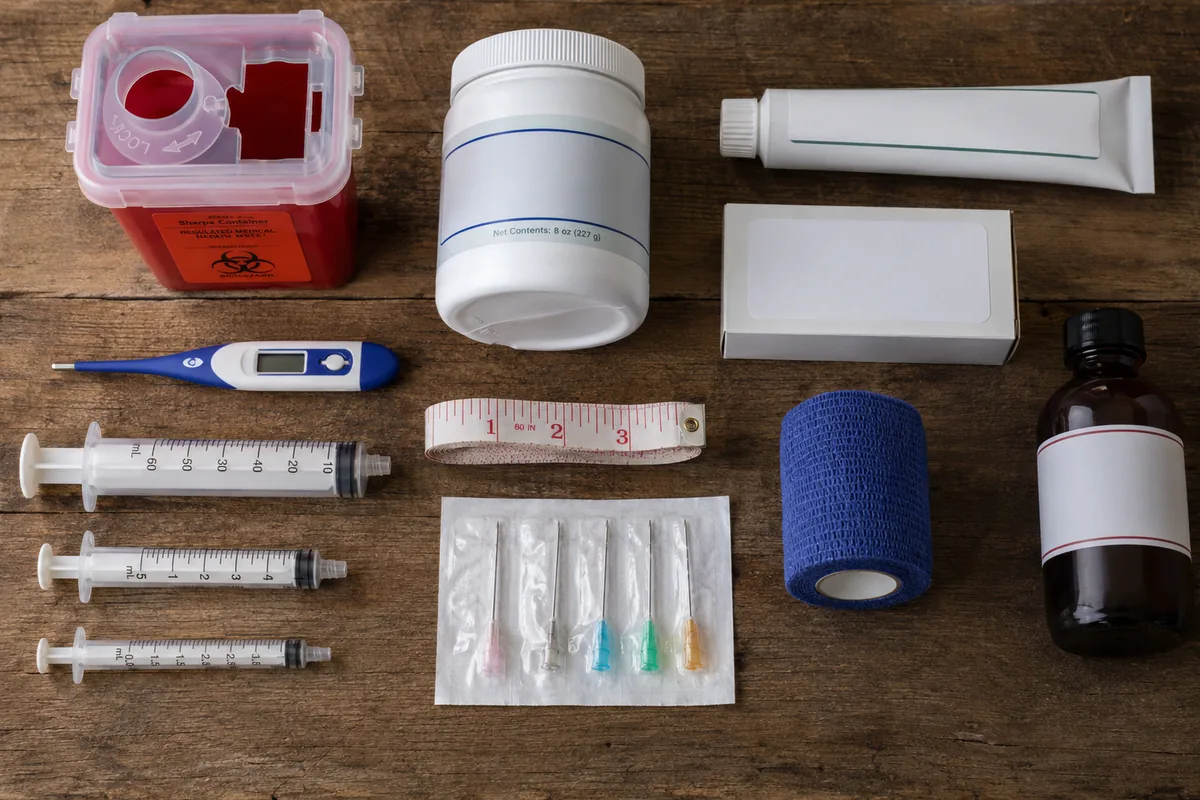
Store it somewhere you can reach in seconds, a labeled tote or wall cabinet near where you handle your goats, not across the property in the house. Pair that kit with the everyday basics of goat health, and you’ll reach for it less often.
Sources and Further Reading
Doses on this page were compiled and cross-checked from established veterinary and goat-health references, including:
- Cornell University College of Veterinary Medicine, Dewormer Chart for Goats
- The Merck Veterinary Manual (drugs and dosages for goats)
- Long-standing breeder references such as Fias Co Farm and Onion Creek Ranch / Tennessee Meat Goats
Recommended doses, approvals, and withdrawal times change over time. Always confirm current figures with your veterinarian before treating, and report adverse reactions.
Frequently Asked Questions
Weigh the goat (or estimate with a weigh tape), find the medication's per-pound or per-kilogram dose, and multiply. For example, a drug labeled 1 mL per 50 lb given to a 100 lb goat is a 2 mL dose. Always round to your goat's actual weight and double-check the concentration printed on the bottle, since the same drug name can come in different strengths.
Procaine penicillin G (300,000 IU/mL) is most commonly cited at roughly 1 mL per 15 to 20 lb of body weight, given under the skin once or twice daily for at least 5 days. Penicillin is extra-label in goats, doses used in practice are often higher than the label, and milk withdrawal is long (about 14 to 20 days), so confirm the exact dose and withdrawal with your vet.
Flunixin meglumine (Banamine, 50 mg/mL) is commonly given at about 1 mL per 100 lb of body weight, once daily, for no more than 3 days. It is an NSAID that can cause stomach ulcers and kidney damage if overused, so it should not be given long-term without veterinary guidance.
Often yes, but goats metabolize many drugs faster than cattle, so cattle doses are frequently too low and the route can differ. Several goat dewormers are dosed at roughly double the cattle or sheep label. Because this is extra-label use, your vet must set the correct dose and withdrawal time for each product.
Yes. This page is built to print cleanly to PDF directly from your browser (File then Print then Save as PDF), so you can keep a copy in your medicine kit. Re-download it periodically, since recommended doses and withdrawal times are updated over time.
A basic goat medicine cabinet includes a digital thermometer, a dewormer, CD antitoxin, electrolytes, probiotics, Banamine or another vet-prescribed anti-inflammatory, injectable epinephrine for vaccine reactions, baking soda for early bloat, and luer-lock syringes with 18 to 20 gauge needles. See the medicine cabinet section below for the full list.