| # | Product | Our Rating | ||
|---|---|---|---|---|
| 1 |  | Best OverallSheep & Goat Pregnancy Test Kit | ★★★★★ | Check Price |
| 2 |  | Manna Pro Goat Colostrum Supplement | ★★★★☆ | Check Price |
| 3 |  | Nutri-Drench Goat & Sheep Supplement | ★★★★☆ | Check Price |
Few things make a goat owner squint at their doe more than the question of whether she is pregnant. Goats hide early pregnancy well, and a round belly alone tells you very little.
The good news is that there is a clear order to the clues, from the earliest behavioral signs to the obvious late-pregnancy changes. Knowing what to look for, and when, takes most of the guesswork out of it.
This guide walks through the signs a goat is pregnant in the order they appear, how to tell pregnancy from simple weight gain, and the ways to confirm it for certain.
Early Signs a Goat Is Pregnant
In the first month, pregnancy is mostly invisible, so the earliest sign is something that does not happen. A bred doe who is pregnant will not return to heat.
Goats cycle roughly every 18 to 21 days, with clear signs of heat like tail flagging, loud calling, and a swollen vulva. If you breed a doe and she sails past her next expected heat with none of that, she has very likely conceived, especially relevant for a doe that can get pregnant outside of obvious heat.
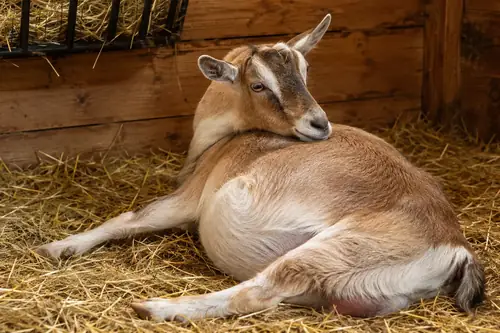
Some owners also notice subtle behavior changes in the first few weeks. A normally flighty or flirtatious doe may settle down, become calmer and more affectionate, and show a steadier appetite.
None of these early signs are proof on their own. But a doe who stops cycling and quietly changes her behavior after breeding is giving you the first real hint.
Physical Signs as Pregnancy Progresses
Goat pregnancy lasts about 150 days, and the visible changes are weighted heavily toward the second half. Patience is part of the process.
By the second month, you may notice gradual weight gain and a slightly fuller body, though it is still easy to miss. The belly begins to widen and drop, usually becoming more pronounced low on the right side where the rumen sits.
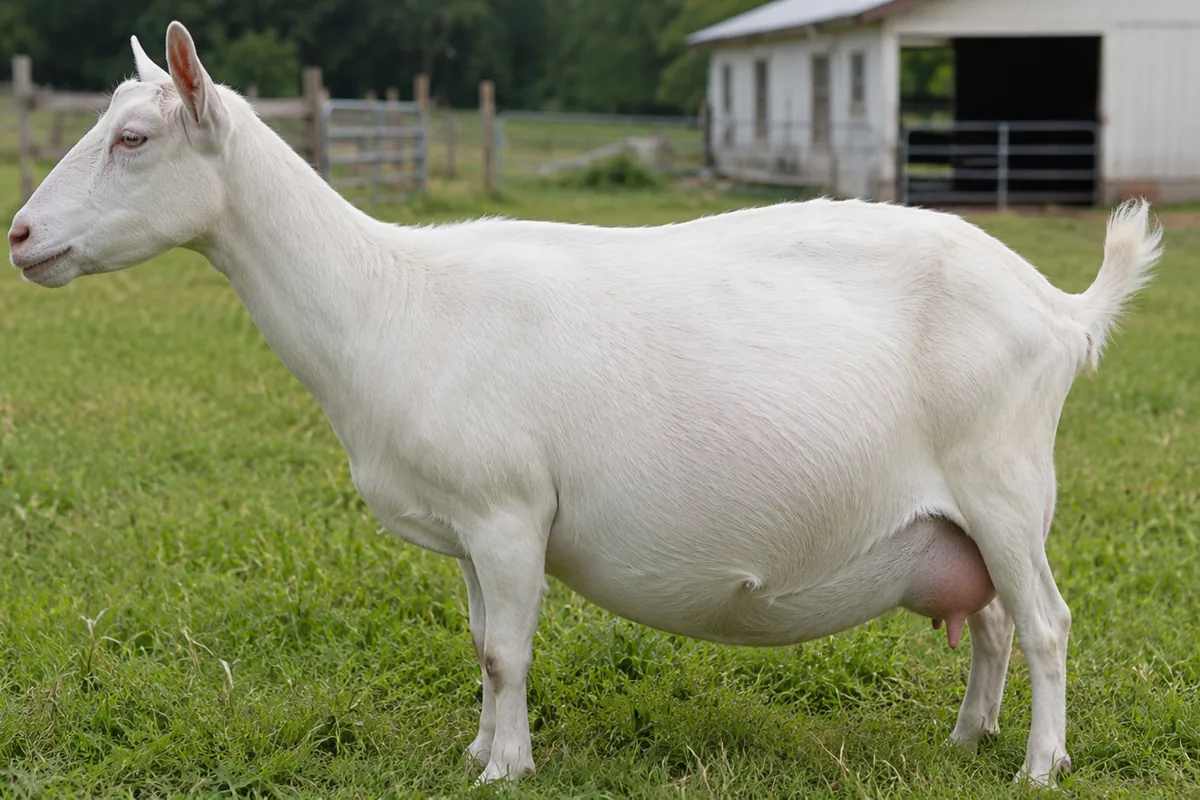
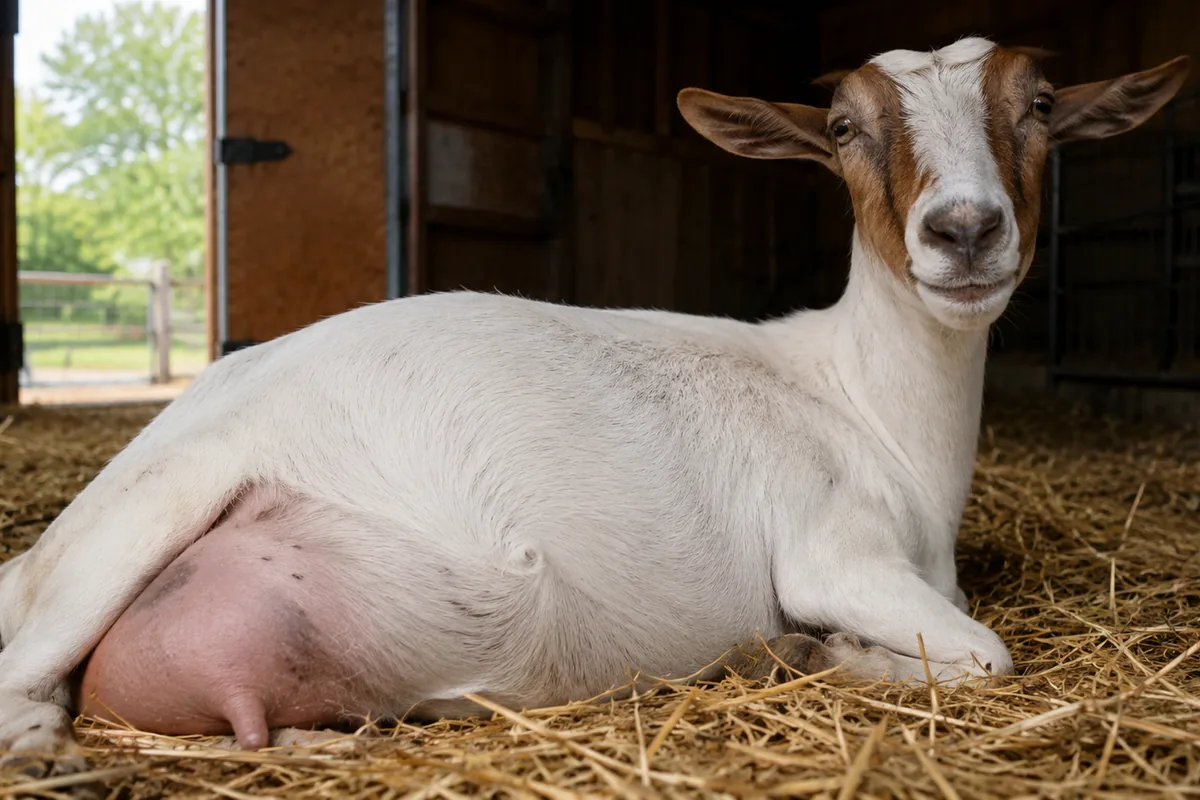
The udder is one of the most useful signs, especially in a first-time doe. A maiden doe who has never freshened will start developing an udder in the weeks before kidding, which is a strong indicator that kids are on the way.
One exception is a precocious udder, which can fill in a doe that was never bred.
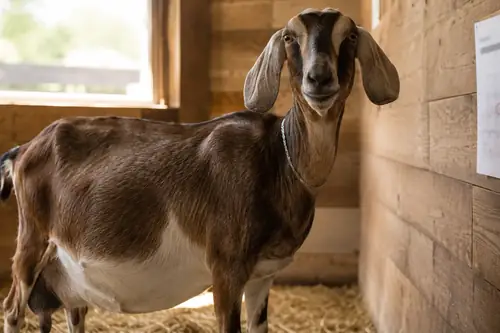
In the final six to eight weeks the signs become obvious. The belly is large and low, the udder fills out, and you may see the kids moving if you watch her flank while she is resting.
Pregnant or Just Fat?
This is the question that trips up the most owners, because a well-fed goat and a pregnant goat can look surprisingly similar. The reliable way to tell them apart is behavior, not body shape.
A fat doe keeps cycling. She will still come into heat every 18 to 21 days with all the usual flagging and calling, while a pregnant doe goes quiet and stops cycling entirely.
The shape of the belly also helps. Pregnancy tends to push the belly low and out to the right as the uterus grows, while general fat spreads more evenly over the body and along the back.
The udder is the tiebreaker. A doe developing or enlarging her udder is almost certainly pregnant, since extra body fat does not build udder tissue. When the signs are still ambiguous, move on to an actual test.
How to Confirm a Goat Pregnancy
When you need to know for sure rather than guess, several methods confirm a goat pregnancy with increasing accuracy. Most owners start cheap and simple.
At-home urine test kits made for sheep and goats are inexpensive and give results in minutes. They are a quick first step that works from a few weeks into pregnancy and saves a lot of belly-watching.
For a definitive answer, your vet has two excellent tools. A blood test can confirm pregnancy from around 30 days, and an ultrasound from roughly 45 days not only confirms it but counts the kids and estimates their age.
Whichever route you take, knowing the breeding date matters, because counting forward about 150 days gives you a due date to plan around. Confirming early lets you adjust her nutrition and prepare for kidding on time.
Is She Carrying Twins?
Goats are highly prolific, and twins are the norm rather than the exception, which is why so many owners wonder how many kids to expect. First-time does usually have singles, while mature does often have twins or triplets.
You cannot reliably count kids by eye. A huge belly might hold a single large kid, while a modest belly might surprise you with triplets, because so much depends on the doe and how the kids are positioned.
The only dependable way to count is a vet ultrasound, which can distinguish singles, twins, and triplets and helps you plan. Knowing the number matters, since does carrying multiples need more careful late-pregnancy nutrition and closer monitoring at kidding.
If imaging is not an option, simply prepare as though twins are likely. Have your kidding supplies ready early, and watch for the early signs of labor as her due date approaches.
Sources and Further Reading
Compiled and cross-checked against established livestock and extension references:
- University extension publications (Penn State, Oklahoma State, Maryland) on goat reproduction
- American Dairy Goat Association (ADGA) management resources
- Langston University, Meat Goat Production Handbook, reproduction chapter
- Merck Veterinary Manual, pregnancy diagnosis in small ruminants
Pregnancy diagnosis is part observation and part confirmation. Track the heat cycle, watch the belly and udder, and when it truly matters, let a test or your vet give you the certain answer.
Frequently Asked Questions
The simplest home method is to watch whether she returns to heat about 18 to 21 days after breeding. If she does not cycle back, she is very likely pregnant. You can confirm it with an at-home sheep and goat urine test kit, which gives results in minutes, and watch for supporting signs like a widening belly and a developing udder over the following weeks. For certainty, a vet blood test or ultrasound is the gold standard.
The first reliable sign, not returning to heat, shows up around three weeks after breeding. Visible physical changes come much later, with most does not looking obviously pregnant until the final six to eight weeks of the roughly 150-day pregnancy. Udder development in a first-time doe and a clearly widening belly are usually the most noticeable late signs.
The key difference is the heat cycle. A fat doe still comes into heat every 18 to 21 days, while a pregnant doe stops cycling. A pregnant belly also tends to drop and widen low on the right side as the kids grow, and a bred doe often develops or enlarges her udder, which a simply overweight goat does not. When in doubt, a urine test kit or a vet check settles it quickly.
Many pregnant does become noticeably calmer and more affectionate, eat more, and stop showing heat behaviors like tail flagging and loud calling. In late pregnancy they often rest more, move slowly, and seek out quiet spots. Behavior alone is not proof, since it varies a lot between goats, but a normally flirty doe who suddenly settles down after breeding is a good clue.
You cannot reliably tell twins from singles by looking, since belly size depends on the doe and the kids' position. The only sure way is a vet ultrasound, which can count and even age the fetuses, usually from around 45 to 90 days. Twins and triplets are very common in goats, so a wide, heavy belly in late pregnancy often does mean multiples, but confirm with imaging if it matters for your kidding plans.