| # | Product | Our Rating | ||
|---|---|---|---|---|
| 1 |  | Best OverallDurvet OB All-Purpose Lubricant | ★★★★★ | Check Price |
| 2 |  | Vetericyn Super 7 Ultra Navel Care Spray | ★★★★☆ | Check Price |
| 3 |  | Manna Pro Goat Colostrum Supplement | ★★★★☆ | Check Price |
Few things test a goat owner’s nerves like a doe who is due any day. She looks enormous, she is acting strange, and every odd stretch has you wondering if tonight is the night.
The good news is that does telegraph labor in a fairly reliable order, from changes you can spot weeks out to the unmistakable signs of the final hour. Learn the sequence and you can stop guessing.
This guide walks through the signs as they appear, the three stages of labor, and the handful of situations where a doe genuinely needs your help.
How Do You Know When a Goat Is Close to Giving Birth?
Start watching in the last month of the roughly 150-day pregnancy, counting from the breeding date. If you know that date, a gestation calculator gives you the expected window so the signs below have context.
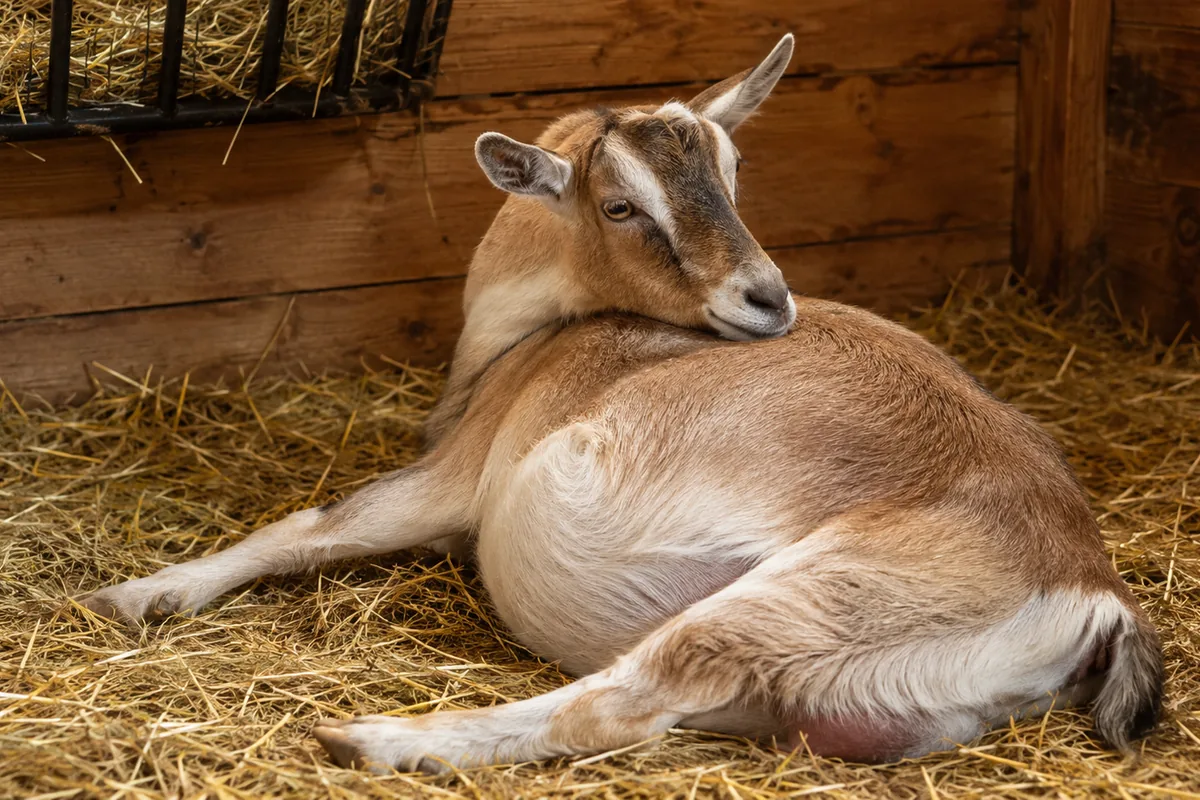
The earliest changes are gradual. The udder begins filling two to four weeks out, the belly drops lower, and the doe slows down and rests more.
| Sign | Typical Timing | What You Will Notice |
|---|---|---|
| Udder fills | 2-4 weeks before | Udder grows and firms, fills fastest in first fresheners late |
| Belly drops | 1-2 weeks before | Kids shift low and back, flanks look sunken |
| Tail ligaments soften | 12-48 hours before | The pencil-like cords beside the tail go soft, then seem to vanish |
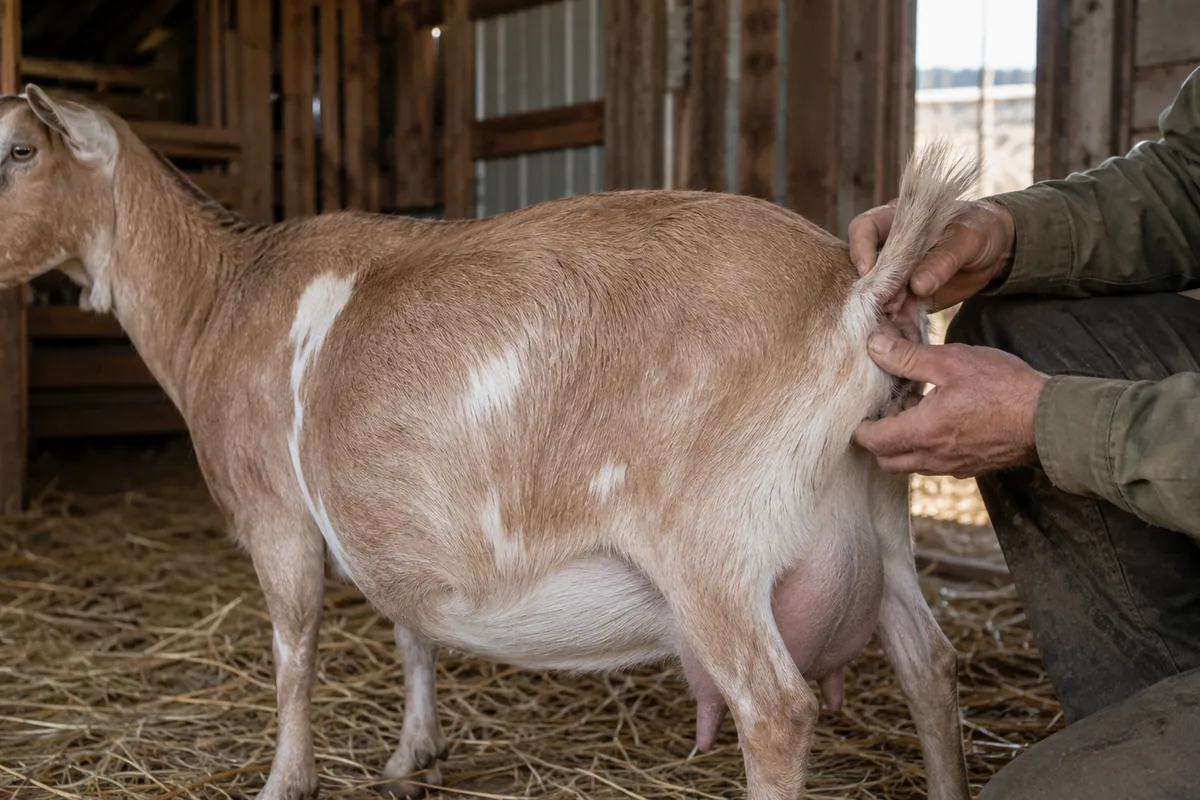
| Udder “strutes” | 12-24 hours before | Udder turns tight and shiny, teats point slightly out |
| Amber discharge | 12-24 hours before | A long string of thick amber or clear mucous |
| Nesting and restlessness | 2-12 hours before | Pawing bedding, up and down, staring at her flank |
The tail ligaments are the single most useful check, and they cost nothing. Pinch gently on either side of the spine just above the tail head once a day; when the firm cords you have been feeling all month seem to melt away, kids are usually less than a day out.
This is also your last call for setup. The kidding stall should be bedded and ready, and the doe should have had her CDT booster about four weeks earlier so her colostrum protects the kids.
Goat Labor Signs Week by Week
It helps to think of the last month as a countdown, because each week has its own normal. Here is what a typical doe shows as the due date approaches.
Four to five weeks out, the workload is yours, not hers. This is CDT booster time, the week to set up the kidding stall, and the week to start daily ligament checks so you learn what her firm ligaments feel like.
Two to three weeks out, the udder starts filling and the belly drops visibly lower. Experienced does often bag up earlier, while first fresheners may not show much udder until the final days.
The final week, the changes accelerate. The doe slows down, lies around more, may hollow out in front of the hips as the kids drop, and her vulva becomes longer and looser.
The final 24 to 48 hours belong to the ligaments, the strutted udder, and the discharge, covered in detail below. From here on, check on her every few hours and keep her in or near the kidding stall at night.
Two practical notes make this countdown work. Check ligaments at the same time every day so you feel the trend rather than a one-off, and log what you find, because next year her pattern will repeat almost exactly.
Signs of Goat Labor Within 24 Hours
The final-day signs are harder to miss. The udder strutes, going from full to tight and shiny like a balloon, and many does stream a long amber mucous string from the vulva.
Behavior changes just as clearly. A doe close to labor often walks away from the herd, claims a corner, paws obsessively at the bedding, and lies down and gets up over and over.
Many does will go quiet and inward, while others get unusually clingy or vocal, murmuring softly at their own sides. Going off feed in the last hours is common and normal.
One pattern worth planning around: goats love to kid at night. Does instinctively deliver in the dark when predators are less active, so if the ligaments are gone at evening chores, set an alarm or turn on the barn camera.
A temperature drop is the bonus sign many owners use. A doe’s rectal temperature often falls below about 101 degrees in the 12 to 24 hours before kidding, so a quick evening reading can settle the “tonight or not” question.
False Labor or the Real Thing?
Heavily pregnant does are dramatic, and plenty of owners lose a night’s sleep to a doe who was just rearranging her bedroom. Practice nesting days before real labor is common, especially in experienced does.
The difference is progression. False alarms fade after an hour or two, with the doe going back to eating and cud chewing, while real labor escalates from restless to focused to pushing.
The ligaments break the tie. A doe with firm ligaments who is pawing the straw is almost certainly rehearsing, while the same behavior with vanished ligaments and a strutted udder is the opening act.
Two final-stretch problems can masquerade as a doe “taking forever.” Pregnancy toxemia makes a late-term doe dull, wobbly, and off feed before labor ever starts, and it is a same-day vet call, not a wait-and-see.
The other is ringwomb, where the cervix simply fails to dilate. If a doe has been in obvious early labor for many hours and gentle checking finds no opening, she needs a veterinarian immediately.
What Are the Stages of Goat Labor?
Goat labor runs in three stages, and knowing which one you are watching keeps you calm. Most of the worrying happens during stage one, which is also the stage where nothing is wrong.
| Stage | What Happens | Normal Duration |
|---|---|---|
| Stage 1: Early labor | Cervix dilates, mild contractions, restlessness and nesting | 4-12 hours (longer in first fresheners) |
| Stage 2: Active labor | Hard pushing, bubble appears, kids delivered | A kid within ~30 min of hard pushing; 30 min between kids |
| Stage 3: Afterbirth | Placenta passes | 2-4 hours, up to 12 |
Stage two is unmistakable: the doe lies down, strains hard, and a fluid-filled bubble appears at the vulva. The normal presentation looks like a diver, two front hooves with a little nose resting on top of them.
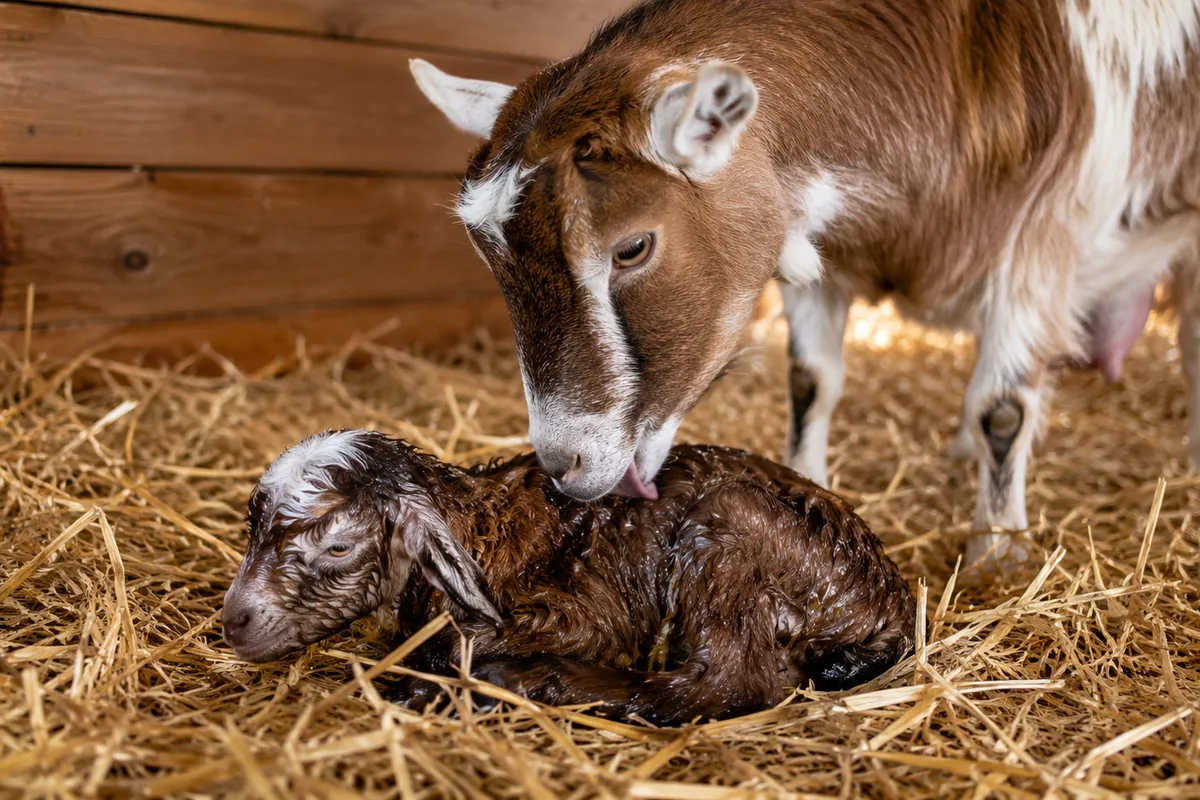
Once the first kid is out, expect any siblings within about 30 minutes each, and remember that twins and triplets are the norm, not the exception. The doe should be up, licking, and talking to each kid between deliveries.
Stage three is the placenta, which usually passes within a few hours. Let it happen naturally, never pull on it, and know that passing tissue between kids can fool you into thinking she is finished when another kid is still coming.
How Long Can Early Labor Last in Goats?
Early labor commonly runs 4 to 12 hours, and an anxious first freshener can stretch toward 24 hours while still being completely normal. As long as the doe is comfortable, occasionally eating, and progressing, patience is the right call.
The clock that actually matters starts with hard pushing. From the first real strain, you should see a bubble or feet within roughly 30 minutes, and a kid shortly after.
A doe who goes past her window entirely is a different question. If she sails days beyond day 155 with no labor at all, talk to your vet about whether inducing is appropriate rather than waiting indefinitely.
When Should You Help or Call the Vet?
The honest rule is that most kiddings need you to do nothing but watch. Somewhere around 9 in 10 deliveries finish without assistance, and early meddling causes more problems than it solves.
Step in, or call the vet, when you see hard pushing for 30 to 45 minutes with no progress, a tail or a single leg presenting, a nose with no feet, or a doe that simply stops trying. Those are malpresentations, and kids in the wrong position rarely fix themselves.
Here is how to read what you are seeing at the business end:
| What Presents | What It Means | Action |
|---|---|---|
| Two hooves, soles down, nose on top | Normal “diver” position | Let her work |
| Two hooves, soles up | Likely backwards (hind feet first) | Deliverable, but kid must come quickly once started |
| One hoof only | Other front leg folded back | Push back gently between contractions, fetch the leg |
| Nose but no feet | Both front legs back | Reposition; call vet if you cannot sort it fast |
| Tail or rump first | True breech, the dangerous one | Call the vet now |
| A tangle of 3+ legs | Twins coming together | Trace each leg to its body before pulling anything |
Backwards kids deserve one extra note: hind-feet-first deliveries are common in multiples and usually fine, but once the hips pass, the umbilical cord pinches, so the kid needs to come out promptly rather than leisurely.
If you do have to assist, clean hands and plenty of lubricant are non-negotiable, and you work between contractions, not against them. Reposition gently, and if you cannot sort out the puzzle of legs within a few minutes, stop and get professional help.
What to Do Once the Kids Arrive
The first hour after delivery has a short, important checklist. Work through it calmly and then get out of the family’s way.
Clear each kid’s nose and mouth the moment it lands, with a towel and a bulb syringe if the airways sound bubbly. Let the doe do the licking and talking, because that cleanup is how she bonds to and claims each kid.
Dip every navel in 7 percent iodine as soon as the cord is dry enough to handle. That one habit prevents navel ill, the joint infection that cripples kids weeks later.
Then make sure colostrum happens within the first hour or two. Watch for each kid to actually latch and swallow, and if one cannot, milk the doe and get it into the kid by bottle without waiting to see if things improve.
The doe needs her own minute of care. Offer warm water with a splash of molasses, refresh the hay, and feel her abdomen for any remaining kid once she seems finished.
Keep half an eye on her for the next day or two. The placenta should pass within 2 to 4 hours and never be pulled, and a retained placenta past 12 hours, a fever over 104, foul-smelling discharge, or refusing feed are the signs of metritis that justify a vet call.
Weigh the kids at birth and again at 24 hours if you want one number that catches trouble early. A kid that loses more than about 10 percent of its birth weight in the first day is not nursing enough and needs supplemental bottles immediately.
Most breeders wait at least two to three months after kidding before breeding a doe again.
Sources and Further Reading
Compiled and cross-checked against established veterinary and extension references:
- Merck Veterinary Manual, parturition and dystocia in goats
- Oklahoma State University Extension, Meat Goat Production kidding chapter
- Kentucky State University small ruminant kidding management resources
- Langston University, Meat Goat Production Handbook, reproduction chapter
Every doe writes her own version of this timeline, so keep notes on what her normal looks like. Watch the ligaments, count from hard pushing, and trust that she knows the job better than we do.
Frequently Asked Questions
The classic combination is softened or vanished tail ligaments, a tight and shiny udder, a long amber mucous string, and restless nesting behavior like pawing and getting up and down repeatedly. Many does also isolate themselves from the herd and talk softly to their sides. When the ligaments you could pinch yesterday seem completely gone, kids usually arrive within 12 to 24 hours.
Stage 1 is early labor, when the cervix dilates and contractions begin but no pushing happens yet. The doe acts restless, paws the bedding, stretches, yawns, gets up and lies down, and may stare at her flank or talk quietly to it. This stage commonly lasts 4 to 12 hours, and it is normal for a first-time doe to take the longer end of that range.
Early labor typically runs 4 to 12 hours, and up to 24 hours can still be normal in a nervous first freshener as long as the doe stays comfortable and progress continues. The line that matters is hard pushing: once a doe is actively straining, you should see a bubble or feet within about 30 minutes. Hard pushing with no progress for 30 to 45 minutes means call your vet immediately.
Goats can kid at any hour, but night and early-morning kiddings are famously common because does feel safer delivering in the dark, when predators are harder to spot. That instinct is why experienced breeders set up a barn camera or baby monitor near the kidding stall. Checking ligaments at evening chores tells you whether you should expect to lose sleep that night.
Most do not. Roughly 90 to 95 percent of goat kiddings finish without any human assistance, and intervening too early causes more harm than good. Your job is to watch quietly, make sure each kid gets cleared off and nursing, and step in only for real trouble: 30 to 45 minutes of hard pushing with no progress, a tail or single leg presenting, or a doe that gives up pushing entirely.