| # | Product | Our Rating | ||
|---|---|---|---|---|
| 1 |  | Best OverallREDMOND Goat Mineral Supplement (5 lb) | ★★★★★ | Check Price |
| 2 |  | Wholesome Harvest 16% Goat Feed (10 lb) | ★★★★☆ | Check Price |
| 3 |  | Manna Pro Goat Treats | ★★★★☆ | Check Price |
Celery is a crisp green vegetable made up almost entirely of water. That high water content makes it a light snack rather than a real source of feed.
Can goats eat celery safely, and how much is too much? Those are the two answers most owners want before handing a stalk over the fence.
Both answers are below, along with the parts nobody covers well. That means the leaves, the seeds, the juice, portion sizes by weight, and the signs of too much.
Can goats eat celery?
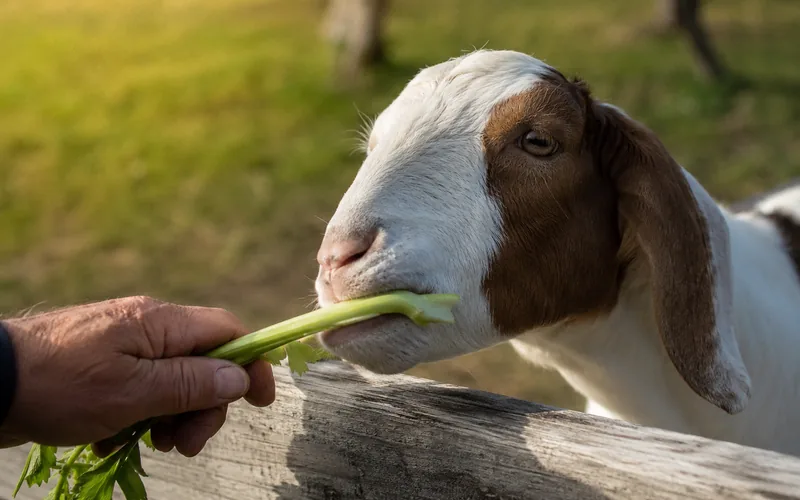
Goats can eat celery, and it sits among the safer vegetables they can eat. The plant holds no toxin, no anti-nutrient, and nothing that blocks mineral absorption.
That clean record covers the whole plant. Stalks, leaves, and seeds are all fine, which is not true of every vegetable they can reach.
The plant belongs to the Apiaceae family, alongside carrots and parsley. Both of those are safe too.
Compare that with onions, which damage red blood cells even in modest amounts. Nothing in the plant works that way.
The real limits are mechanical and about quantity. A long stalk can choke a small animal, and a big pile of any watery snack crowds out the hay a rumen needs.
Why a goat’s rumen sets the celery limit
A goat is a ruminant with a four-part stomach, built to break down fibrous plants. Food lands in the rumen first, where bacteria ferment tough plant fiber into usable energy.
Those microbes adapt slowly, and a sudden flood of easy-to-ferment material shifts rumen pH faster than the bacteria can adjust to.
But there’s a catch.
That pH swing has a name. The Merck Veterinary Manual lists ruminal acidosis among the nutritional diseases of goats, caused when rumen pH drops from too much fermentable carbohydrate.
Luckily, the stalks are low in sugar and mostly water, so a treat-sized serving barely registers. Tip a whole bag into a trough and the load changes completely.
What celery gives a goat nutritionally
WebMD puts celery at about 95 percent water, with only 14 calories in a cup of chopped stalks.
That water is the main thing it offers on a hot afternoon, adding moisture without sugar or starch.
Past the water, WebMD lists celery as a good source of Vitamin K, folate, and potassium. The stalks also carry Vitamin A, which supports immune function and vision, and Vitamin C, which helps with tissue repair.
A healthy animal also makes its own Vitamin C in the rumen, and Vitamin K too. It adds almost nothing on either count.
Which makes that a small bonus, not a reason to feed it. A goat’s real needs come from good hay, fresh browse, and a loose mineral mix, not from vegetables.
How much celery can a goat eat?
Keep celery and every other treat under 10 percent of the daily diet. For most adults that works out to two or three stalks per serving.
Portions by goat size
| Goat | Celery per serving | How often |
|---|---|---|
| Adult standard breed, 120–160 lb | 3 stalks, chopped | 3–4 times a week |
| Adult mini breed, 60–80 lb | 1–2 stalks, chopped | 2–3 times a week |
| Weaned kid over 3 months | Half a stalk, chopped small | Twice a week |
| Kid under 3 months | None | N/A |
Weight matters more than appetite. A 70-pound Nigerian Dwarf should get about half what a Boer buck gets.
The short version: portion by the animal, not by the bunch.
Kids and weanlings
Kids under three months should not get any at all, since their rumen is still developing. After weaning, half a stalk chopped fine twice a week is plenty, cut smaller than an adult portion because their throats are narrower.
Can goats eat celery leaves and stalks?
Both parts are safe. The leaves carry more nutrition, and the stalks need chopping before they go in the bucket.
Celery leaves
Celery leaves are safe, and many of them go for the leafy tops first. Those tops carry more calcium and Vitamin A than the pale inner stalks do.
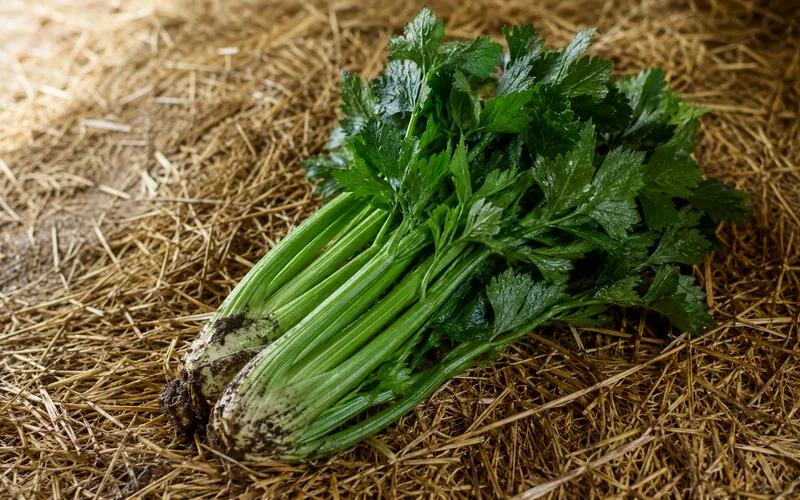
Keep the leaves instead of trimming them off, since they’re the most nutritious part of the plant.
Other leafy scraps work the same way, which is why lettuce trimmings belong in the same bucket.
Celery stalks
Stalks are safe too, and they are the part most people offer. They are also the part that causes choking, since a full stalk is long, stringy, and rigid.
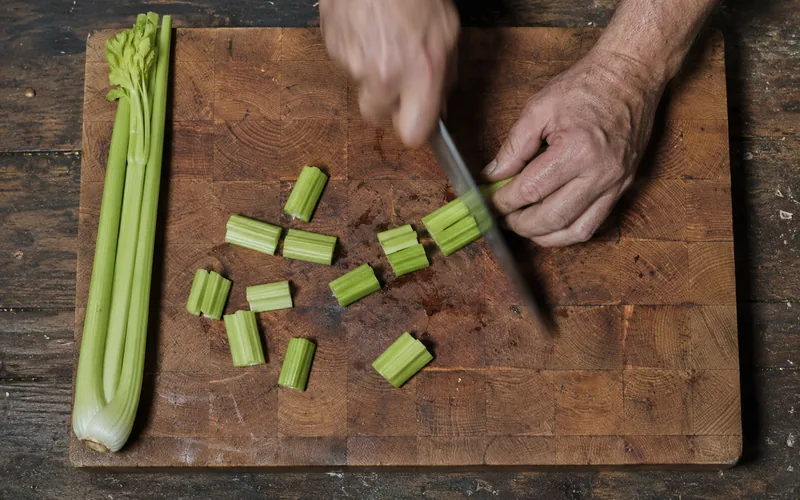
Cut each stalk into pieces about two inches long. Two inches is short enough to chew properly and too short to lodge in a throat.
Can goats eat celery seeds?
Celery seeds are safe in the amounts found on a bolted garden plant. The seed is the same one sold as a cooking spice, and it carries no toxin for livestock.
Concentrated celery seed extract is a different matter, so skip it, because the oils are strong and no safe livestock dose has been established.
Any goat that strips a bolted plant in the garden will be fine. One that gets into a jar of the dried seed needs watching.
Can goats eat celery juice?
Celery juice is safe in small amounts, but it does nothing useful. Juicing removes the fiber and leaves mostly water and a trace of sugar.
So why not just juice it for them?
A rumen runs on fiber, and there is none left, so the microbes get nothing to ferment.
Plain fresh water does the hydration job better and costs nothing.
How to prepare celery safely
Preparation takes two steps: a rinse, then a chop into two-inch pieces. Skipping either raises the risk of pesticide residue or choking.
Wash it first
Rinse the stalks under running water before they go in the bucket. Celery is one of the crops most likely to carry pesticide residue, and a rinse takes off most surface spray. Cucumbers need a firmer scrub, since residue settles into their waxy skin.
Chop to a safe size
Cut the stalks into two-inch pieces and separate the leaves. Goats eat fast and swallow large pieces of food whole, which is exactly how choking happens.
So what does that mean at the feed bucket?
Spread the pieces out rather than dumping them in one heap. A single heap turns into a competition, and animals that rush their food are the ones that choke.
Throw out any stalk showing mold or slime. Moldy food causes real illness, and the vet bill costs far more than a fresh bunch.
Can goats eat celery every day?
Feeding a small portion every day won’t hurt a goat, but it isn’t a habit worth building. Rotating treats spreads the nutrients wider and keeps the herd interested.
What this means for you: pick two or three days a week for it and use other vegetables on the rest. Chopped carrots or squash slot into that rotation well.
Can goats eat celery and carrots together?
Yes, and the pair works well together. Carrots supply more Vitamin A than celery, so a few chopped pieces of each give a wider mix of nutrients.
Can goats eat celery in winter?
In winter, it stays safe and keeps well in a cold shed for about two weeks. The winter problem is not safety, it is water intake.
Goats drink less when the water is near freezing, and a watery snack helps a little. Even so, it can’t replace a heated or frequently refilled bucket.
Avoid feeding it cold and wet straight from a freezing shed. Let it warm in the barn for an hour first.
Signs a goat has had too much celery
Loose stools show up first, usually within a day, as an animal that overate a watery vegetable passes soft, wet manure.
Watch also for one that walks away from the hay feeder. Filling up on treats leaves less room for the forage a rumen actually needs.

Bloating and gas can follow a large serving. WebMD notes that celery is high in mannitol, which can cause bloating and upset sodium balance when eaten in excess.
When to call a vet
Pull the celery and offer plain hay and water if you see any of these signs, and most cases settle within a day.
Call a vet if the goat stops chewing its cud, the left flank stays tight and drum-like, or the animal will not stand. Those signs point to bloat, which moves fast.
Final thoughts
Celery is a low-risk treat for goats as long as you chop it and keep the portion small. Every part of the plant is safe, from the ribs to the leafy tops to the seeds.
What celery will not do is feed a goat. Hay, browse, and a loose mineral mix are the real diet, while the stalks add water and a little variety.
Start with one chopped stalk if yours have never tried it. Increase the portion if the manure looks normal the next day.
Frequently Asked Questions
Goats should never eat onions, garlic, or leeks, which damage red blood cells. Skip rhubarb leaves and the foliage of potatoes and tomatoes, since that foliage carries toxic solanine. Avocado stays off the list as well. Celery has none of these problems in any part of the plant.
Internal parasites, especially the barber pole worm, are widely considered the leading cause of goat deaths. Digestive emergencies such as bloat and enterotoxemia come next. Celery does not cause either one directly, but a large pile of any watery vegetable can trigger the upset that leads to bloat.
Most goats reach for sweet, crunchy food first, which means carrots, apples, squash, banana peels, and celery leaves. Grain and commercial goat treats rank even higher, though those need tighter limits. Popularity is not the same as safety, so keep every favorite to a small portion.
Goats handle most kitchen and garden scraps well, including carrot tops, celery leaves and ends, squash rinds, cucumber peels, and lettuce trimmings. Leave out onion and garlic skins, potato peels, and anything moldy. Rinse the scraps and chop the long, stringy pieces before feeding.