| # | Product | Our Rating | ||
|---|---|---|---|---|
| 1 |  | Best OverallREDMOND Goat Mineral Supplement (5 lb) | ★★★★★ | Check Price |
| 2 |  | Wholesome Harvest 16% Goat Feed (10 lb) | ★★★★☆ | Check Price |
| 3 |  | Manna Pro Goat Treats | ★★★★☆ | Check Price |
Few treats move a herd as fast as the rustle of a carrot bag. The root is cheap, keeps for weeks, and a garden glut always outpaces a household.
What trips people up is everything past the obvious. Most advice covers the orange root and stops, leaving the feathery tops, the seed heads on a bolted plant, and how much is too much for a 120-pound doe.
Can goats eat carrots?
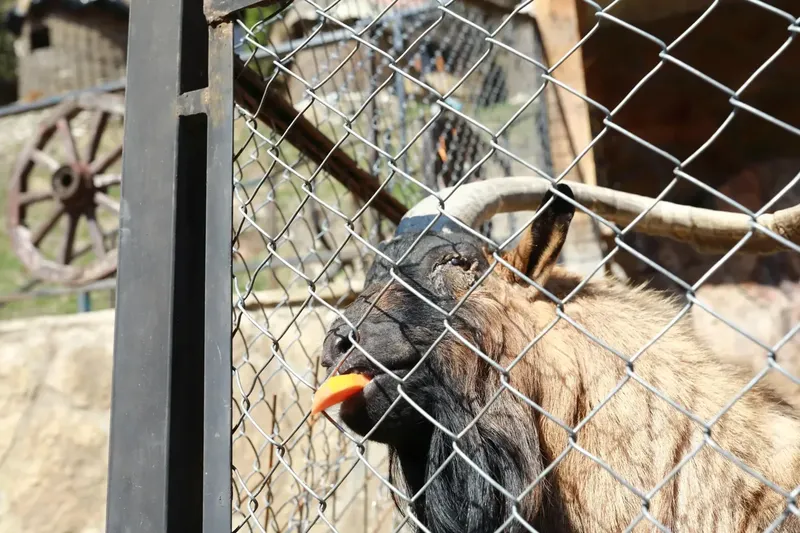
Goats can eat carrots, and among common garden vegetables this one carries about as clean a safety record as you will find. No part of the plant contains a toxin, an anti-nutrient, or a compound that interferes with mineral absorption.
That sets carrots apart from most treats. No thyroid concern like brassicas, no solanine like nightshade foliage, and no gas-forming reputation to manage.
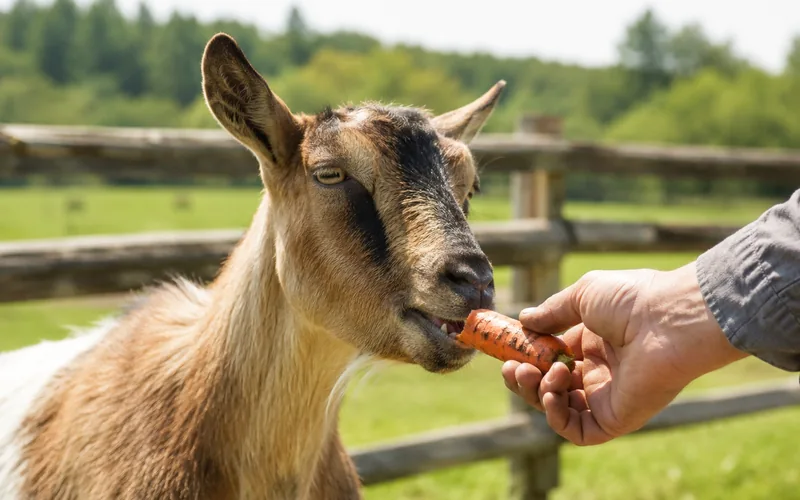
The real risks are mechanical and quantitative. Hand a whole carrot to a small goat and you’ve got a choking hazard, and tip in a bucket at once and you’ve got a sugar load no rumen was built to process in one sitting.
Why carrots suit a ruminant digestive system
A goat is a ruminant with a four-compartment stomach, built to break down fibrous plant material that most animals cannot use. Feed enters the rumen first, where a dense population of bacteria ferments cellulose into usable energy.
Those microbes are why portion size matters more than the food itself. They’re slow to adapt, so a sudden flood of easily fermented sugar shifts rumen pH faster than the population can keep up with.
Carrots are moderately fibrous and roughly 88 percent water, which keeps that load light at treat-sized portions. Ten pounds dumped in a trough is a different animal, behaving more like a grain overload and triggering acidosis and scours.
What carrots actually deliver nutritionally
The headline nutrient is beta-carotene, the pigment responsible for the orange color. Plant foods supply carotenoids that the body converts into retinol, and the NIH Office of Dietary Supplements identifies beta-carotene as the most significant provitamin A carotenoid in the diet.
That conversion matters for livestock. The same agency notes that vitamin A supports vision, immune function, and reproduction, and that deficiency shows up as night blindness and greater susceptibility to infection.
Past the carotenoids, carrots bring potassium, vitamin K, a little vitamin C, and roughly 3 grams of fiber per medium root. That makes them a nutritionally honest treat rather than empty calories, though none of it replaces a mineral program.
Goats on well-managed pasture rarely run short on vitamin A. The treat earns its keep in winter, when dry hay has lost much of its carotene content.
Can goats eat carrot tops and greens?
Carrot tops are safe, nutritious, and frequently the part a goat reaches for first. The persistent claim that carrot greens contain toxic alkaloids traces back to confusion with wild relatives in the same family, not to the cultivated vegetable in a supermarket bunch.
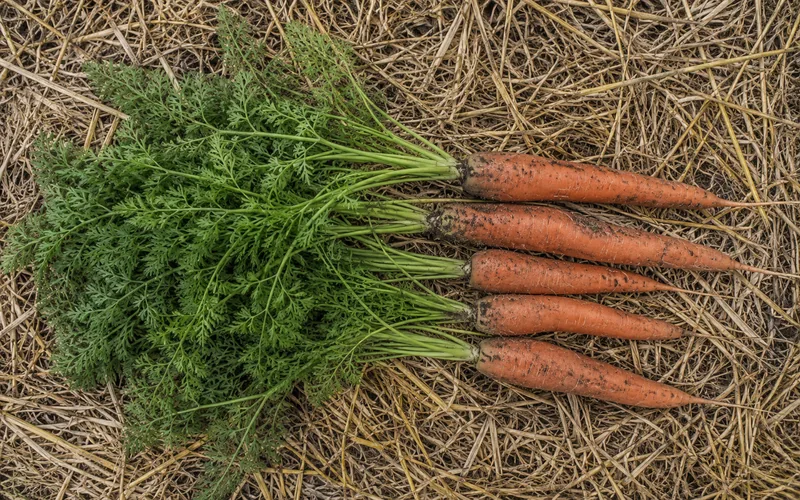
The greens carry more calcium and vitamin C than the root, plus a leafy texture that suits an animal built for browsing rather than grazing.
If you grow carrots, hand the tops over fresh rather than composting them, the same way many keepers save celery leaves that would otherwise hit the bin.
Can goats eat carrot seeds?
Carrot seeds are non-toxic and pose no danger in any amount a goat would encounter. A plant that bolts in a second-year bed can be fed whole, umbel and all, without stripping the seed heads.
Palatability is the real limit. The seeds are tiny, dry, and strongly aromatic, so most goats strip the stalks and leave the seed heads alone.
One caution applies to foraging rather than feeding. Wild carrot looks similar to poison hemlock, so identify any volunteer umbel plant before letting a herd browse it.
Raw or cooked: which is better?
Raw wins on nearly every measure. It preserves the full carotenoid and vitamin C content, and the crunch drives the saliva production that helps buffer the rumen.
Cooked carrots are safe, just softer and less interesting to most goats. Leftovers are fine once cooled, as long as there’s no butter, salt, oil, or seasoning on them.
Anything glazed, salted, or cooked with onion is a hard no, since onion damages red blood cells in ruminants.
How many carrots can a goat eat?
Treats of every kind should stay under roughly 10 percent of daily intake, which for a standard-sized adult goat works out to one or two medium carrots per day. Miniature breeds such as Nigerian Dwarfs should get about half that.
| Goat | Carrot portion per day | Frequency |
|---|---|---|
| Standard adult (100–150 lb) | 1–2 medium carrots | Daily is fine |
| Miniature breed (50–75 lb) | Half to one medium carrot | Daily is fine |
| Weaned kid | A few small chopped pieces | 3–4 times a week |
| Pregnant or lactating doe | 1–2 medium carrots | Daily, alongside full ration |
| Unweaned kid | None | Milk and starter only |
The rest of the diet does the real work. Good-quality hay or browse, clean water, a goat-specific mineral, and any grain the herd’s stage of production calls for should account for the other 90 percent.
Can goats eat carrots every day?
Daily carrots are fine at the portions above, and nothing accumulates. Unlike brassicas, there’s no compound that builds up in the system with repeated feeding.
Variety is still worth pursuing. Rotating safe vegetables spreads the nutrient profile wider and keeps a picky animal interested, which is why keepers often alternate carrots with bell peppers or apple slices.
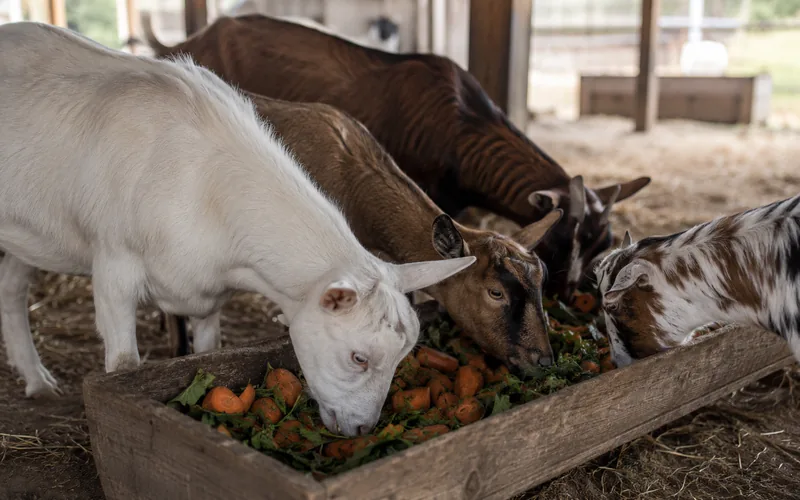
One situation needs a second look. An overweight goat with limited exercise does not need the extra sugar, and cucumber slices serve the same purpose at a fraction of the carbohydrate.
How to prepare and serve carrots safely
Wash, then chop. Almost every carrot problem traces back to a piece that was too big.
Washing removes soil and any pesticide residue, particularly on supermarket produce. Cut the carrots lengthwise or into 2 to 3 inch chunks rather than passing over a whole root.
Choking is the most common carrot-related emergency, and it happens when a goat bolts a piece sized for a human bite. Goats have no upper front teeth, so they can’t break a hard root down nearly as well as their enthusiasm suggests.
Discard anything soft, slimy, or spotted with mold. Mycotoxins are a serious hazard for ruminants, and the same rule that makes moldy hay dangerous applies just as firmly to vegetables past their prime.
Can baby goats eat carrots?
Kids should not get carrots until they are eating solid food reliably, which typically means somewhere past six to eight weeks of age. Before that point their rumen is still developing, and milk plus a starter ration is what builds it properly.
Once a kid eats hay and grain consistently, small chopped pieces make a reasonable introduction. Start with two or three thumbnail-sized pieces and watch the manure the next day for softening.
Cut smaller than instinct tells you to. A kid’s esophagus is narrow, and a chunk an adult would swallow without trouble is a genuine obstruction risk in a two-month-old.
Signs your goat has had too many
Loose manure is the earliest signal, usually within 12 to 24 hours of an oversized portion. It is a mild rumen disturbance rather than a poisoning, and it resolves once you pull the treat and let hay reset the fermentation.
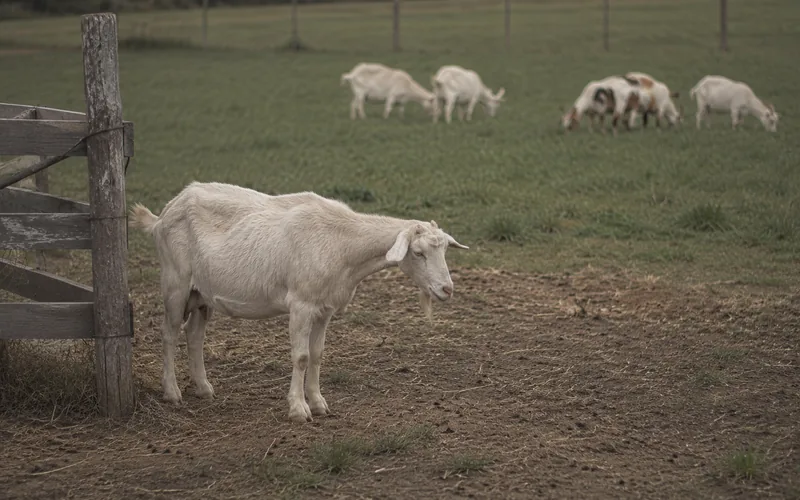
Watch for a distended left flank, reluctance to eat, teeth grinding, or a goat standing apart from the herd. Those point toward bloat or acidosis and warrant a vet call rather than wait-and-see.
New keepers sometimes read a single loose stool as a carrot allergy. True allergies in goats are vanishingly rare, and quantity is almost always the actual explanation.
Can goats eat carrots and tomatoes together?
Yes, but only the ripe tomato fruit. The vine, leaves, and any green unripe fruit carry solanine and belong on the avoid list.
Both count toward the same treat allowance, so pull the stems and leaves off first. Goats will happily eat the part that hurts them.
Can goats eat carrots and apples together?
Yes, and this pairing is popular for good reason. Both are non-toxic and crunchy, and neither carries the gas risk of a brassica.
Halve the portion of each so the combined amount still lands inside the treat allowance. Apple seeds contain trace amygdalin, so coring larger quantities is sensible.
Vegetables to skip entirely
Onions, garlic, and leeks damage red blood cells, while rhubarb leaves carry oxalates and potato foliage carries solanine. Avocado and the wider nightshade family round out the avoid list.
Carrots share none of that chemistry, which is what makes them about as low-risk as the category gets.
Final thoughts
Carrots earn their reputation. They’re safe root to tip, they deliver real provitamin A rather than filler, and every part of the plant can go over the fence.
Keep the portion honest, chop before serving, and let hay and browse carry the diet.
Frequently Asked Questions
Goats should never eat onions, garlic, or leeks, which damage red blood cells, and they must avoid rhubarb leaves plus the foliage of potatoes and tomatoes because of toxic solanine. Avocado is off the list entirely. Carrots sit at the opposite end of that spectrum, with no toxic compound in the root, the stem, or the greens.
Carrots are one of the strongest all-round choices because they combine high provitamin A content, a texture goats enjoy chewing, and zero toxic compounds in any part of the plant. Squash, pumpkin, and celery rank close behind. The best vegetable is ultimately the one your goats will actually eat in a small, consistent portion alongside good hay.
The most dangerous plants for goats include azalea, rhododendron, mountain laurel, yew, oleander, and wilted cherry or plum leaves, which release cyanide as they dry. Among foods, avocado, chocolate, and anything moldy pose real risk. Nothing in the carrot plant belongs on that list, which is what makes it such a reliable treat.
Internal parasites, particularly the barber pole worm, are widely considered the leading cause of goat deaths, with digestive emergencies such as bloat and enterotoxemia close behind. Carrots do not cause either problem directly, but dumping a large volume of any sugary treat into a rumen at once can trigger the kind of upset that leads to bloat.