| # | Product | Our Rating | ||
|---|---|---|---|---|
| 1 |  | Best OverallWeaver Leather Livestock Goat Collar | ★★★★★ | Check Price |
| 2 |  | Manna Pro Goat Treats | ★★★★☆ | Check Price |
| 3 |  | HoAoOo Pet Training Clicker with Wrist Strap | ★★★★☆ | Check Price |
Yes, goats can jump high. If you’ve ever watched a goat clear a fence you thought was tall enough, you already know this firsthand.
Understanding how high different breeds can jump is the first step to keeping your herd where it belongs. Here’s what you need to know about goats and their jumping ability.
Can goats jump high?
The vast majority of goats can comfortably jump 4 to 5 feet from a standing position. Give them a running start or something to push off of, and they can clear even more.
Their powerful hind legs and lightweight frames make them natural athletes.
Domestic goats are natural jumpers. Their ancestors spent thousands of years scrambling up rocky hillsides across central Asia, and that athletic ability hasn’t gone anywhere.
Not every goat is a jumper though. Some goats never leave the ground unless they have a reason to, and others start testing fences on day one.
Personality plays a huge role in whether you end up with an escape artist or a couch potato.
Goats are also climbers, not just jumpers. They’ll scale rock piles, lean against fences to bend them down, and squeeze through any gap they can find.
Jumping is just one tool in their escape arsenal.
What’s the average height a goat can jump?
The average goat clears about 4 feet without much effort. Nigerian Dwarf goats and Alpine breeds are the most athletic jumpers and can hit 5 feet or higher when motivated.
Boer goats are heavier and stockier, so they tend to jump less. But don’t count on a Boer staying put either, because a bored Boer will still test your fencing.
How high can different breeds jump?
Nigerian Dwarf goats are the surprise athletes of the goat world. Despite their small size, they have compact, muscular builds that let them clear fences that look way too tall for them.
Pygmy goats are nimble and playful, but their short legs limit how high they can get. A solid 4-foot fence will usually contain them without trouble.
Boer goats are heavy and rarely bother jumping at all, though they might push right through a weak panel instead. Some goats are athletic enough to climb steep hillsides at extreme angles, which gives you a sense of their natural ability.
Why do goats like to jump?
Goats jump for the same reasons they do most things: curiosity and survival instinct. In the wild, mountain goats navigate cliffs and ledges to escape predators, and goats can even be tamed while retaining that athletic drive in domesticated breeds.
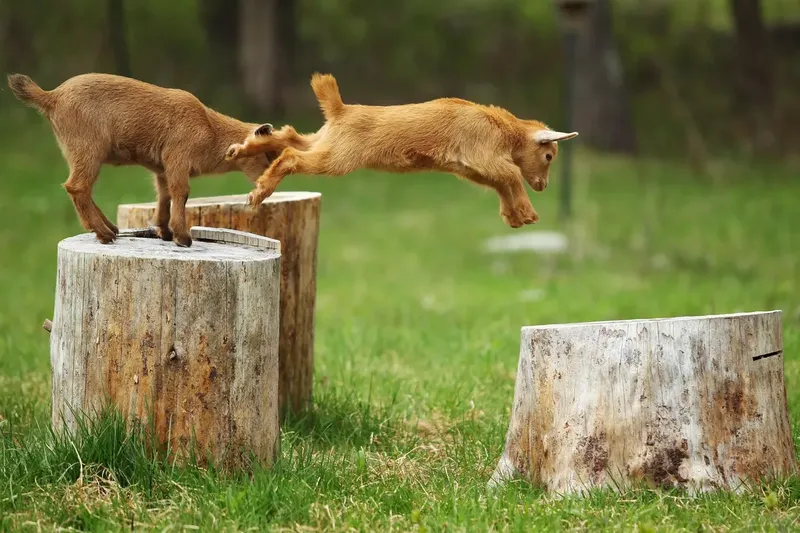
Young goats especially love jumping as a form of play. Kids will bounce off rocks, stumps, and each other all day long, and it’s how they build the muscle and coordination they need as adults.
Jumping also helps goats stretch their muscles and keep their joints loose. A bored goat stuck in a small pen with nothing to do will test every boundary it can find.
It’s actually a good sign of health when kids are leaping off everything in sight. That same energy is why house training baby goats is nearly impossible.
What are the risks associated with goats jumping?
Your biggest risk? escape. A goat that clears your fence is exposed to predators like foxes, traffic, toxic plants, and angry neighbors whose gardens just became a buffet.
Injuries can happen too. Goats can break legs landing on hard surfaces or get tangled in fence wire at the top of a jump.
Horned goats sometimes catch their horns in fencing during a jump attempt, which can lead to neck injuries.
How to prevent goats from jumping?
Build your fences at least 4 feet tall, and go to 5 feet for agile breeds like Nigerians, Alpines, and Nubians. Cattle panels attached to sturdy T-posts are one of the most reliable and affordable options for most setups.
A strand of electric wire along the top of the fence works as a strong deterrent. Keep anything goats could use as a launching pad, like stumps, feeders, or rock piles, well away from fence lines.
Woven wire and cattle panels are your best options because they don’t give goats any footholds. Board fences with horizontal rails are basically ladders for goats.
Bored goats jump more, so providing browse, toys, and companionship helps reduce escape attempts. Goats that bond with their owners and have enrichment are less likely to test boundaries.
Understanding how goats can be tamed also helps, since a well-socialized goat is less motivated to escape. Avoid chain-link fencing with horizontal rails because goats will use those rails as steps to climb over.
They don’t just jump, they climb
Jumping isn’t even the main escape method for most goats. Climbing is the real problem.
Goats will stand on hind legs, wedge hooves into gaps, and use anything nearby as a step stool to get over or onto structures. You can redirect this energy by training a goat to pull a cart or teaching other commands.
Keep hay bales, equipment, and dog houses away from fence lines. Anything a goat can stand on near a fence becomes a launchpad, and they’re smart enough to figure that out fast.
I’ve watched a goat use a turned-over water trough as a stepping stone to clear a fence that had held her for months. A goat with the right temperament may also become friends with your dog, giving it a companion that reduces the urge to escape.
What kind of goats jumps the most?
Nigerian Dwarf goats and Pygmy goats are the worst offenders. These are the same breeds popular for urban goat keeping, so fencing is especially important in city settings.
They’re small, light, and loaded with energy, which is the perfect recipe for fence clearing.
Alpines and Nubians are strong jumpers too, despite their larger size. Boer goats are the least likely to jump thanks to their heavy build, but every herd has that one individual goat who treats fencing as a personal challenge.
Final Thoughts
Plan your fencing around the most athletic breed you own, not the laziest. A 5-foot woven wire fence with a hot wire on top will hold the vast majority of goats.
Give your goats things to climb inside their pen so they have less reason to test the boundaries. Large rocks, wooden platforms, and old cable spools make great playground structures.
A goat with plenty of browse, companionship, and things to do is far less likely to go looking for greener pastures on the other side of the fence.
Some goats are just born escape artists no matter what you build. For those individuals, adding a strand of electric wire or switching to a taller panel setup is usually the final fix.
Frequently Asked Questions
Goats can jump high. They're able to jump over obstacles that are up to five feet tall. Goats have strong muscles in their hind legs that allow them to propel themselves into the air. They also have hooves that are well-suited for gripping surfaces.
The average goat clears about 4 feet without much effort. Nigerian Dwarf goats and Alpine breeds are the most athletic jumpers and can hit 5 feet or higher. Boer goats are heavier and tend to jump less.
One theory is that goats jump because it helps them to escape predators. In the wild, goats are constantly on the lookout for danger, and jumping gives them a quick way to get out of harm's way.
The biggest risk is escape, which exposes goats to predators, traffic, and toxic plants. Goats can also break legs landing on hard surfaces or catch their horns in fence wire during a jump attempt.
Goats jump because they need exercise, stimulation, and because it's fun for them. Jumping also helps them stretch muscles and keep joints loose, and young goats bounce around constantly as part of normal healthy play.
Rather than training goats to jump, focus on fencing that keeps them contained. Use woven wire or cattle panels at least 5 feet tall for agile breeds, and add a single strand of electric wire along the top to discourage fence-testing.