| # | Product | Our Rating | ||
|---|---|---|---|---|
| 1 |  | Best OverallWeaver Leather Livestock Goat Collar | ★★★★★ | Check Price |
| 2 |  | Manna Pro Goat Treats | ★★★★☆ | Check Price |
| 3 |  | HoAoOo Pet Training Clicker with Wrist Strap | ★★★★☆ | Check Price |
Scroll through enough animal pages and you’ll eventually meet the goat glued to a wall that should be impossible to stand on. The caption always carries a number, and that number keeps creeping upward with every repost.
Eighty-nine becomes ninety, ninety becomes ninety-one, and somewhere along the way a goat is supposedly climbing 92 degrees. It sounds astonishing right up until you hold the figure against a protractor.
Here’s what that angle would actually demand, the slopes goats genuinely conquer, and the exact point where the viral math quietly falls apart.
Can Goats Climb 92 Degrees?
Goats cannot climb 92 degrees, because no surface at that angle exists for them to climb in the first place.
Picture a wall standing perfectly straight up. That’s 90 degrees, the steepest a flat face can reach.
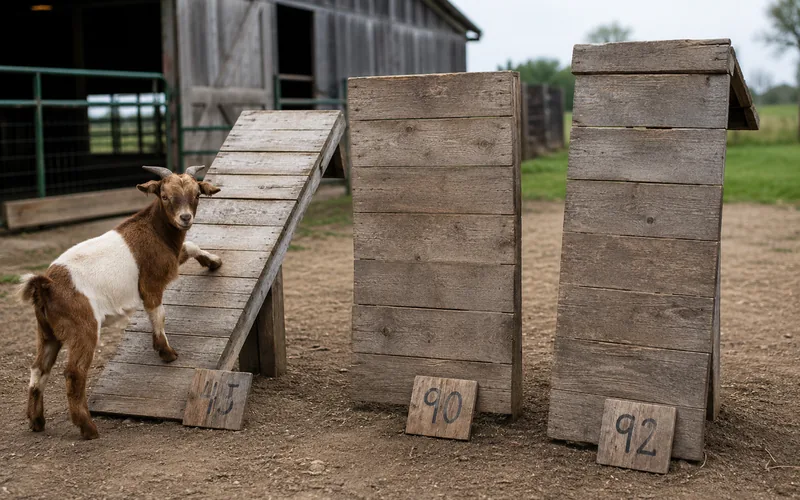
Anything past 90 stops leaning away from you and starts leaning back over you. By 92 degrees the surface has tipped into a low overhang, the kind of roof a climber dangles beneath on ropes.
A goat has no way to hang upside down from a ceiling. So the honest answer is that the famous 92-degree climb was never a climb at all.
Why 92 Degrees Breaks the Math
Put simply, slope angles top out at 90 degrees, so 92 is an overhang, not a climb.
The confusion comes from treating “steeper” as a number that can rise forever. But slope angles run into a hard ceiling.
Degrees measure how far a surface tilts up from level ground. Flat dirt sits at zero, a comfortable ramp at 45, and a sheer cliff face at 90.
There’s simply nowhere left to tilt past vertical without folding the surface back on itself. Every degree beyond 90 carves out more overhang and leaves less climbable wall.
That single rule is what unravels the meme. A “92-degree slope” describes an overhang you’d need ropes to hang from, not a steeper hill a goat could charge straight up.
| Slope angle | What it looks like | Can a goat climb it? |
|---|---|---|
| 30 to 45 degrees | Steep hillside or ramp | Yes, with ease |
| 60 degrees | Rugged rock slope | Yes, the realistic limit for sustained climbing |
| 80 to 89 degrees | Near-vertical cliff with ledges | Short bursts only, using cracks and footholds |
| 90 degrees | Dead-vertical wall, no footholds | No, nothing to push against |
| 92 degrees | Overhang leaning past vertical | Impossible for any goat |
The Real Angles Goats Can Handle
The short answer: wild mountain goats sustain about 60 degrees, domestic goats 40 to 45.
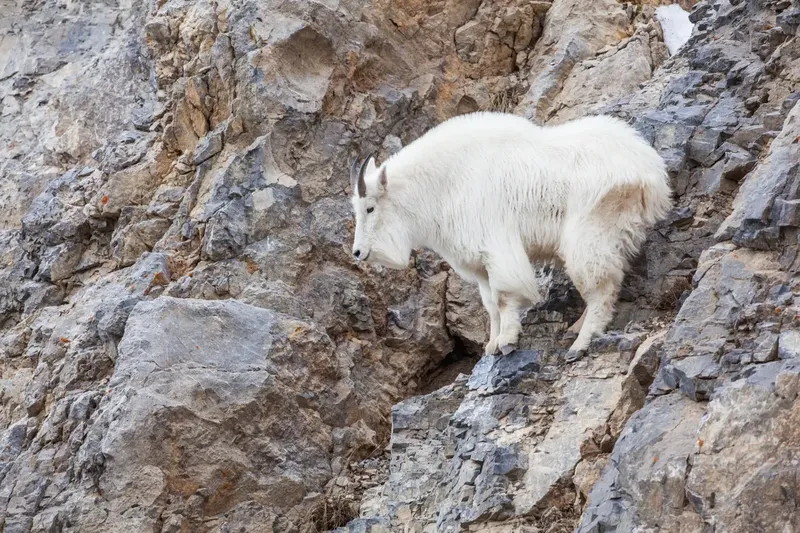
Strip away the hype and the true numbers are still impressive. Wild mountain goats work slopes around 60 degrees for long stretches without breaking stride.
That grade would send most hikers crawling, yet it sits comfortably short of vertical. On shorter scrambles these animals push far closer to a cliff face, stringing together ledges, seams, and slim ramps as they go.
The species behind the legend is Oreamnos americanus, the Rocky Mountain native built for exactly this terrain. Field observers watch it cross pitches that would need ropes and a harness for a person.
Domestic goats run a gentler version of the same program. A fit backyard goat treats a 40 to 45-degree bank as easy ground and turns woodpiles, boulders, and barn roofs into playground equipment.
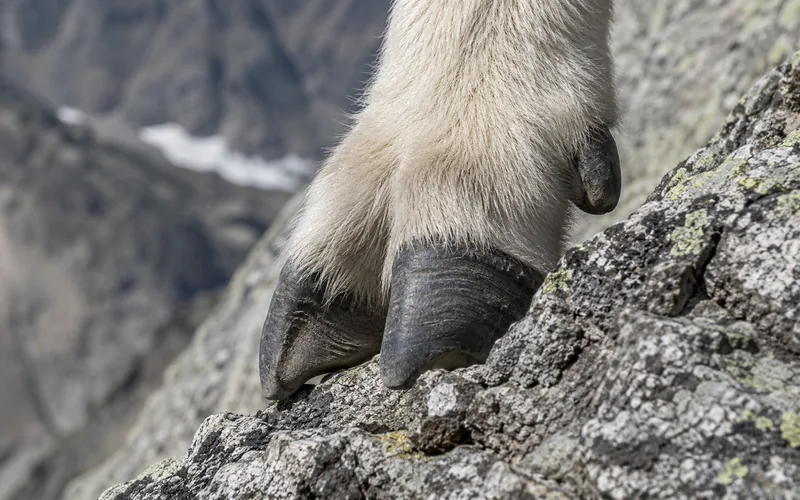
The key word is sustained. No goat holds a vertical face for long, but almost any goat will fire up a steep pitch for a heartbeat to land a foothold, and that flash of motion is exactly what a photo freezes and exaggerates.
What Makes Goats Such Good Climbers
Here’s what matters most: their split hooves and low center of gravity.
All of this traces back to the foot. Each goat hoof divides into two separate toes that spread and pinch to match the shape of the rock.
Every toe pairs a hard outer shell of keratin with a soft, rubbery pad underneath. The firm rim hooks onto thin edges while the cushioned center grips bumps, working much like the sole of a climbing shoe.
Higher up the leg sit two dewclaws that barely register on flat pasture. On a steep pitch they jab into the surface as brakes, killing any backward slide.
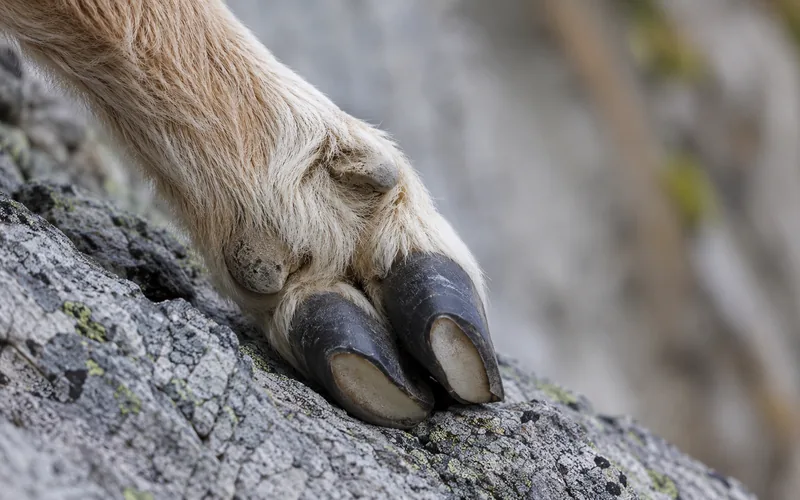
Goats pair that footwear with a low, compact frame that keeps their weight pressed close to the slope. The same balance that lets them scale a slanted tree trunk keeps them steady on a ledge built for nothing bigger than a bird.
Power finishes the package. Spring-loaded hindquarters let a goat launch several feet straight up to reach the next foothold, and on a cliff that thrust simply points upward instead of forward.
National Geographic has clocked those standing leaps at up to 12 feet, an explosive boost that turns a blank stretch of rock into a reachable next hold.
Mountain Goats and Ibex vs Backyard Goats
The key difference is specialization, wild ibex and mountain goats are cliff experts.
Not every goat earns the cliff-dweller reputation, and the difference matters when a viral clip lands in your feed. True specialists like the mountain goat and the alpine ibex spent millions of years evolving for vertical stone.
Their oversized hooves, dense muscle, and split-second reflexes are purpose-built, and a newborn kid can follow its mother across a ledge within days of birth. Ibex famously scale the near-vertical face of Italy’s Cingino Dam to lick mineral salt straight off the masonry.
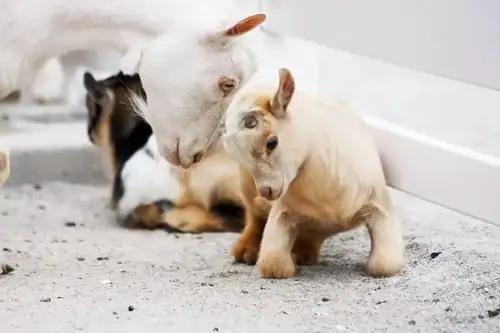
Backyard breeds inherit a diluted copy of that toolkit. Nigerian Dwarfs, Pygmies, and Alpines rank among the bolder climbers in any herd and will summit whatever you leave lying around.
Still, a pet goat on a stacked pallet isn’t doing ibex work on a dam wall, no matter how the frame is cropped. Remember, too, that wild mountain goats are genuinely powerful animals, with rare but documented attacks on hikers when a dominant billy feels cornered.
How 92 Degrees Became a Meme
If goats top out near 60 degrees, why do the photos scream vertical? Most of the illusion is built by the camera, not the climber.
A long lens compresses depth, flattening a slope until foreground and background pile into a single plane. A 60-degree hill shot from far below can read as a dead-straight wall.
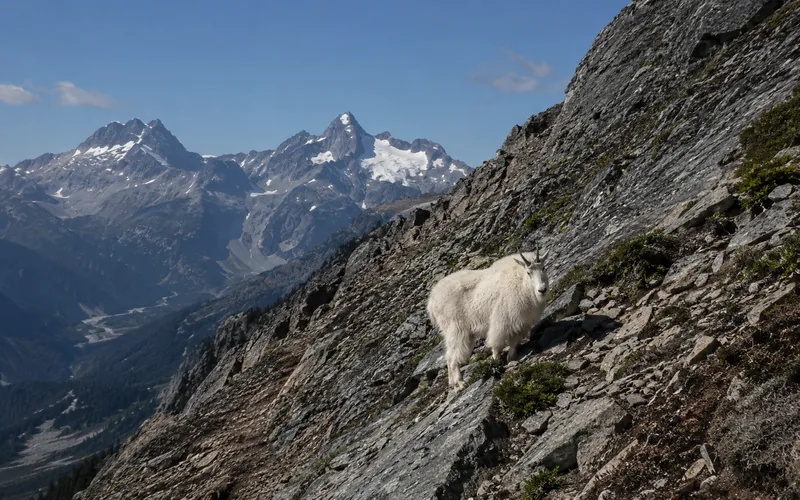
Cropping seals the trick. Cut away the sky, the valley, and any familiar object, and the viewer loses every clue about which way is actually up.
From there it becomes a game of telephone. Each reshare nudges the guessed angle a notch higher, which is precisely how one picture circulates as 89, then 90, then 91, and finally a triumphant 92.
A Note on 92 Degrees Fahrenheit
Quick clarification: 92 degrees Fahrenheit is fine for goats, 92 degrees of slope is not.
A smaller group of searchers means something completely different by the number: 92 degrees of summer heat. Read that way, the real question is whether 92 degrees is too hot for a goat.
Goats tolerate warm weather better than cold, and a healthy adult handles temperatures in the low 90s Fahrenheit as long as it has shade, airflow, and constant fresh water. Trouble starts when high heat pairs with high humidity, which is when panting, drooling, and listlessness flag heat stress.
Shade and misting beat a dip in the pond, since a soaked goat risks hoof and skin infections.
So a goat can stay perfectly active at 92 degrees of temperature, even though it can never climb 92 degrees of slope. Same number, two very different questions.
What This Means for Your Fences
Debunking the angle has a real payoff for owners. If your goats blast up 45-degree banks and bound off steep rock, your fencing has to respect that reach.
Anything climbable near the perimeter turns into a launch pad. A leaning pallet, a packed snowdrift, or a sloped shed roof can hand a determined goat the extra height to clear a fence you assumed was tall enough.
The smarter move is to work with the instinct, not against it. A stable rock pile or tiered platform gives the herd a safe place to burn energy, wear their hooves down, and beat the boredom that fuels escape attempts.
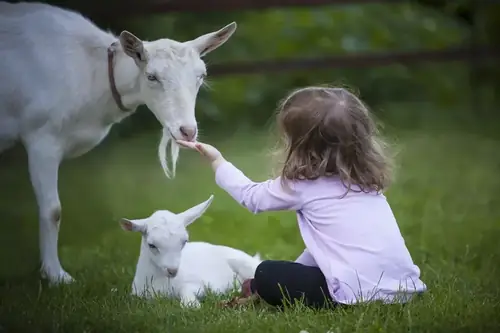
That outlet pays off in temperament, too. Goats with room to climb and play settle into handling far more easily, and the shift tends to show up quickly once even a simple climbing structure appears in the pen.
Frequently Asked Questions
Wild mountain goats sustain slopes of roughly 60 degrees and scramble up near-vertical rock in short bursts using ledges and cracks. Domestic goats comfortably handle 40 to 45-degree hillsides, rock piles, and hay stacks. Nothing close to a true 90-degree wall is possible for any real distance.
A genuine 90-degree wall is dead vertical with no footholds, and no goat can scale that. What looks like 90-degree climbing is almost always a steep face dotted with small ledges and seams the camera flattens. Goats exploit those features rather than gripping smooth, sheer stone.
No, most healthy goats stay comfortable at 92 degrees Fahrenheit when they have shade, ventilation, and plenty of water. The bigger risk is heat combined with high humidity, which can trigger heat stress. Watch for heavy panting, drooling, or lethargy and cool the animal down if those appear.
Goats carry a low center of gravity, split hooves with hard rims and soft pads, and strong hindquarters for hopping between footholds. Add a long camera lens that compresses depth, and a steep but climbable slope can look perfectly vertical in a single frame.