| # | Product | Our Rating | ||
|---|---|---|---|---|
| 1 |  | Best OverallProbios Probiotic Oral Gel for Goats | ★★★★★ | Check Price |
| 2 |  | Manna Pro Goat Electrolyte Powder | ★★★★☆ | Check Price |
| 3 |  | Nutri-Drench Goat & Sheep Supplement (8 oz) | ★★★★☆ | Check Price |
When a goat spikes a fever, strains after a hard kidding, or goes down with a painful injury, Banamine is one of the first things experienced owners reach for. It works fast, but it is also one of the easiest goat drugs to misuse, and the wrong route or too many doses can do real harm.
I keep a bottle in the barn fridge year-round, but after more than a decade of treating my own dairy and meat goats with it, I stick to three hard rules: under the skin only, never more than three days, and never as a cover-up for finding what is actually wrong.
This guide gives you the Banamine dosage chart by weight, exactly how to inject it safely, and the safety rules that matter most.
Banamine is often given alongside an antibiotic, and each drug has its own dose by weight.
Important: Banamine is prescription-only and is used extra-label in goats (it is not FDA-approved for them). That means your veterinarian must set the dose, route, and legal withdrawal time. The figures below are commonly published references for education, not a prescription.
What Is Banamine and What Does It Treat?
Banamine is the brand name for flunixin meglumine, a non-steroidal anti-inflammatory drug (NSAID). It does three things well:
- Reduces fever, useful with pneumonia, mastitis, and other infections (alongside the actual antibiotic).
- Relieves pain, injuries, post-kidding soreness, a hard bout of bloat, or a painful eye.
- Reduces inflammation, including the lung inflammation that makes respiratory disease worse.
Banamine is not an antibiotic. It treats the symptoms (pain, fever, swelling), not the infection itself.
A goat with pneumonia needs an antibiotic and Banamine, not Banamine alone. Masking a fever with Banamine while ignoring the cause is a common and dangerous mistake.
Banamine Dosage Chart for Goats by Weight
Standard Banamine is 50 mg/mL. The most commonly cited goat dose is 1 mL per 100 lb of body weight (about 1.1 mg/kg), given once daily.
Always weigh your goat, guessing is the most common dosing error.
| Goat weight | Banamine dose (50 mg/mL) |
|---|---|
| 20 lb (kid) | 0.2 mL |
| 40 lb | 0.4 mL |
| 60 lb | 0.6 mL |
| 80 lb | 0.8 mL |
| 100 lb | 1.0 mL |
| 125 lb | 1.25 mL |
| 150 lb | 1.5 mL |
| 175 lb | 1.75 mL |
| 200 lb | 2.0 mL |
Some veterinarians use up to roughly 2.2 mg/kg (about 2 mL per 100 lb) for acute pain, only do this if your vet directs it. For kids and very small goats, use a 1 mL syringe so you can measure fractions of a milliliter accurately.
How to Give Banamine to a Goat
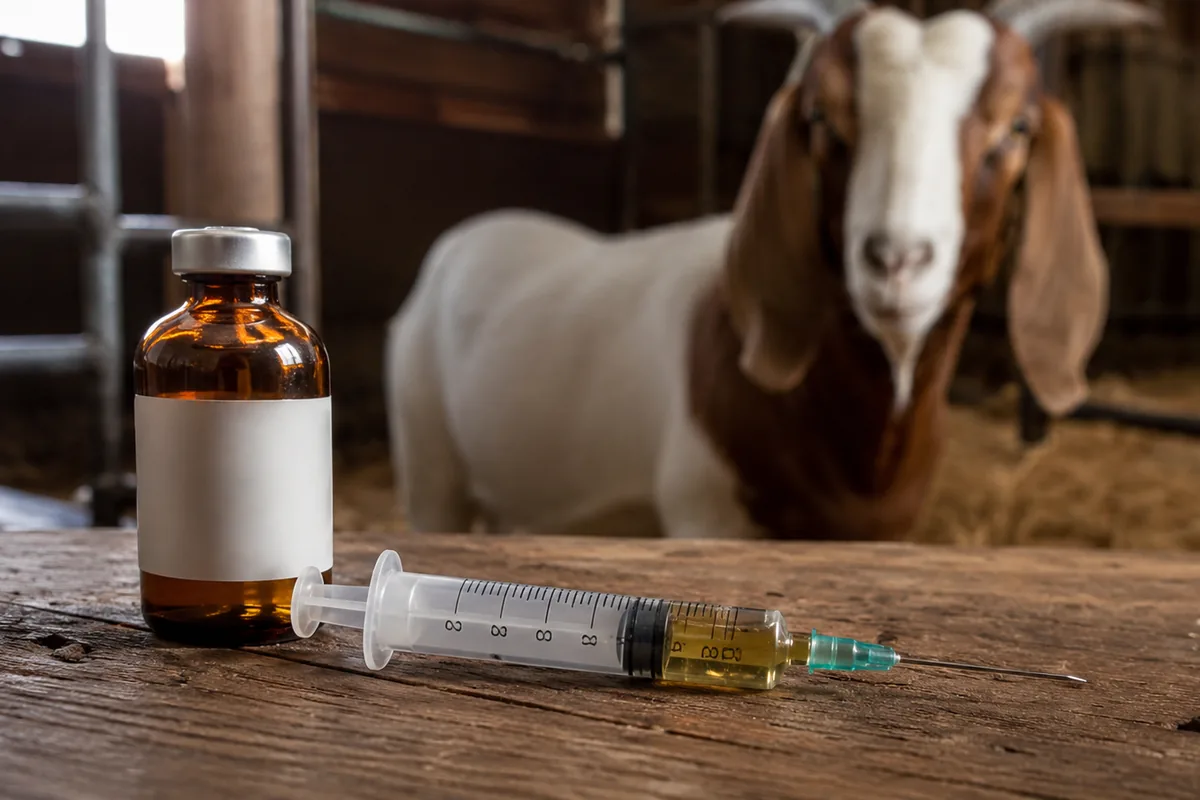
Give Banamine SQ (under the skin), not in the muscle. This is the single most important safety rule with this drug.
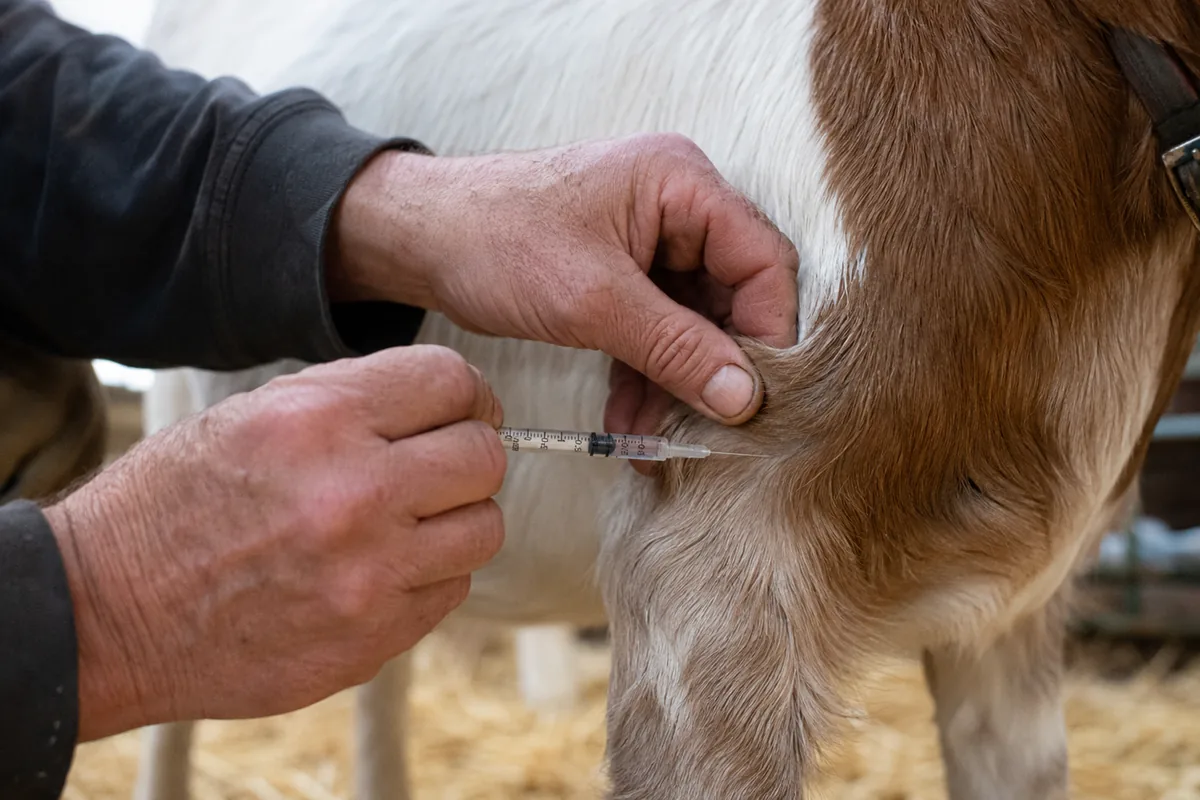
Intramuscular (IM) injection of flunixin can cause severe muscle damage and has been linked to clostridial myositis, a fast-moving, often fatal infection, in livestock. The label allows IM in some species, but in goats the safe, standard practice is subcutaneous.
To give it SQ:
- Draw up the correct dose for your goat’s weight with a luer-lock syringe and an 18 to 20 gauge, 3/4 inch needle.
- Tent a fold of loose skin over the ribs or behind the front leg.
- Slide the needle into the tent (parallel to the body, not into muscle), pull back to check you are not in a vein, and inject.
- Use a fresh needle per goat.
Your vet may give Banamine IV in a hospital setting for the fastest effect, but IV injection is not something to attempt at home.
How Often and How Long to Give It
- Frequency: once every 24 hours.
- Duration: no more than 3 consecutive days without veterinary guidance.
Banamine provides relief for roughly 12 to 24 hours per dose. It is built for short-term rescue, not ongoing pain management.
If a goat still needs pain control after 3 days, that is a conversation with your vet, often switching to a longer-term NSAID like meloxicam under prescription.
When Not to Use Banamine
Avoid Banamine, or use only under direct veterinary supervision, in these situations:
- Dehydrated or shocky goats, NSAIDs can tip stressed kidneys into failure. Rehydrate first.
- Goats with kidney disease or stomach ulcers, Banamine worsens both.
- Alongside another NSAID or a steroid (like dexamethasone), never stack them; the ulcer and kidney risk multiplies.
- Late pregnancy, NSAIDs can affect the pregnancy; ask your vet first. For pregnancy-safe options, see medications for pregnant does.
- Very young kids, dose precisely and only with vet guidance.
Never give human painkillers as a substitute without veterinary direction, and dose even a household remedy like Pepto-Bismol by weight.
Side Effects and Overdose
At the correct dose for a short course, Banamine is well tolerated. Problems come from too much, too often, or in the wrong goat.
Watch for:
- Loss of appetite, teeth grinding (a sign of abdominal pain or ulcers)
- Black, tarry stool (gastrointestinal bleeding)
- Reduced urination or other signs of kidney stress
If you see these, stop the drug and call your vet. An overdose is a veterinary emergency, bring the bottle and your dosing record so the vet knows exactly how much was given.
Meat and Milk Withdrawal Times
Because Banamine is extra-label in goats, your veterinarian must assign the legal withdrawal time. Commonly cited references put milk withdrawal around 3 to 4 days and meat withdrawal longer, but extra-label use typically extends both.
When you cannot confirm a withdrawal, discard the milk and do not slaughter until your vet clears the animal.
Banamine vs Aspirin vs Meloxicam
| Drug | Best for | Typical use | Notes |
|---|---|---|---|
| Banamine (flunixin) | Fast relief of fever and acute pain | 1 mL/100 lb SQ, once daily, ≤3 days | Strong, short-term; SQ only |
| Meloxicam | Longer-term pain control | Per vet (oral) | Vet-preferred for ongoing pain |
| Aspirin | Mild, short-term pain or fever | ~1 tablet (325 mg) per 10 lb oral | Weak and very short-acting in goats |
Every other common goat drug, from dewormers to coccidiosis treatments, is also dosed by weight. Keep a goat medication dosage chart handy for antibiotics and emergency meds too.
Sources and Further Reading
Cross-checked against established veterinary and goat references:
- The Merck Veterinary Manual, flunixin meglumine and NSAIDs in ruminants
- FARAD (Food Animal Residue Avoidance Databank), extra-label withdrawal guidance
- Long-standing breeder references (Fias Co Farm; Onion Creek Ranch / Tennessee Meat Goats)
Banamine is prescription-only and extra-label in goats; always confirm the dose and the withdrawal time with your veterinarian.
Frequently Asked Questions
The most commonly cited goat dose is 1 mL of Banamine (flunixin meglumine 50 mg/mL) per 100 lb of body weight, once daily, given under the skin. A 50 lb goat would get about 0.5 mL and a 150 lb goat about 1.5 mL. Banamine is extra-label in goats, so confirm the exact dose with your veterinarian.
It is strongly preferred to give Banamine SQ (under the skin) in goats. Intramuscular injection of flunixin can cause significant muscle damage and has been linked to clostridial myositis, a rapidly fatal infection, in livestock. Most goat owners and vets give it SQ; only give it IM or IV if your vet specifically directs.
Once every 24 hours, for no more than 3 days in a row without veterinary guidance. Banamine is an NSAID that can cause stomach ulcers and kidney damage with repeated or high doses, so it is meant for short-term relief, not ongoing pain control.
Banamine usually starts reducing fever and pain within 1 to 2 hours, with peak effect within a few hours. If your goat is no better after the first dose, or is still off feed and dull, that points to a serious underlying problem that needs a vet, not just more Banamine.
Because Banamine is used extra-label in goats, withdrawal times must be set by your veterinarian. Commonly cited figures are roughly 3 to 4 days for milk and longer for meat, but extra-label use almost always extends these. When in doubt, discard the milk and wait for your vet's clearance before slaughter.