| # | Product | Our Rating | ||
|---|---|---|---|---|
| 1 |  | Best OverallREDMOND Goat Mineral Supplement (5 lb) | ★★★★★ | Check Price |
| 2 |  | Wholesome Harvest 16% Goat Feed (10 lb) | ★★★★☆ | Check Price |
| 3 |  | Manna Pro Goat Treats | ★★★★☆ | Check Price |
A head of cauliflower goes soft on the counter, or the garden row bolts. Either way, there is a yard full of goats that would happily take it.
Cauliflower is one of the cheaper vegetables to hand over, and goats rarely refuse it. The only real question is how much, and one group of compounds in the plant sets that limit.
Is cauliflower safe for goats?
Yes, and a goat raiding your garden row is not an emergency, because no part of the cauliflower plant is poisonous.
That safety starts with how a goat breaks food down. Goats are ruminants with a four-part stomach, and the first chamber works on plant material long before the rest of the belly sees it.
So cauliflower suits how a goat eats. It does not suit volume, because a treat and a daily meal do two different jobs in the diet.
What cauliflower gives a goat
Cauliflower gives a goat vitamin C, potassium, and water for very few calories.
As vegetables go, cauliflower is not rich, and that is exactly its value as a treat. USDA FoodData Central lists raw cauliflower at 92 percent water and only 25 calories per 100 grams.
That same 100 grams carries 48 mg of vitamin C, 299 mg of potassium, and 15 mg of magnesium. Those nutrients add to a hay-based diet rather than replace anything in it.
The high water content also helps in summer, when a goat drinking less still takes in fluid from wet florets.
None of those nutrients are the real reason to feed cauliflower, though. Variety is.
Which parts of the cauliflower plant can goats eat?
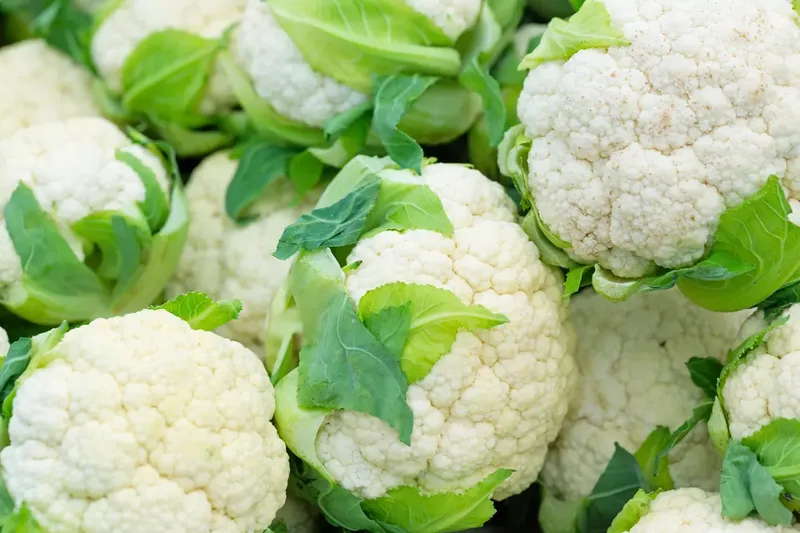
All of them. Florets, the thick central stalk, the outer leaves, and the seeds are each safe.
The outer leaves are the part that usually gets thrown out, and goats treat them like any other leafy scrap with more fiber than the white curd.
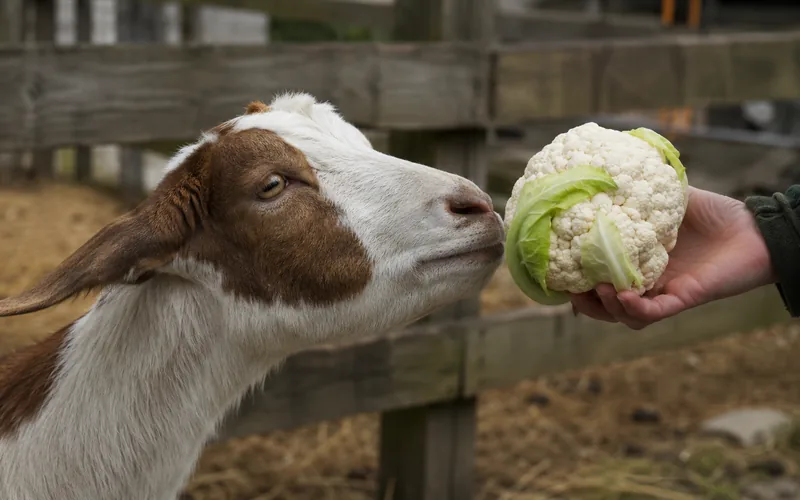
You might be wondering: do the leaves count toward the same limit? They do, and so does the stalk, so a pile of trimmings is already a full serving.
The stalk is dense, so chop it into pieces a goat can chew, since whole stalks are a choking risk for young goats and smaller breeds. Seeds appear when the plant bolts, and they are safe in the amounts a browsing goat picks up.
Glucosinolates, goitrogens, and the thyroid
Cauliflower contains glucosinolates, the compounds the plant makes to defend itself against insects. Wikipedia’s glucosinolate entry cites livestock research showing these act as goitrogens and anti-thyroid agents at high doses.
In a goat, those compounds interfere with how the thyroid takes up iodine, and a thyroid short on iodine swells. That swelling shows as a goiter, a soft lump.
But there’s a catch. Reaching that point takes weeks of heavy brassica feeding, which looks nothing like a cup of florets twice a week.
Goats with loose minerals containing iodine handle brassicas better.
Bloat is the faster risk
The thyroid problem takes weeks, but bloat can happen in an afternoon.
Brassicas break down fast in the belly and release gas as they go. A goat that eats half a head at once builds gas faster than it can belch out.
Watch for a swollen left side, restlessness, and a goat that stops chewing at all, because a bad case turns into an emergency within hours.
Raw, boiled, or roasted
Raw is simplest, so wash the head, chop it, and hand it over.
Cooked works too, whether boiled, steamed, or roasted, but the rule is that no topping goes on it.
That means no butter, salt, or garlic, and seasoned leftovers off a plate are the most common way owners get this wrong.
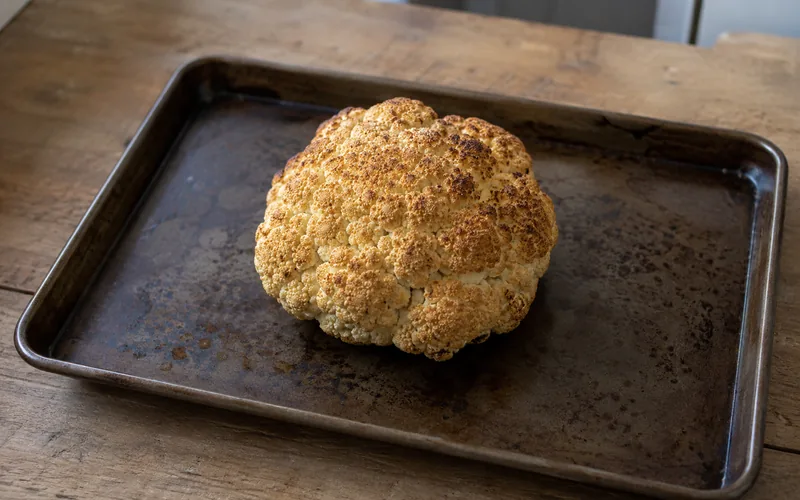
Roasting does change the flavor. Sinigrin, one of cauliflower’s glucosinolates, drives the bitterness of cooked cauliflower and Brussels sprouts, according to Wikipedia’s entry on those compounds.
The short version: plain roasted florets are safe, and they still count against the daily treat limit.
How much cauliflower per goat
Treats of every kind should stay under 10 percent of the daily diet. Cauliflower shares that allowance with carrots, snacks, and anything else handed over.
Judge it by the goat’s body, not by the size of the head. What this means for you: the serving is smaller than most owners guess.
| Goat | Cauliflower per serving | How often |
|---|---|---|
| Nigerian Dwarf or Pygmy | Half a cup, chopped | 2× a week |
| Adult doe or wether | 1 cup, chopped | 2–3× a week |
| Large buck | 1½ cups, chopped | 2–3× a week |
| Kid under 6 months | A few small pieces | 1× a week |
A whole head is a week of treats for one goat, not a single meal. Start new goats on half the amount above, then move up to a full serving after three days.
How cauliflower compares to other brassicas
Cauliflower is a cultivar of Brassica oleracea, the single wild species behind broccoli, cabbage, kale, and Brussels sprouts. Wikipedia’s entry on that species notes they all contain glucosinolates and isothiocyanates.
So what does that mean? Cauliflower is no safer than broccoli in a goat’s diet, and no riskier than cabbage fed in small amounts.
| Brassica | Difference from cauliflower |
|---|---|
| Broccoli | Stems ferment faster, so more gas |
| Cabbage | Dense leaves swallowed in big pieces |
| Kale | Richer per bite, easy to overfeed |
| Brussels sprouts | Round and small, so halve them first |
Feeding cauliflower on Monday and kale on Tuesday does not start the count over, because every brassica goes against one running total.
Do purple and orange cauliflower work the same?
Colored heads are the same vegetable in a different shade. Purple cauliflower gets its color from the natural compounds behind other purple vegetables.
Orange varieties carry more of a nutrient a goat can use, and neither one changes those compounds or the portion.
Every other variety follows the same rules.
Feeding cauliflower in winter
Goats can eat cauliflower in winter, fed at the same amount as any other season.
Cauliflower stores well in a cool shed, so it is one of few fresh treats around in January. Winter is also when hay matters most, because its fiber helps a goat stay warm.
A goat filling up on water-heavy florets eats less hay and gets fewer nutrients from it. Keep the same cup and the same twice a week, and throw out anything moldy.
Winter bareness also pushes hungry goats toward the edge of the yard. Walk it and clear any plants that turn toxic once the ground goes bare.
Frequently Asked Questions
The allium group is the hard no, so skip onions, garlic, leeks, and chives entirely because their sulfur compounds rupture red blood cells. Avocado carries persin, rhubarb leaves hold oxalic acid, and green potato or tomato foliage brings solanine. Cauliflower sits nowhere near that list. It belongs to the portion-controlled group instead, where the amount is the only thing that decides whether it helps or hurts.
Internal parasites take more goats than any other single cause, and the barber pole worm is the one that does most of the damage by feeding on blood in the stomach lining. Enterotoxemia and bloat sit behind it. Cauliflower plays no part in a parasite load, though feeding a big pile of it in one go is a genuine bloat trigger, which is the whole reason the serving stays small.
Almost anything from a normal kitchen works, including carrot tops, pea pods, cucumber ends, squash rinds, banana peels, and watermelon rind. Cauliflower trimmings fit right in, and the coarse outer leaves are usually the part goats like best. Two rules cover the rest. Nothing moldy, salted, buttered, or seasoned goes in, and the whole pile still counts inside the 10 percent treat allowance.
Carrots are the easiest daily option because goats find them palatable and they cause almost no digestive trouble at sensible amounts. Pumpkin, squash, cucumber, and celery follow closely. Cauliflower places lower on that list purely because its glucosinolates force a smaller portion, not because it offers less. Per bite it is a perfectly good treat, and goats often prefer its leaves to the white curd.