| # | Product | Our Rating | ||
|---|---|---|---|---|
| 1 |  | Best OverallREDMOND Goat Mineral Supplement (5 lb) | ★★★★★ | Check Price |
| 2 |  | Wholesome Harvest 16% Goat Feed (10 lb) | ★★★★☆ | Check Price |
| 3 |  | Manna Pro Goat Treats | ★★★★☆ | Check Price |
Most fruit comes with a catch for goat owners: wash it, core it, watch the seeds, ration it carefully. Blackberries are the rare exception where the whole plant, thorns and all, sits firmly on the safe list.
That makes them one of the most useful things growing on a lot of goat properties, whether you’re handing over a summer treat or turning a herd loose on an overgrown thicket. This guide covers both jobs, from the right handful at snack time to clearing a wall of bramble the natural way.
Can goats eat blackberries?
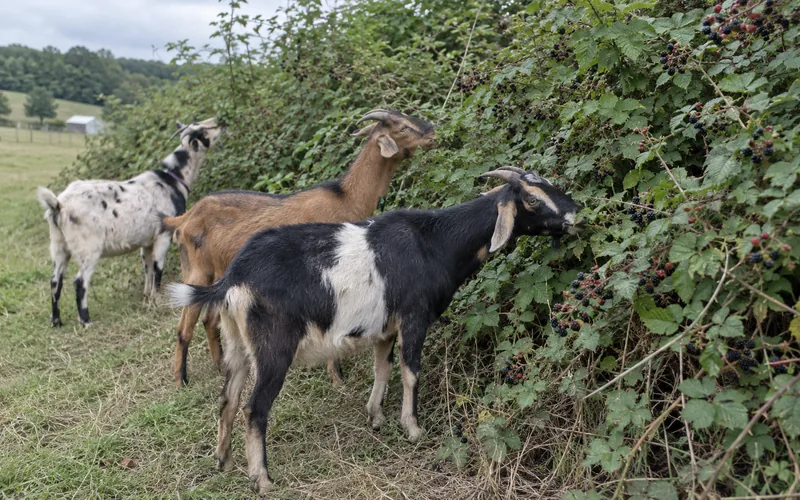
Goats can eat blackberries, and they tend to attack a bush with real enthusiasm. The berries, leaves, stems, and even the thorny canes are all safe, which is unusual for a fruit-bearing plant.
That top-to-bottom appetite comes down to how goats are built to eat. According to the Merck Veterinary Manual, goats are intermediate browsers, meaning they naturally select browse, forbs, and readily digestible plant material ahead of grass.
A blackberry bramble is exactly the kind of woody, leafy browse that appetite evolved for. Leave them to it and they’ll work a patch from the outside in, stripping leaves and tender canes as they go.
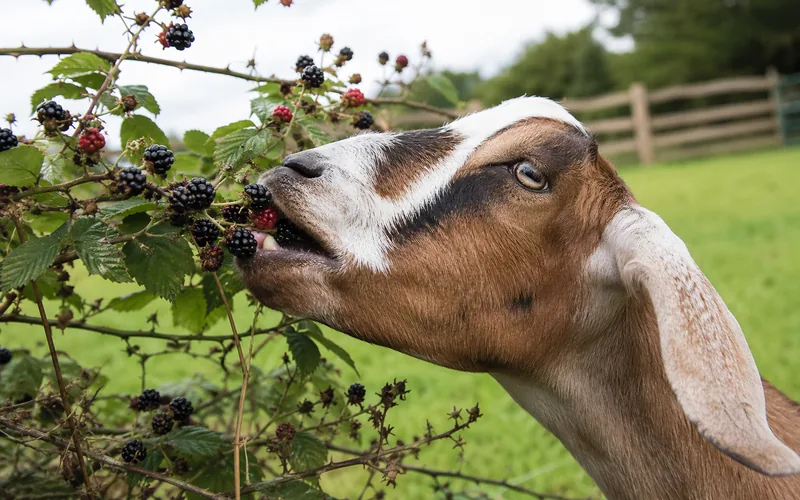
The one place to apply a little restraint is the ripe berries themselves. They’re high in natural sugar, so they belong in the treat category rather than the daily-ration category, a distinction we’ll put real numbers on further down.
Can goats eat the whole bush: leaves, canes, and thorns?
This is the question that trips people up, and the answer is yes across the board. Goats can eat blackberry leaves, stems, and thorny canes without injury.
The thorns just don’t register the way they would for other animals. A goat’s mouth is lined with tough, leathery tissue, and its prehensile lips let it grip and strip a spiny cane that would shred the mouth of a cow or horse.
If you’ve ever watched a goat clean a thorny cane in a few seconds and reach for the next one, the toughness is obvious. Those same spines that shred your gardening gloves are a non-event for the herd.
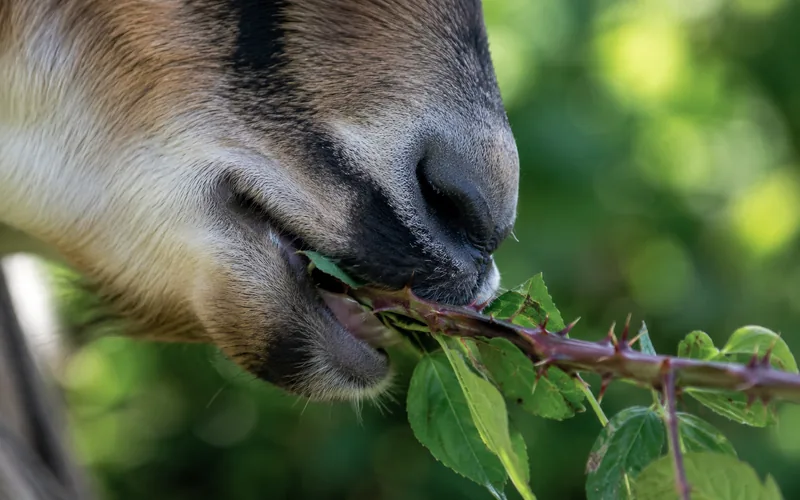
The leaves and canes aren’t just filler, either. They deliver fiber and plant compounds that support digestion, which is a big part of why goats reach for woody browse instead of sticking to grass.
Hawthorn works the same way in a pasture hedge, where every part is safe to browse down to the seeds inside the berries. Both plants carry moderate tannin, which is part of what makes them worth eating rather than a reason to avoid them.
Goats handle other spiny plants the same way, from wild rose to the mixed bag of thorny sticker bushes that torment other livestock. Blackberry just happens to be the tastiest of the bunch, so it usually gets eaten first.
What blackberries actually give a goat
In simple terms, blackberries give goats a low-calorie hit of antioxidants, vitamins C and K, manganese, and fiber, spread across the berries, leaves, and canes.
Blackberries earn their treat status with a genuinely dense nutrient profile. They belong to the genus Rubus, the same group that includes raspberries and dewberries, and the whole genus is known for antioxidant-rich fruit.
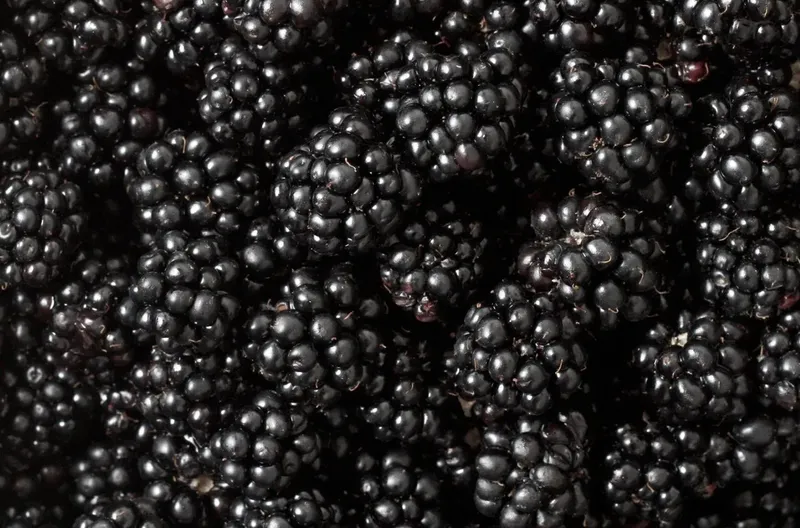
That deep purple-black color is the clearest clue to what’s inside. Blackberries are loaded with anthocyanins, the pigment compounds behind that dark hue.
Per WebMD, those anthocyanins carry anti-inflammatory and anti-microbial properties, and the same source notes research linking blackberry intake to better insulin sensitivity. For a goat, that translates to antioxidant support that helps the immune system push back against everyday oxidative stress.
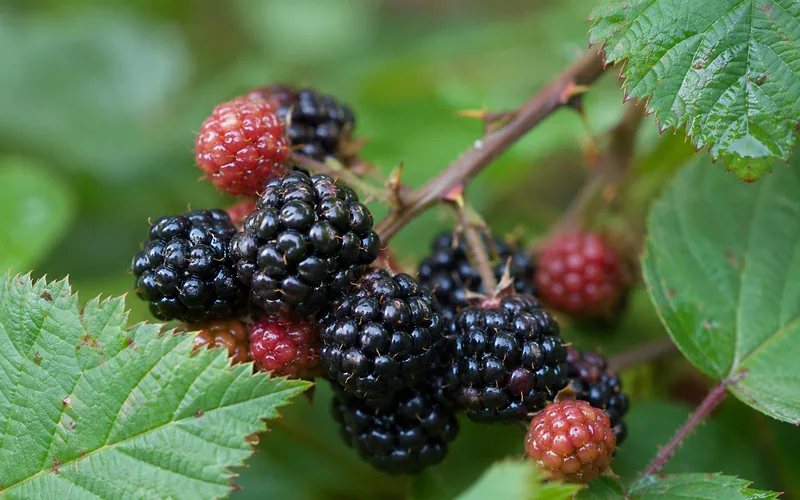
The macronutrient side is just as goat-friendly. WebMD reports that a one-cup serving of raw blackberries holds about 62 calories, 14 grams of carbohydrate, 8 grams of fiber, and 7 grams of sugar, which is a lot of fiber for a fairly low calorie load.
That fiber is why the berries rarely upset a healthy rumen the way a pure-sugar treat would. Here’s how the key nutrients line up and what each one does for the herd.
| Nutrient | Found in | Why it matters for goats |
|---|---|---|
| Anthocyanins | Berries | Antioxidants that support immune function |
| Vitamin C | Berries | Backs immune health, especially under stress |
| Vitamin K | Berries and leaves | Supports blood clotting and bone health |
| Manganese | Berries | Aids bone development and metabolism |
| Fiber | Berries, leaves, canes | Keeps the digestive tract moving |
| Tannins | Leaves and canes | Astringent compounds that firm loose stools |
The mineral side is broader than most people expect. Alongside manganese, blackberries supply potassium for muscle and nerve function, magnesium for dozens of enzyme reactions, calcium for bone and milk production, and a small amount of iron for healthy blood.
Vitamin C, vitamin K, and a handful of B vitamins round out the picture. None of it replaces a balanced diet, but as far as fruit treats go, blackberries punch well above their weight.
How many blackberries can a goat eat?
The short answer is a small handful of berries per adult goat, two or three times a week, kept under 10% of the total diet.
Portion size is where “safe” quietly turns into “safe if you don’t overdo it.” The berries are sugary, so how much you give matters more than whether they’re allowed at all.
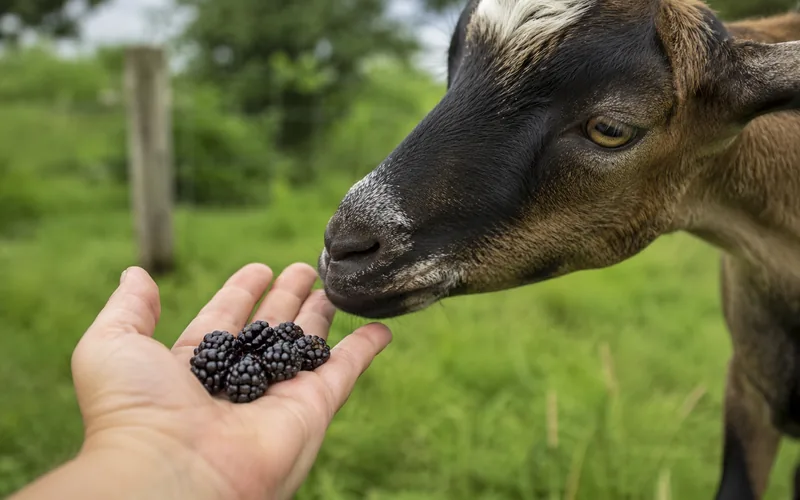
A practical rule for the ripe fruit is a small handful per adult goat, offered two or three times a week at most. That keeps blackberries as a supplement to the diet rather than a competitor with it.
The reason to cap treats is baked into goat digestion. The Merck Veterinary Manual notes that goats can consume up to 6.5% of their body weight as dry matter daily, and that a fast rate of passage limits how much low-quality forage they process, so every bite of treat displaces something more useful.
The widely used benchmark is to keep treats under 10% of total intake, leaving the remaining 90% to hay, pasture, and minerals. Berries by the handful fit neatly inside that budget.
Portions scale with body size, so a Nigerian Dwarf and a full-grown Boer shouldn’t get the same amount.
| Goat type | Berry treat portion | Frequency |
|---|---|---|
| Full-sized adult | Small handful | 2 to 3 times a week |
| Miniature breed | Half a handful | 1 to 2 times a week |
| Kid (weaned) | A few berries | 1 to 2 times a week |
| Pregnant or milking doe | Small handful | 2 to 3 times a week |
Browsing on the bushes is a different story. Because the leaves and canes are high-fiber rather than high-sugar, goats can work a blackberry thicket far more often without any portion math, since they naturally rotate between plants and self-regulate on rough browse.
How to feed blackberries safely
Put simply, wash store-bought berries, feed wild ones only from unsprayed patches, introduce them slowly, and serve fresh or frozen.
The berries need almost no prep, which is half their appeal. Still, a couple of habits keep them genuinely low-risk.
Wash any store-bought or roadside blackberries before feeding them. A quick rinse clears pesticide residue and dirt that could unsettle a goat’s stomach, and choosing organic when you buy them cuts that concern further.
Wild blackberries growing on ground you know hasn’t been sprayed can be fed straight from the cane. This is the most natural way to offer them, since it lets goats eat berries, leaves, and stems in one go.
Fresh and frozen both work. Frozen blackberries make a genuinely good hot-weather treat, and blackberries are roughly 88% water, so they double as light hydration on a scorching afternoon.
Introduce them gradually the first time. Start with three to five berries per goat and watch for a day or two before making blackberries a regular thing, the same slow rollout you’d give any unfamiliar food.
There are a few pleasant ways to hand them over. Offering berries by hand makes a good bonding exercise, scattering a few in the pen encourages foraging, and a single berry works nicely as a training reward for leading or hoof trimming.
Wild vs. store-bought blackberries
Both kinds of blackberry are safe, but each comes with different homework. It’s worth sorting out which is which before you fill a bucket for the herd.
Wild blackberries growing on untreated land are arguably the ideal goat treat. The goats harvest them straight from the cane, get the leaves and stems along with the fruit, and there’s no packaging or pesticide to think about.
The catch with wild patches is history. Roadside and property-line brambles are common targets for county spraying programs, so a stand that looks pristine may still carry herbicide residue on the canes.
Store-bought blackberries flip the trade-off. You know exactly what you’re getting, but conventional berries are grown with pesticides, which is why a thorough rinse, or buying organic, matters more for supermarket fruit than for a clean wild patch.
Neither option is better across the board. A verified spray-free wild thicket is hard to beat for a browsing herd, while washed store berries are the safer pick when you can’t vouch for the land a bush grew on.
The real risks worth knowing
Here’s what matters: the real hazards are too much sugar, chemical residue, mold, and fermenting fruit, not the plant itself.
Blackberries are safe, but “safe” is not the same as “unlimited.” A few specific scenarios turn a healthy treat into a problem.
The first is simple overindulgence in the berries. Too much fruit sugar at once can disrupt the delicate pH balance of the rumen, and a big pile of sugary berries is exactly the kind of rapid-fermentation load that tips it off balance.
That imbalance is how bloat gets started. The Merck Veterinary Manual explains that bloat develops when highly fermentable feed generates gas faster than the goat can belch it out, which is precisely the failure mode a berry binge can set up.
The second risk is a chemical one. Berries from sprayed patches can carry pesticide residue, and wild bushes along roadsides or property lines are sometimes treated with herbicide, so confirm a patch is spray-free before your goats browse it.
Mold is the third hazard, and it’s a serious one. Never feed moldy or rotting blackberries, because spoiled fruit can grow mycotoxins that cause real digestive harm, the same caution that applies to any spoiled or chemically treated forage.
Finally, watch for berries that have gone past ripe into fermenting. Fruit that’s begun to ferment produces small amounts of alcohol, which can cause digestive upset, so clear out any overripe mush rather than letting the herd hoover it up.
In the worst cases, a sudden overload of sugary treats can trigger enterotoxemia, the overeating disease caused by a bloom of Clostridium bacteria in the gut. It’s uncommon from berries alone, but it’s the reason a goat that raids an unlimited fruit stash is a bigger concern than one that gets a measured handful.
Goats with existing health problems deserve extra care here. Animals that are overweight or prone to metabolic issues should get blackberries sparingly or not at all, since the extra sugar works against them more than it helps.
Warning signs your goat has had too many
The clearest tells are loose, purple-tinted stool, bloating, and a goat that suddenly loses interest in its hay.
Even a safe treat leaves clues when a goat overdoes it. Catch them early and the fix is usually nothing more than cutting off the berries for a few days.
The most common tell is loose, purple-tinted stool. Excess fruit sugar loosens the gut, and the berry pigment stains the droppings a giveaway shade.
Other digestive signs include visible bloating, a swollen left side, and a sudden lack of interest in hay. A goat that fills up on berries and then snubs its forage is telling you the treats have crossed the line.
Behavioral changes matter too. Lethargy, tooth grinding, or restlessness after a heavy berry session all point to discomfort and are worth a closer look.
Most of these clear up within a day or two once you pull the berries and make sure fresh hay and water are front and center. If the bloating looks severe or symptoms drag on, that’s a call-the-vet situation rather than a wait-and-see one.
The takeaway is that blackberries rarely cause trouble on their own. Nearly every problem traces back to unlimited access or spoiled fruit, both easy to prevent with a little portion discipline and a quick look before you feed.
Blackberry leaves, tannins, and parasites
In short, blackberry leaves are rich in tannins that help firm loose stools and may offer a mild, natural anti-parasite benefit for browsing goats.
The leaves are where blackberries get quietly interesting. Blackberry leaves and canes are rich in tannins, the same astringent compounds that give strong tea its pucker.
In a goat, those tannins pull double duty. Their firming, astringent effect can help tighten up loose stools, which is exactly why old-time keepers dried blackberry leaves and kept them on hand for mild digestive upsets.
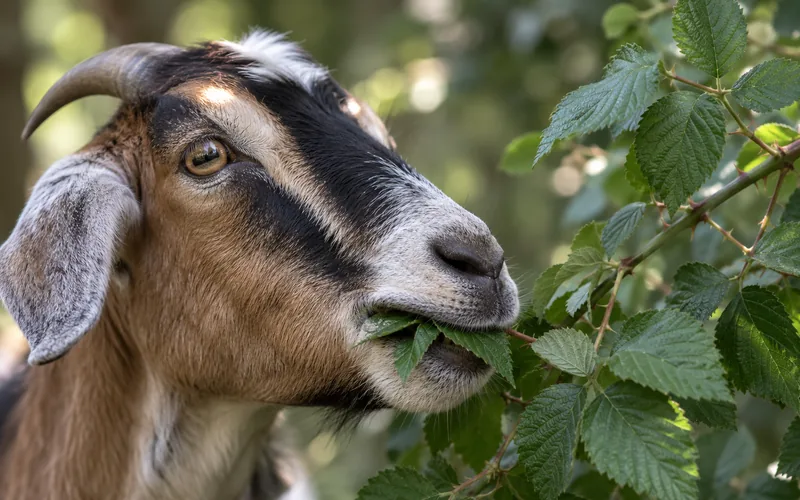
Tannins have also drawn scientific interest for a natural anti-parasite effect in browsing ruminants. The research is promising rather than settled, so treat blackberry browse as a helpful supplement to good parasite management, never a replacement for a fecal egg count and a vet-approved dewormer.
That two-for-one of fiber plus tannins is a big reason goats instinctively seek out blackberry canes. It’s the same draw that pulls them toward other tannin-rich browse like wild honeysuckle when it’s within reach.
How blackberries compare to other berries and fruit
Blackberries aren’t the only fruit worth feeding, and rotating treats keeps things interesting for the herd while spreading out the sugar. It helps to know where blackberry sits among the other common options.
Blueberries are the closest cousin on safety and antioxidants, and goats usually take to a small serving of blueberries with the same enthusiasm. The catch is that you can’t hand a goat a blueberry bush the way you can a blackberry cane.
Grapes are another safe favorite, though feeding grapes to goats calls for the same moderation on sugar and, ideally, cutting larger grapes to reduce any choking risk. Strawberries round out the trio of easy berry treats, sweet, low-hazard, and popular at snack time.
Pineapple chunks carry more than twice the sugar of blackberries, cup for cup, so they need a tighter limit.
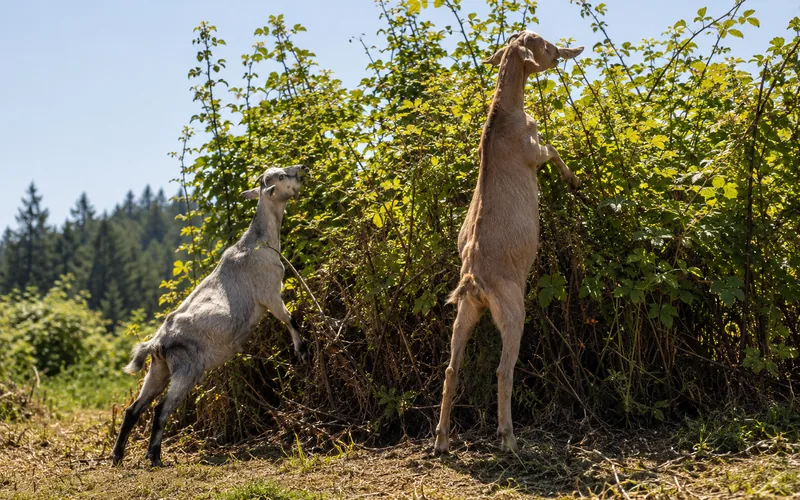
The advantage blackberries hold over all of them is the plant itself. No other common fruit gives you a treat and a free brush-clearing crew rolled into one, which is why blackberry earns a permanent spot on most goat properties.
Will blackberries affect a doe’s milk?
Dairy keepers often ask whether a berry treat changes what ends up in the milk pail. For blackberries in normal treat amounts, the honest answer is not meaningfully.
A handful of berries a few times a week won’t taint the flavor of milk or cause any problem for a lactating doe. If anything, the extra vitamins, minerals, and hydration are a small plus during the demands of lactation.
Claims that blackberries dramatically boost milk yield are overstated. Steady milk production comes from consistent energy, protein, and quality forage, so treat blackberries as a healthy bonus rather than a lever for the milk pail.
The one thing to keep in mind is the sugar budget still applies. A milking doe has high nutritional needs, so the berries should complement her ration, not crowd out the hay and grain that actually fuel milk.
Using goats to clear a blackberry patch
Yes, goats are one of the best natural tools for clearing blackberry, eating the whole plant down and returning for the regrowth until the roots give out.
Here’s where blackberries flip from treat to tool. Goats are one of the most effective living brush-clearers you can put on an overgrown bramble, and land managers hire herds specifically for the job.
Much of that demand targets one plant in particular: Rubus armeniacus, the Himalayan blackberry, an aggressive invasive species that forms impenetrable thickets across the Pacific Northwest and much of the country. Left alone, it smothers native plants and piles up dry, flammable canes.
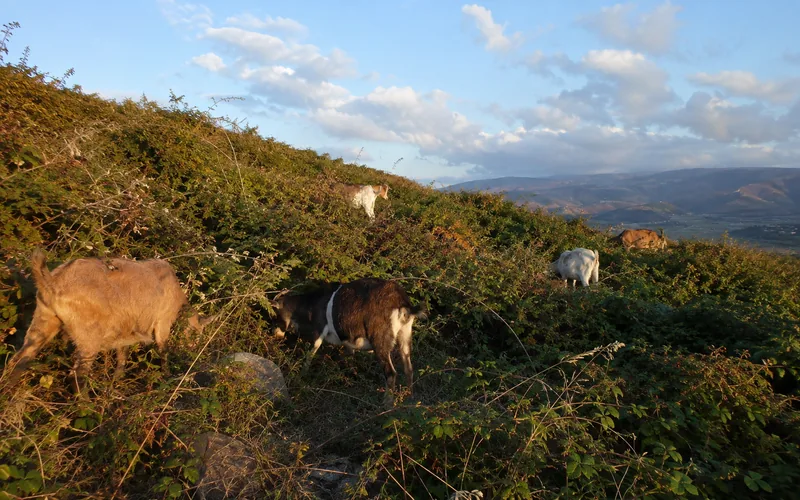
Goats break that cycle without chemicals or machinery. Using them this way is a form of conservation grazing, where a controlled herd suppresses the invasive bramble and gives native species room to recover.
The method is simple, though it isn’t instant. Goats strip the leaves and tender shoots, which starves the plant of energy, then keep coming back for the regrowth until the root system finally gives out.
A small herd can knock down an acre of bramble in a few weeks, though full eradication takes several grazing passes across a season. The payoff is a cleared, fertilized, and fire-safer patch of ground, with none of the herbicide you’d otherwise spray to get there.
The timing of your grazing passes matters as much as the goats themselves. Turning the herd in during the growing season, when canes are leafy and palatable, does far more damage to the plant than a single autumn pass once the leaves have hardened off.
For a stubborn thicket, cutting the tallest canes first gives goats access to the interior they can’t otherwise reach. After that initial knock-down, the herd can work the regrowth at the tender stage where their browsing does the most harm to the roots.
One practical warning: goats are famous escape artists, so a blackberry-clearing project lives or dies on solid fencing. Plan on sturdy woven wire or electric netting before you turn the herd loose, and check the perimeter often, since a goat that finds a gap will head for the neighbor’s bramble.
Best goat breeds for brush clearing
Any goat will eat blackberry, but some breeds are built for the heavy lifting of a full clearing job. Size, appetite, and a taste for rough browse are what separate a good brush goat from a picky one.
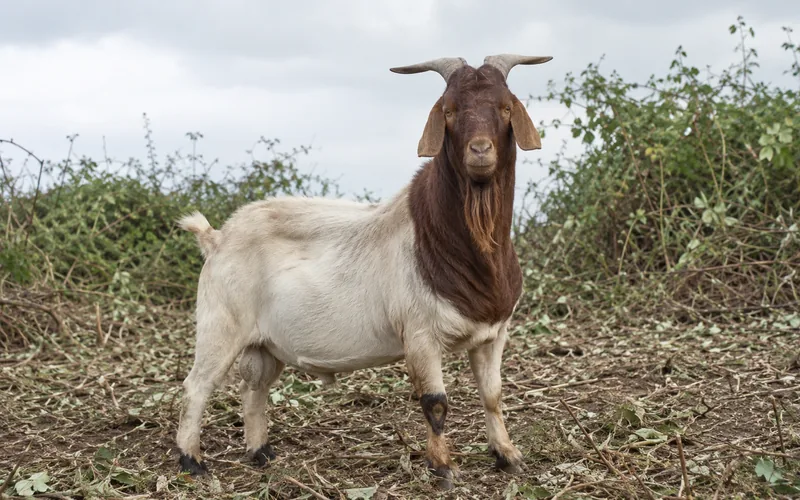
Spanish goats are a classic choice, prized for their hardiness and willingness to eat coarse, thorny vegetation most animals refuse. They thrive on exactly the kind of scrubby, marginal ground a bramble takes over, which makes them a favorite of professional grazing outfits.
Boer goats bring size and appetite to the table, and their bulk lets them push into dense thickets and pull down high canes. Kikos, bred in New Zealand for low-input hardiness, round out the top tier with strong browsing drive and easy keeping.
For a small backyard patch, the breed matters far less than the number of goats and the time you give them. Even a couple of dwarf goats will steadily clear a manageable bramble, working through it patiently over a few weeks the same way a larger herd tackles an acre.
Can baby goats eat blackberries?
Kids can eat blackberries once they’re reliably on solid food, usually somewhere around three to four weeks old. Before that, their diet should stay centered on milk.
With young goats, the whole game is small portions. A kid’s rumen is still developing, so a few berries at a time is plenty, and too much fruit sugar hits a small digestive system harder than it hits an adult’s.
Let kids nibble blackberry leaves and tender canes during normal browsing without much worry, since that fiber-rich browse suits them well. It’s the sugary berries that need the tighter limit while they’re small.
As with adults, the bulk of a kid’s growing diet should come from quality forage. Good pasture and appropriate hay build the frame, and blackberries are just a pleasant, vitamin-rich extra on top.
Feeding blackberries through the seasons
Bottom line: hand out ripe berries in summer, let goats browse leaves and canes through fall, and lean on hay once winter strips the plant bare.
Blackberries don’t stay the same treat all year, so what you offer shifts with the calendar. Once you get the rhythm of it, the herd stays interested and the feeding stays safe from spring through frost.
Summer is peak berry season and the natural time to hand out the ripe fruit. This is also when a wild patch is at its leafiest and most palatable, making it the best window to let goats browse the whole plant.
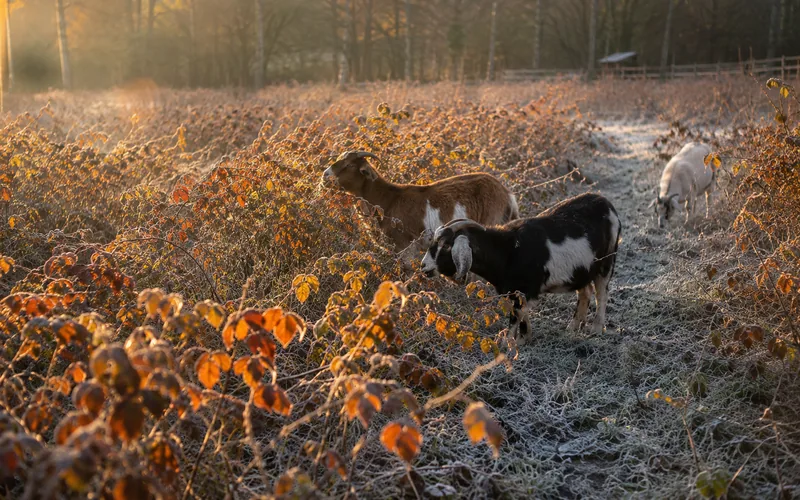
By fall, most of the berries are gone, but the plant still earns its keep. Late-season goats will happily strip the remaining leaves and canes for fiber, and autumn is often the practical time to put a herd on a bramble you want knocked back before the first hard frost.
Winter shifts the plant into a bare, dormant cane. Goats will still nibble the woody stems, though the nutritional payoff drops, so this is the season to lean hardest on hay and let blackberry play a minor supporting role.
Once the canes leaf out again in spring, the tender new growth is exactly what a clearing herd should target. Hitting that fresh growth early does the most to weaken the roots before the plant rebuilds its energy for the year.
Final thoughts
Blackberries are about as close to a perfect goat plant as you’ll find, safe from the ripe fruit right down to the thorns most animals won’t touch. Offer the berries as an occasional handful, and let the herd browse the leaves and canes as freely as they like.
Keep the few real risks in view: cap the sugary berries, skip anything moldy or sprayed, and watch for purple, loose stool as your signal to ease off. Everything else about this plant is working in your favor.
And if you’ve got a wall of bramble taking over a corner of your land, the goats will happily solve that problem too. You get free brush clearing, they get a feast, and the same appetite that makes them useful on nearly any overgrown browse turns your biggest weed into their favorite meal.
Frequently Asked Questions
Yes, blackberry bushes are safe for goats to eat, including the leaves, stems, and thorny canes. A goat's mouth is lined with tough tissue that handles thorns without injury, and the leaves add fiber and beneficial tannins. Just make sure the bushes haven't been sprayed with herbicides before turning your herd loose on them.
Goats should never eat avocado, which contains persin and can be fatal, and they should avoid the pits of cherries, peaches, plums, and apricots, since those seeds release cyanide. Moldy or rotting fruit of any kind is also off the table because of mycotoxins. Blackberries carry none of these hazards, which is part of why they rank among the safest fruits you can offer.
Yes, blackberry seeds are safe for goats and do not need to be removed. Unlike the pits of stone fruits, blackberry seeds contain no cyanide-releasing compounds, and a goat's digestive system passes them without trouble.
Yes, goats can eat blackberries in the fall, and late-season browsing on the canes and remaining leaves is perfectly safe. The berries themselves are mostly gone by autumn in most regions, but the plant stays a useful source of fiber right up until frost knocks the leaves down.
Yes, goats eat blackberry thorns without any problem. Their prehensile lips and tough oral tissue are built for thorny browse, so they strip and swallow spiny canes that would shred the mouths of cattle or horses.