| # | Product | Our Rating | ||
|---|---|---|---|---|
| 1 |  | Best OverallLamb & Goat Bottle with Pritchard Teat | ★★★★★ | Check Price |
| 2 |  | Manna Pro Goat Kid Milk Replacer (4 lb) | ★★★★☆ | Check Price |
| 3 |  | Pritchard Teat Nipples (12 Pack) | ★★★★☆ | Check Price |
Picture a small backyard herd where a Pygmy nanny and a Nigerian Dwarf billy share the same pen all year. Sooner or later nature takes its course, and the owner is left wondering whether those kids will arrive healthy or cause problems.
That worry is understandable, but it’s mostly unfounded. These two miniature breeds were practically made to cross, and homesteaders pair them on purpose for tiny, colorful, easy-keeping goats.
What follows is the full picture, from genetics and the safest breeding direction to what the kids look like, how much milk you can expect, and how to get both animals safely through kidding day.
The short answer and why it works
A Pygmy nanny and a Nigerian Dwarf billy are completely cross-compatible, with no fertility barrier between them. Both are true goats of the same species, Capra hircus, and carry the same 60 chromosomes.
Their shared history seals the deal. Both breeds descend from small West African goats brought to North America aboard ships in the early-to-mid 1900s, which makes them close genetic cousins rather than distant relatives.
They also mature fast and stay fertile for most of their adult lives. As the Oklahoma State breed profile notes, Nigerian Dwarfs can be fertile while just weeks old, so an unplanned pairing happens easily when a billy shares a pen.
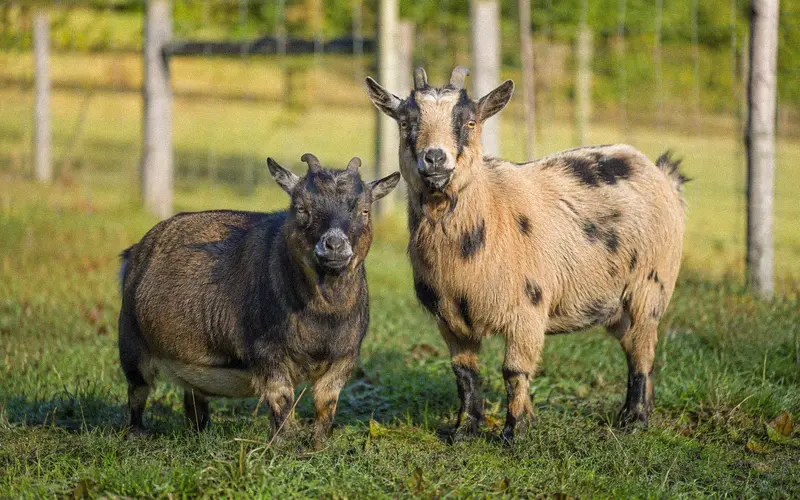
Size is the other reason the pairing is so low-risk. Unlike crossing a tiny doe with a giant Boer or Nubian buck, both of these breeds sit in the same miniature weight class, so the kids stay small enough to deliver without trouble.
The result is a fertile crossbred kid, often nicknamed a Pygerian. Those kids can go on to breed and reproduce themselves, which isn’t true of every animal hybrid.
Far from being a rare experiment, this is one of the most common small-goat crosses in North America. Plenty of breeders pair them deliberately, and many of the colorful mini goats sold as pets are exactly this combination.
Pygmy vs. Nigerian Dwarf at a glance
In short, the Pygmy is the stocky meat-and-pet breed and the Nigerian Dwarf the colorful dairy one.
Before you pair them, it helps to know exactly how the two breeds differ. They look similar to newcomers, but they were bred for opposite goals: the Pygmy as a stocky meat and companion goat, the Nigerian Dwarf as a miniature dairy animal.
| Trait | Pygmy | Nigerian Dwarf |
|---|---|---|
| Buck weight | 60 to 85 lbs | 40 to 80 lbs |
| Doe weight | 50 to 75 lbs | 35 to 65 lbs |
| Height at shoulder | 16 to 23 in | 17 to 21 in |
| Build | Stocky, short-legged | Slender, finer-boned |
| Primary purpose | Meat and pets | Dairy |
| Coat colors | Limited, agouti and caramel | Wide range, often spotted |
| Blue eyes | No | Sometimes |
| Milk per day | Minimal, hard to milk | 1 to 2 quarts |
Put simply, the Pygmy brings substance and a compact, hardy frame, while the Nigerian Dwarf brings dairy ability, finer bone, and far more color variety. A cross lets you blend those strengths in a single small package.
Should the Pygmy be the mother or the father?
Either direction works, though the Nigerian Dwarf usually makes the slightly safer mother.
The cross works in both directions, but which animal you choose as the mother matters more than most beginners realize. The general rule across all goat breeding is to avoid putting a much larger sire over a much smaller dam, because oversized kids are the leading cause of difficult births.
With these two breeds the size gap is small, so neither direction is dangerous. Still, the Nigerian Dwarf doe is often the slightly safer mother, since she tends to carry a bit more length and height through the barrel than a blocky Pygmy.
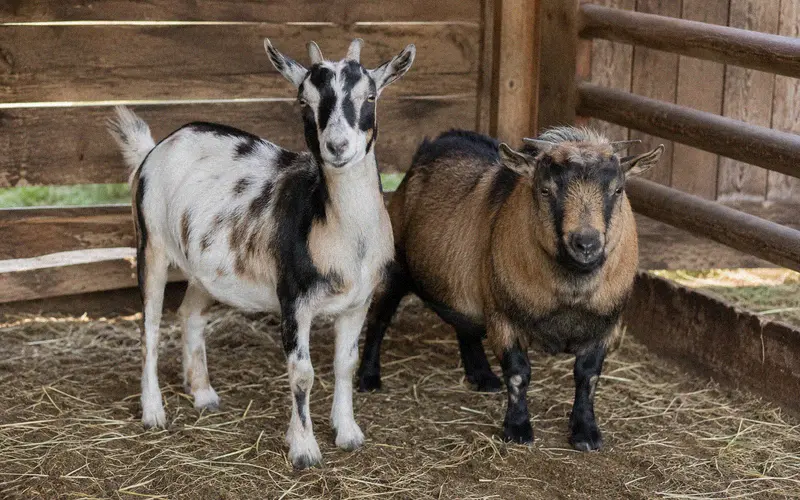
If you want to breed your Pygmy nanny to a Nigerian Dwarf billy, the cross is still perfectly fine. Just choose a smaller, refined-boned billy rather than a heavyset one, and keep a close eye on her as her due date approaches.
The same logic applies to a maiden doe of either breed. A first-time mother does best bred to a proven, moderately sized buck so her first kidding is as smooth as possible.
Whichever direction you choose, steer clear of breeding closely related goats. Doubling up on hidden faults is exactly how genetic problems surface in a small backyard herd.
With a wider size gap, like a Nigerian buck and Boer doe, the smaller breed must be the sire.
You can manage the mating two ways. Pen breeding, putting the pair together for a day or two during heat, gives you an exact due date, while pasture breeding is easier but leaves timing a guess.
Meet the Pygerian: what the kids turn out like
Pygerian kids fall between the two breeds, mixing the Pygmy’s build with the Nigerian Dwarf’s color.
Pygerian kids are a genetic grab bag, and that unpredictability is half the fun. Each kid pulls a different mix of traits from both parents, so a single litter can hold a stocky Pygmy look-alike right next to a slim, dairy-shaped sibling.
Adult size usually lands somewhere between the two breeds, roughly 16 to 22 inches at the shoulder and 50 to 75 pounds. Pygmy genes tend to pull toward the shorter, heavier end, while Nigerian Dwarf genes lean taller and lighter.
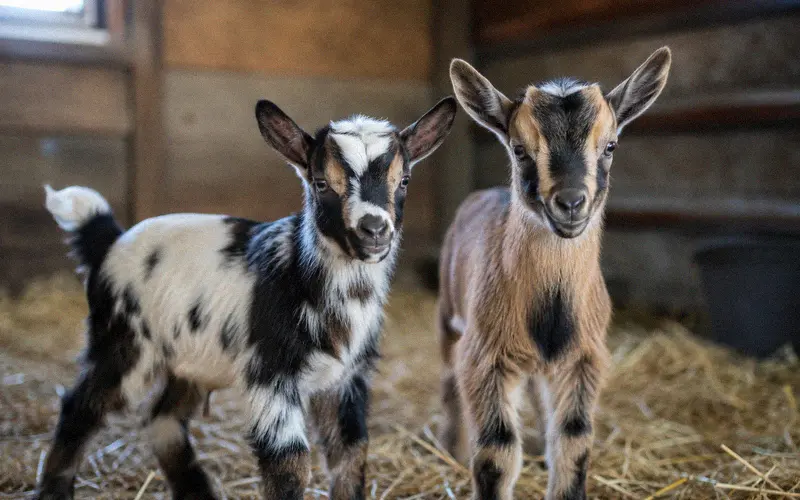
Color is where the Nigerian Dwarf influence really shows. Because Nigerians carry an enormous palette, including spots, moonspots, roan, and buckskin patterns, Pygerian kids often arrive far more colorful than a purebred Pygmy ever could.
Blue eyes are another possibility, since that trait comes from the Nigerian side and can pass to the kids. Some cross kids are also born polled, meaning naturally hornless, when one parent carries the polled gene.
Most kids will grow horns, though, so you’ll want to disbud them within the first two weeks if a hornless goat is the goal. Either way, a well-cared-for Pygerian commonly lives 12 to 15 years, the same long lifespan as both parent breeds.
Keeping a buckling as a pet? Plan to wether him, because an intact Pygmy-Nigerian Dwarf male turns pungent and pushy once he hits maturity.
Can you milk a Pygmy-Nigerian Dwarf cross?
Yes, and honestly it’s one of the best reasons to make the cross on purpose. Purebred Pygmies are notoriously hard to milk because of their small teats and udders, while Nigerian Dwarfs are prized dairy goats despite their tiny size.
A Pygerian doe usually splits the difference in a useful way. Most give one to two pints a day, with some dairy-leaning crosses pushing closer to a quart at peak lactation.
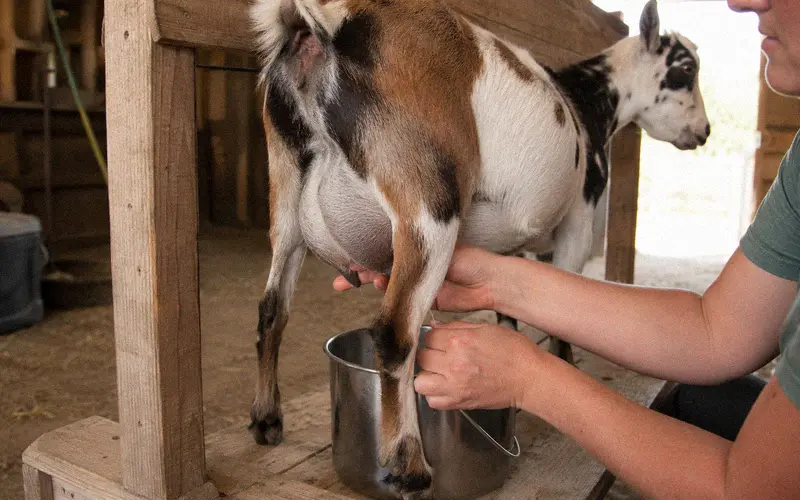
The milk tends to be rich, with butterfat often landing between 5 and 8 percent, which makes it excellent for cheese, soap, and coffee. Better still, crosses that inherit the Nigerian Dwarf’s teat size are far easier to hand milk than their Pygmy parent.
A Pygmy-Nigerian Dwarf cross doe will typically milk for around 7 to 10 months after kidding before you dry her off ahead of the next breeding. Production is heaviest in the first couple of months and then tapers, so plan your cheese and soap making around that early peak.
If milk is your main goal, breed for it by choosing a Nigerian Dwarf doe from a milking line and keeping back the cross daughters with the largest, best-attached udders. Our overview of raising goats for milk protein explains what to expect from a small home dairy herd.
The personality of a Pygerian
A Pygerian is typically a friendly, playful, people-loving goat.
Both parent breeds are famous for being friendly, curious, and a little mischievous, so the Pygmy-Nigerian Dwarf cross is almost always a sweet-natured animal. These goats bond closely with people and do well as pets, 4-H projects, and herd companions.
They’re also chatty and social, quick to call out the moment you appear and happy to trail you around the paddock like a dog.
Temperament is mostly shaped by how the kids are raised, not by the cross itself. Bottle-raised or well-handled kids grow into confident, affectionate goats, while neglected ones stay flighty regardless of breeding.
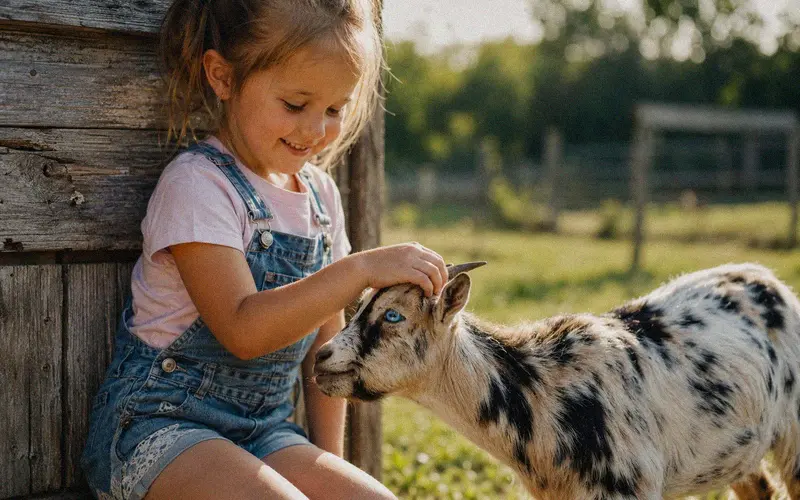
Be warned, both breeds are talented escape artists with a real love of climbing. A Pygerian will test every gap in your fence, so plan on sturdy woven-wire fencing at least four feet high and latches a clever goat can’t flip.
One rule overrides all the cute factor: goats are herd animals and must never live alone. A single Pygerian will cry, stress, and pace the fence line constantly, so always keep at least two together for a calm, healthy animal.
Getting both goats ready to breed
What matters most is good body condition, a solid mineral program, and clean health checks beforehand.
A smooth pregnancy starts well before the billy ever meets the nanny. The single most important factor is body condition, because a doe that is too thin or too fat is more likely to struggle with conception and kidding.
Aim for a moderate body condition score, where you can feel the ribs with light pressure but not see them. Start both animals on a good loose mineral with adequate selenium and copper several weeks ahead, since deficiencies here cause weak kids and retained placentas.
A trick called flushing can improve your odds of twins. Begin offering a small amount of grain a couple of weeks before and during breeding, which tells the doe’s body that food is plentiful and nudges her to release more eggs.
If the billy is coming from another farm, quarantine him for two to three weeks and confirm he tests clean for CAE, CL, and Johnes disease first. One infected buck can spread trouble through your whole herd in a single breeding.
Age matters too. A Nigerian Dwarf or Pygmy doe should reach at least 8 months old and a good size before her first breeding, while a billy is best used from around 7 to 8 months once he is mature enough to settle her reliably.
Time the introduction to the doe’s heat cycle, which comes roughly every 18 to 21 days. Tail flagging, a swollen vulva, and loud talking spot heat better than a body temperature reading.
Signs the breeding took
You confirm it in stages, from a missed heat at three weeks to a vet’s test.
You won’t know for certain the moment the billy covers the doe, but a few clues build your confidence over the following weeks. The clearest early sign is a doe that does not return to heat about three weeks later, because a bred doe stops cycling.
Watch her around day 21 after the breeding date. If she shows no tail flagging, no restlessness, and no interest in the buck, she most likely settled on the first try.
Over the next month or two, other signs appear gradually. Her appetite picks up, her barrel begins to widen, and her udder slowly starts to develop, especially in a first freshener.
Watch for one oddity called a cloudburst, a false pregnancy where the doe fills with fluid and then passes it with no kid. It’s uncommon, but it’s a solid reason to confirm with a vet rather than trust her dates alone.
For certainty, a vet can run a blood test as early as 30 days or an ultrasound from around 45 days to confirm and even count the kids. Pairing home observation with lab work gives you the clearest picture.
From the breeding pen to kidding day
The stretch from breeding to birth runs about five months, with most does kidding near day 150.
Once the doe is bred, mark the date and count forward, because both breeds share the same gestation length of 145 to 155 days. Most miniature does kid right around day 150, so a calendar reminder takes the guesswork out of it.
For most of pregnancy, your bred doe needs little beyond clean water, good hay, and her minerals. Hold off on heavy grain until the last six weeks, then increase her ration gradually to fuel the rapidly growing kids without making them oversized.
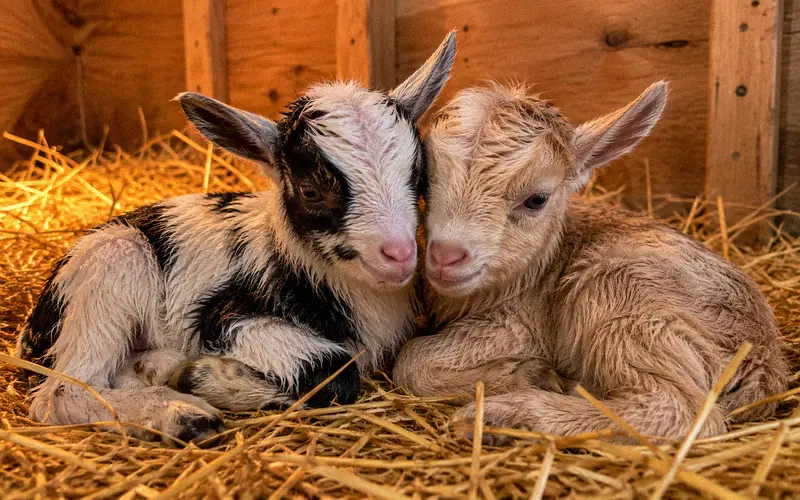
A CDT vaccine about four weeks before the due date passes protection against tetanus and enterotoxemia to the kids through the colostrum. Have a clean, draft-free kidding stall ready by day 140, along with towels, iodine for navels, and a vet’s number on hand.
Because these crosses are small and well matched in size, most kiddings are quick and unassisted. Watch for normal labor signs like a softened tail ligament, restlessness, and pawing, and step in only if a doe pushes hard for 30 minutes without progress.
A normal birth presents two front hooves with the nose resting on top, and the first kid usually slips out within half an hour of hard pushing. Anything else, a lone leg, a tail, or a stuck kid, means call your vet, as the Merck Veterinary Manual details for goat parturition.
Where these crosses stand with registries
No major registry counts this cross as a purebred, so the kids are logged as crossbreds.
If your goal is registered, show-quality stock, the cross has one real drawback. No major registry recognizes a Pygmy-Nigerian Dwarf cross as a purebred, so the kids cannot be registered as either breed.
The American Dairy Goat Association and American Goat Society register Nigerian Dwarfs, while the National Pygmy Goat Association handles Pygmies, and all of them require purebred parentage. A Pygerian is recorded as a crossbred at best.
This is different from a Kinder goat, which is an officially recognized Pygmy-Nubian cross with its own registry. There is no equivalent breed association for the Pygmy-Nigerian Dwarf combination, so the kids stay informal crossbreds.
A few registries do run experimental or recorded-grade herdbooks for grading up over several generations. Even then, a first-cross Pygmy-Nigerian Dwarf kid still won’t count as a purebred of either breed.
For pets, brush control, and family milkers, none of that matters. Registration only becomes a concern if you plan to sell breeding stock at premium prices or compete in sanctioned shows, in which case stick to purebred pairings.
If you are weighing the paperwork side, our note on registering a Nigerian Dwarf without papers is worth a read.
Mistakes and health risks to avoid
The Pygmy-Nigerian Dwarf cross itself is safe, but a few avoidable errors trip up beginners. The biggest is pairing a small maiden doe with an oversized buck, which raises the risk of dystocia, a difficult birth caused by kids too large for the birth canal.
Overfeeding during pregnancy is another common trap. A doe that gets too fat is prone to pregnancy toxemia and tends to grow oversized kids, so keep her in working condition rather than letting her balloon.
Health prep is non-negotiable. Both animals should be current on their CDT vaccine, treated for internal parasites based on a fecal test or FAMACHA score, and free of CAE and other diseases that can pass between herd members.
Timing matters in cold climates, too. Tiny newborn kids chill fast, so either aim kiddings for milder weather or be ready with a heat lamp, deep bedding, and dry towels to warm them the moment they hit the ground.
Finally, don’t let an intact billy run with does year-round if you want any say over timing. Bucks in rut are determined and persistent, so separate housing keeps you in charge of when and what gets bred.
Final Thoughts
A Pygmy nanny and a Nigerian Dwarf billy are one of the most forgiving crosses in the small-goat world. They’re genetically compatible, similar in size, and produce healthy, fertile Pygerian kids that blend the Pygmy’s hardy build with the Nigerian Dwarf’s color and milk.
Set the pairing up for success and the rest is straightforward. Keep both goats in good condition, lean toward the Nigerian Dwarf as the mother when you can, prepare for a normal day-150 kidding, and you’ll end up with tiny, colorful goats that are a joy to raise.
Frequently Asked Questions
The Nigerian Dwarf usually makes the safer mother. She tends to be slightly taller and longer in the barrel than a Pygmy, which gives the kids more room and lowers the odds of a hard birth. Breeding a Pygmy nanny works too, but pick a smaller-framed Nigerian Dwarf billy and watch her closely near her due date.
A Nigerian Dwarf billy is usually fertile by 8 to 12 weeks, but that does not mean he should be used that young. Most breeders wait until he is 7 to 8 months old and well grown before his first real breeding so he can settle a doe reliably and pass on mature size.
No major registry recognizes the Pygerian as a purebred. The American Dairy Goat Association, American Goat Society, and National Pygmy Goat Association all register only purebred stock, so the kids are recorded as crossbreds at best. That rarely matters for pets, brush goats, or family milkers.
No. A Kinder is a recognized cross between a Pygmy and a full-size Nubian, not a Pygmy and a Nigerian Dwarf. A Pygmy crossed with a Nigerian Dwarf is simply a miniature crossbred, informally called a Pygerian, with no separate breed registry of its own.