| # | Product | Our Rating | ||
|---|---|---|---|---|
| 1 |  | Best OverallDurvet High Level Vitamin B Complex (500ml) | ★★★★★ | Check Price |
| 2 |  | 3ml Luer-Lock Syringes with Needles | ★★★★☆ | Check Price |
| 3 |  | Agri-Pro Veterinary Thermometer | ★★★★☆ | Check Price |
Few things rattle a goat owner like walking out to find a goat circling, head cocked to one side, or standing with its nose pointed at the sky. Two different diseases cause that picture, and telling them apart in the moment is nearly impossible.
The good news is you don’t have to choose perfectly to save the goat. You just have to act fast and, usually, cover both.
This guide explains goat polio and listeriosis, how they differ, why vets often treat for both at once, and how to keep them out of your herd.
Important: Circling, head tilt, and star-gazing are neurological emergencies. This article is educational, not a substitute for a vet. Call your veterinarian the moment you see these signs, because hours matter.
Two Diseases That Look Alike
Goat polio and listeriosis are the two big causes of sudden neurological signs in goats, and they share a frightening overlap: circling, stumbling, head tilt, tremors, blindness, and collapse.
Despite looking alike, they are completely different problems. One is a vitamin deficiency, the other a bacterial infection, and they call for different drugs.
That overlap is exactly why this pair gets covered together. When you find a goat circling in the pen, you are not going to know which one it is, and the clock is running on both.
The safest mindset is simple: treat the emergency now, sort out the label with your vet, and lean toward covering both possibilities.
Goat Polio (Polioencephalomalacia)
Despite the name, goat polio is not a virus. It is polioencephalomalacia, a softening of the brain caused by a deficiency of thiamine (vitamin B1), which the rumen normally produces in abundance.
The trouble starts when something disrupts the rumen’s thiamine supply: grain overload, a sudden diet change, certain plants (like bracken fern), high-sulfur feed or water, or even amprolium (Corid) used for coccidia, which works by blocking thiamine.
Classic signs are star-gazing (the head pulled up and back), apparent blindness, circling, muscle tremors, and a wobbly, stumbling gait, usually with no fever. Left untreated it progresses to seizures, going down, and death.
Watch for those signs while treating coccidiosis with Corid, since the drug blocks thiamine.
The encouraging part is that goat polio often responds dramatically to thiamine, sometimes within hours, which is why the existing question of whether goats can recover from polio without medication really comes down to getting thiamine in fast. A grain binge is a frequent trigger, the same kind of feed-room accident behind bloat and other overeating emergencies.
Listeriosis (Circling Disease)
Listeriosis is a bacterial infection caused by Listeria monocytogenes, and it earns its nickname “circling disease” honestly.
The bacteria usually come from spoiled, moldy hay or silage, which is one of the strongest reasons never to feed moldy hay. They travel up the nerves of the face into the brainstem, which is why the signs are so often one-sided.
Tell-tale signs include a head tilt to one side, facial paralysis (a drooping ear, eyelid, or lip on one side), drooling, trouble swallowing, circling in one direction, depression, and frequently a fever. A goat that can’t swallow will quickly stop eating and risk inhaling food or water.
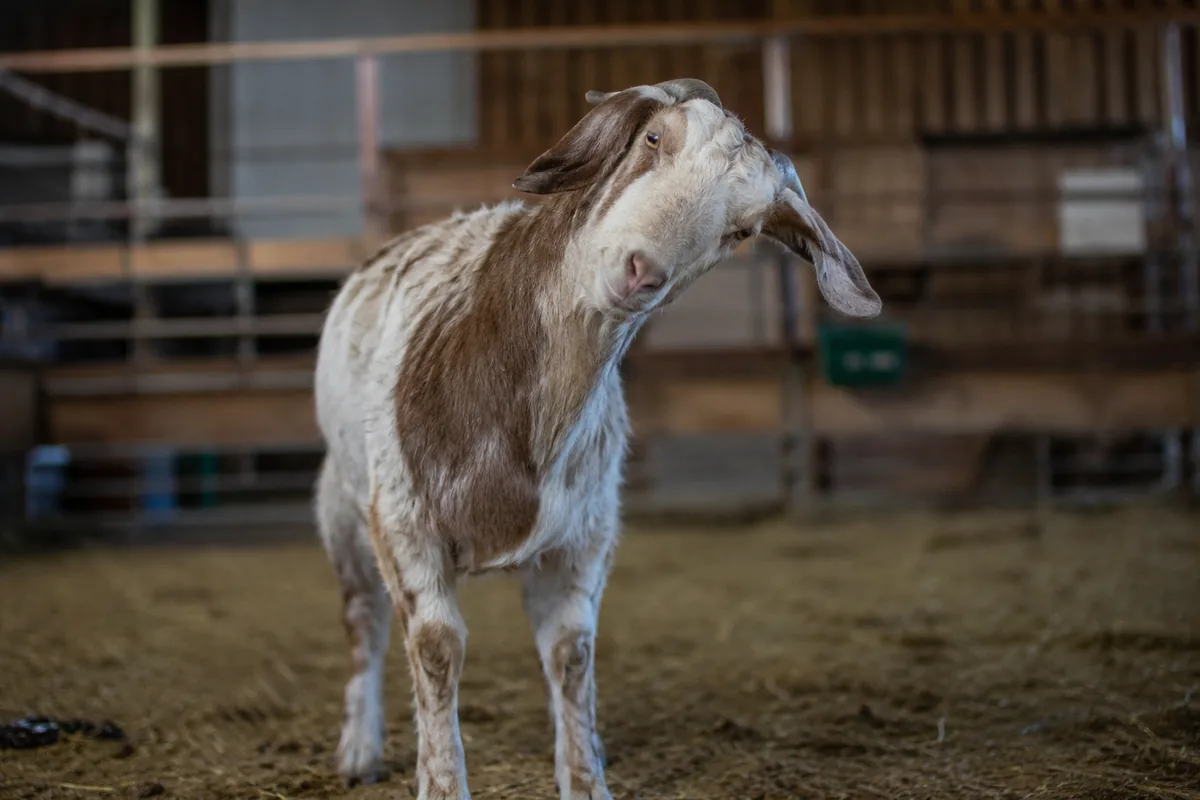
Listeriosis is treatable, but it demands high-dose penicillin given frequently and for far longer than a normal infection, often every 6 hours for one to three weeks. Because a listeriosis goat often can’t eat or drink normally, supportive care like fluids by syringe becomes part of pulling it through.
How to Tell Them Apart
In the moment, you often can’t be sure, and that’s the honest truth most guides skip. But there are leanings that help you and your vet decide.
| Clue | Leans Polio | Leans Listeriosis |
|---|---|---|
| Head position | Star-gazing (up and back) | Tilted to one side |
| Symmetry | Usually both sides | Often one-sided (face droop) |
| Fever | Usually none | Often present |
| Trigger | Grain, diet change, sulfur, Corid | Moldy hay or silage |
| Vision | Often blind | Vision usually intact |
| Response | Fast to thiamine | Slower, needs penicillin |
A goat star-gazing and blind with a recent grain binge leans polio. A goat with a one-sided head tilt, a drooping face, and a fever after eating questionable hay leans listeriosis.
That said, the overlap is real, and getting it wrong wastes the hours that decide whether the goat lives.
Treatment: Why You Treat for Both
Here is the practical takeaway that saves goats: when you can’t be certain, treat for both polio and listeriosis at the same time. It is the approach most experienced keepers and vets use.
That means, under veterinary guidance:
- Thiamine (vitamin B1) injections for possible polio, high dose and repeated
- High-dose penicillin for possible listeriosis, given frequently and continued for the full long course
- Anti-inflammatories (such as dexamethasone) to reduce brain swelling, per your vet
- Supportive care: keep the goat upright and padded, hydrated, and fed; protect it from injuring itself
Get the doses right against a reliable reference like the goat medication dosage chart and your vet, since penicillin in particular is easy to underdose, and there are real cautions around giving too much penicillin as well.
Start treatment at the first signs. Both diseases have a far better outlook when the goat is still standing than once it is down and unable to swallow.
How to Prevent Polio and Listeriosis
Both trace back to feed, so prevention overlaps neatly:
- Never feed moldy or spoiled hay or silage, the leading source of listeriosis
- Introduce grain and diet changes gradually over two to four weeks to protect rumen thiamine
- Don’t let goats gorge on grain; lock up the feed room
- Watch sulfur in feed and water, which can trigger polio
- Use amprolium (Corid) carefully, since it blocks thiamine; ask your vet about pairing it with thiamine during long courses
- Keep feeders clean and don’t let feed sit damp and molding
Good feed hygiene and steady, unhurried diet changes prevent the large majority of cases. The goats that go down are almost always the ones that hit moldy hay or a sudden pile of grain.
These feed habits also head off bloat and other overeating emergencies, making them a cornerstone of goat health.
Sources and Further Reading
Compiled and cross-checked against established veterinary and small-ruminant references:
- The Merck Veterinary Manual, Polioencephalomalacia and Listeriosis in ruminants
- American Association of Small Ruminant Practitioners (AASRP) resources
- Langston University, Meat Goat Production Handbook, neurological disease
- University extension publications (Penn State, Cornell) on goat neurologic disease
Neurological disease is a veterinary emergency; confirm diagnosis, drugs, and dosing with your own veterinarian without delay.
Frequently Asked Questions
Both make a goat look neurologically 'off': circling, stumbling, a head tilt or head pressed up and back (star-gazing), tremors, apparent blindness, and eventually going down and unable to rise. Listeriosis often adds one-sided signs, a head tilt to one side, a drooping ear, eyelid, or lip, drooling, and trouble swallowing. Polio tends toward star-gazing and blindness with no fever. Any goat showing these signs is an emergency.
Goat polio (polioencephalomalacia) is a thiamine deficiency triggered by grain overload, sudden diet change, or certain plants, and it responds quickly to thiamine. Listeriosis is a bacterial infection (Listeria monocytogenes) from spoiled or moldy hay or silage, usually causing one-sided facial paralysis and often a fever, and it needs high-dose penicillin. They look similar enough that many owners and even vets treat for both at once.
Goat polio is treated with injectable thiamine (vitamin B1) at a high dose, repeated every few hours at first and then tapering over several days, often alongside an anti-inflammatory like dexamethasone from your vet. Caught early, the response can be dramatic, with a star-gazing goat improving within hours to a day. Supportive care, keeping the goat hydrated, fed, and propped upright, matters while the brain recovers.
Yes, but only with aggressive, early treatment. Listeriosis needs high-dose penicillin given frequently (often every 6 hours) for one to three weeks, far longer and stronger than a routine infection, plus supportive care. Many goats survive if treatment starts at the first signs, but the prognosis worsens fast once the goat is down and can't swallow. It is one of the few conditions where you truly cannot afford to wait.
The bacteria (Listeria monocytogenes) can infect people, mainly through unpasteurized milk and contaminated food, and it is especially dangerous in pregnancy. The brain form that circles a goat is not casually caught by handling, but you should never drink raw milk from a sick goat, wear gloves handling birth fluids or a sick animal, and wash up well. Pregnant women should be especially cautious around sick goats and raw dairy.