| # | Product | Our Rating | ||
|---|---|---|---|---|
| 1 |  | Best OverallLamb & Goat Bottle with Pritchard Teat | ★★★★★ | Check Price |
| 2 |  | Manna Pro Goat Kid Milk Replacer (4 lb) | ★★★★☆ | Check Price |
| 3 |  | Pritchard Teat Nipples (12 Pack) | ★★★★☆ | Check Price |
Yes, a doe carrying multiples can lose one kid and continue carrying the others. This happens more often than most people realize, especially in early pregnancy when the lost fetus can be reabsorbed by the body without any obvious signs.
If the loss happens later in pregnancy, the dead fetus may be expelled as a mummified kid while the remaining kids continue to develop normally.
Can a goat miscarry one kid and still be pregnant?
When a doe loses a fetus in the first few weeks, her body often reabsorbs it completely. You might never know it happened unless you had an early ultrasound that showed more kids than she eventually delivers.
Later losses are more visible. You may see a one-time bloody discharge, mild cramping, or the doe passing tissue.
If she settles down and goes back to eating and acting normal afterward, there’s a good chance she’s still carrying the remaining kids.
What to do if your goat has a miscarriage?
Get a vet out for an ultrasound as soon as you suspect a partial loss. The ultrasound will confirm whether remaining fetuses are alive and developing normally, and most vets recommend doing this within 48 hours of the suspected miscarriage.
Watch the doe closely for signs of infection over the following days. A fever above 104 degrees, foul-smelling discharge, or refusal to eat are all red flags that something is wrong.
If the doe goes overdue after the partial loss, your vet can help determine whether to intervene. If any of these show up, she likely needs antibiotics right away to protect both her and the remaining kids.
How to care for a pregnant goat?
A doe recovering from a partial miscarriage needs extra calories and minerals. Bump up her grain ration by about 25% and make sure she has free-choice access to a quality goat mineral supplement.
Selenium and vitamin E are especially important during pregnancy. Low selenium levels are one of the leading causes of pregnancy problems in goats, so ask your vet whether a BoSe injection is appropriate for your doe.
If your doe is a first-timer, make sure she’s old enough to breed safely since Nigerian doelings bred too young face serious complications.
What are the common problems during goat pregnancy?
Pregnancy toxemia (ketosis) is common in does carrying multiples during the last month of pregnancy. The growing kids take up so much room that the doe can’t eat enough to meet her calorie needs, and her body starts breaking down fat too quickly.
Dystocia happens when a kid is positioned wrong for delivery. A leg back, a head turned, or a breech presentation can all cause a difficult birth that requires hands-on assistance or a vet call.
Sometimes a doe will even deliver babies a week apart if labor stalls between kids.
Tips for kidding season
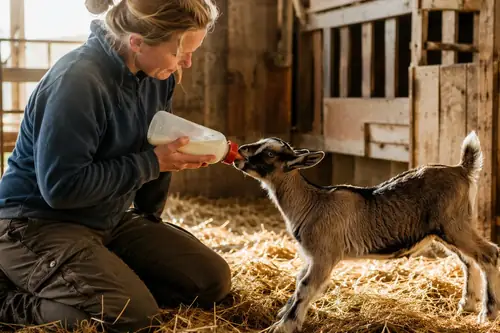
Have your kidding kit packed and ready at least two weeks before the due date. Include clean towels, iodine for navel dipping, a bulb syringe, dental floss for cords, and a bottle with nipple for supplementing weak kids.
Keep colostrum replacer on hand in case the doe can’t produce enough for all her kids, especially if she ends up with quads competing for two teats. Those first hours of colostrum intake are the difference between a strong kid and one that struggles to survive.
The basics of goat reproduction
Goats have a gestation period of about 150 days, or roughly five months. Most breeds are seasonal breeders that cycle in the fall as daylight hours decrease, though some breeds like Nigerian Dwarfs can breed year-round.
A doe can carry anywhere from one to five kids, though twins and triplets are by far the most common outcomes. The number of kids generally increases with the doe’s age, body condition, and the quality of her nutrition during breeding season.
First-time does almost always have singles regardless of breed.
Most does make milk only after kidding, but a few start lactating without being bred.
Final Thoughts
A partial miscarriage doesn’t mean the whole pregnancy is lost. Many does will go on to deliver healthy kids after losing one early in the pregnancy.
The most important steps are getting a vet ultrasound to check on the remaining kids, watching for infection, and boosting the doe’s nutrition to support the rest of the pregnancy. Stay calm, stay observant, and give her the extra care she needs.
Frequently Asked Questions
A doe (female goat) can indeed miscarry one kid and still be pregnant with another. If a doe (female goat) loses a single fetus early in the pregnancy, she will often carry the remaining fetus(es) to term and successfully give birth.
Get a vet out for an ultrasound within 48 hours to confirm whether remaining fetuses are alive. Watch for signs of infection: fever above 104 degrees, foul-smelling discharge, or refusal to eat. She may need antibiotics to protect the remaining kids.
A doe recovering from a partial miscarriage needs extra calories and minerals. Bump up her grain ration by about 25%, ensure free-choice access to quality goat minerals, and ask your vet about selenium and vitamin E supplementation.
Pregnancy toxemia (ketosis) is common in does carrying multiples during the last month. Dystocia happens when a kid is positioned wrong for delivery. Low selenium levels are one of the leading causes of pregnancy problems in goats.