Gum tree is a common name that covers more than one kind of tree. The name points to trees that ooze sap or resin, which is why goat owners keep getting different answers about it.
Two unrelated trees answer to that name in the United States: sweet gum, and eucalyptus, the Australian native planted across California, Florida, and the Southwest.
Your risk depends almost entirely on which one grows in your pasture.
Can goats eat gum tree leaves?
Yes in most cases, but the answer splits by species. Sweet gum leaves are safe browse, while eucalyptus leaves need limits.
Goats are browsers rather than grazers. The Pet Poison Helpline notes that goats browse at eye level and move from plant to plant instead of working through one patch.
| Tree | Botanical name | Also called | Risk to goats |
|---|---|---|---|
| Sweet gum | Liquidambar styraciflua | Gumball tree, star-leaf gum | Safe browse |
| Black gum | Nyssa sylvatica | Black tupelo, sour gum | Safe browse |
| Eucalyptus (most species) | Eucalyptus globulus and others | Blue gum | Limit the amount |
| Sugar gum | Eucalyptus cladocalyx | None | Fence it off |
Which gum tree is in your pasture?
Two leaf shapes tell them apart. Sweet gum leaves look like stars, with five pointed lobes from one stem, and the tree drops woody spiky seed balls every autumn.
Many people call them gumballs, and they cover the ground under a mature Liquidambar styraciflua by October.
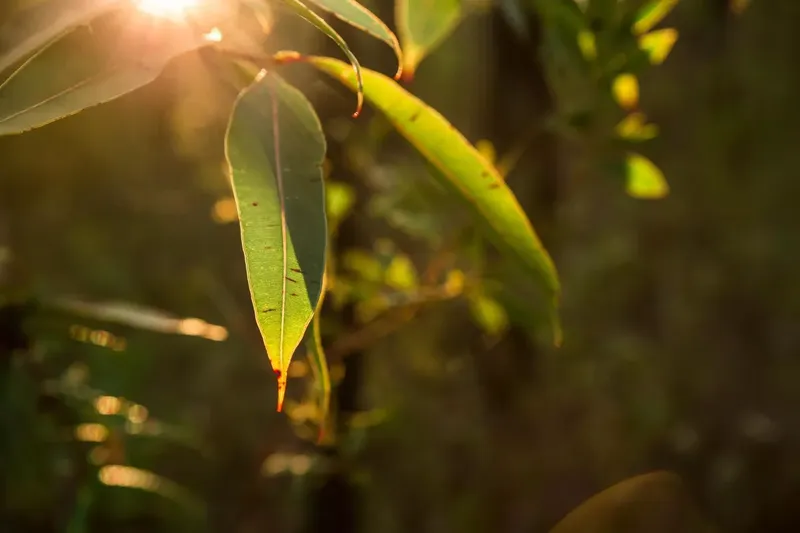
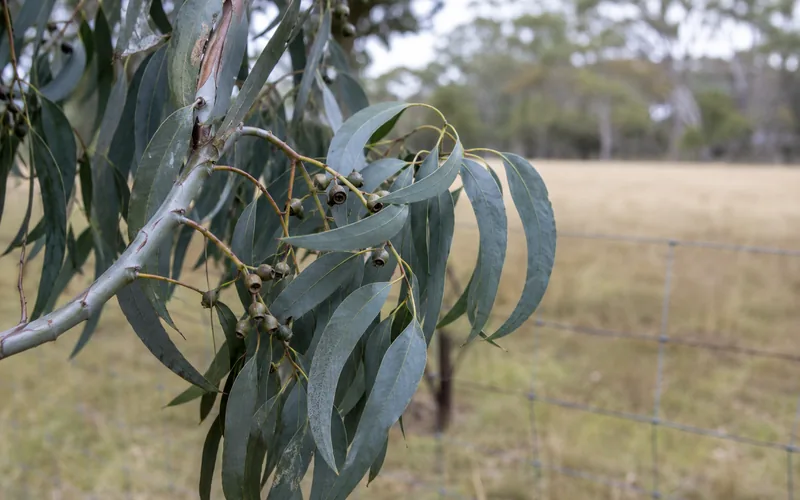
Eucalyptus is easier still: crush a leaf between your fingers and you get a sharp medicinal smell that nothing else in the yard produces. The foliage is long, narrow, and leathery, often blue-green rather than the bright green of the other tree.
But there’s a catch: Australia is home to hundreds of eucalyptus species, and a few of them behave nothing like the rest.
Sugar gum, or Eucalyptus cladocalyx, is the one livestock vets warn about. Its wilted leaves carry cyanogenic compounds that common blue gum does not produce the same way.
Are sweet gum leaves safe for goats?
Sweet gum is the easy answer on this list, with no toxic oils, no grayanotoxins, and no documented poisoning cases in goats.
The leaves do carry tannins, which is normal for tree browse. Goats handle tannins better than horses or cattle, because their rumen microbes break those compounds down.
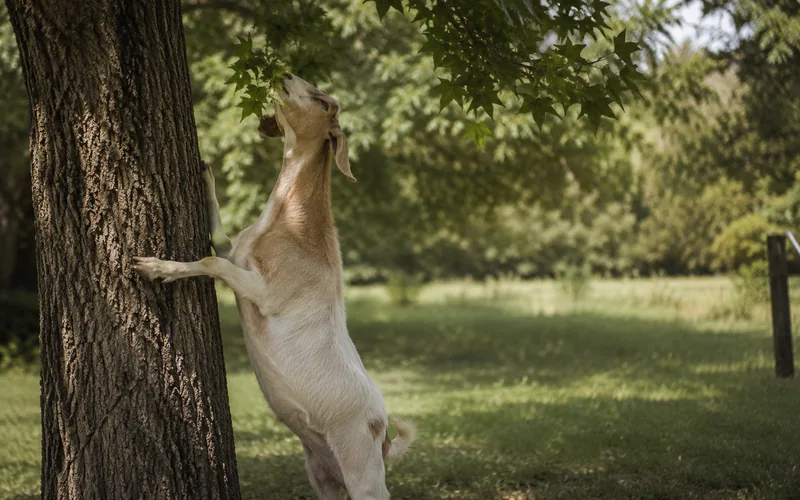
Utah State University Extension maintains a reference on range plants that poison livestock. Sweet gum is absent from it, and so is black gum.
The spiky seed balls are woody and hard, and most goats ignore them. Swallowing one rarely harms an adult goat, though young kids near big piles carry a choking risk.
Are eucalyptus leaves poisonous to goats?
Eucalyptus leaves are mildly toxic in quantity, not deadly in a nibble. The trouble comes from a group of volatile oils, and one of them has a name worth learning.
That one is eucalyptol, an essential oil. The ASPCA names it as the toxic principle in eucalyptus and reports salivation, diarrhea, depression, and weakness as the signs.
That ASPCA listing covers dogs, cats, and horses, and goats aren’t on it, so the guidance is borrowed rather than goat-specific.
Goats also cannot vomit. A goat that eats too much shows drooling, a slowed rumen, loose manure, and dullness instead.
Here’s the deal: most goats sort this out on their own, because eucalyptol, also called cineole, makes the leaves smell strong and taste harsh.
Smaller breeds raise the question more often, since a Pygmy or Nigerian Dwarf reaches a dose on less material. The same oils drive the risk for smaller goats and eucalyptus, just at lower volumes.
How many leaves is too many?
No published threshold exists for these leaves in goats, so any source handing you an exact gram figure is guessing.
The veterinary evidence does point to a dose relationship though. Volatile oils irritate the gut and kidneys as the amount climbs.
A practical rule works better than a number. Treat it like any strong browse: fine in a varied day, a problem as the only green thing on offer.
Here’s where it actually goes wrong: two situations cause nearly every real case.
The first is a stripped pasture. Goats eat down everything they like, then start on the plants they normally walk past.
Drought works the same way on a larger scale, thinning the good browse first.
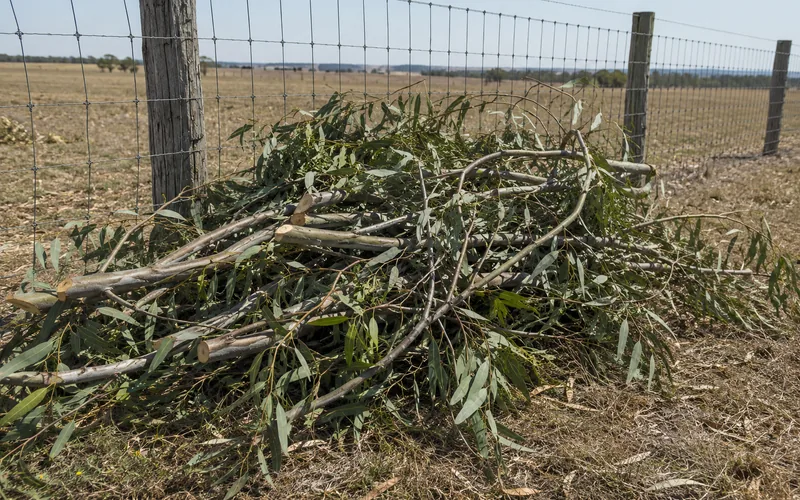
The second is fresh clippings. Someone prunes the tree, tosses the branches over the fence, and a goat suddenly has thirty pounds of wilting leaves at head height.
That second one is more dangerous. Wilting concentrates the compounds in several tree species, and goats often prefer wilted leaves to fresh.
Which tree leaves are toxic to goats?
Gum trees are not what kills goats. Stone fruit trees and a few ornamental shrubs cause most poisonings.
The Pet Poison Helpline names milkweed, Rhododendron, mountain laurel, azaleas, and wilted wild cherry as the most common goat poisonings.
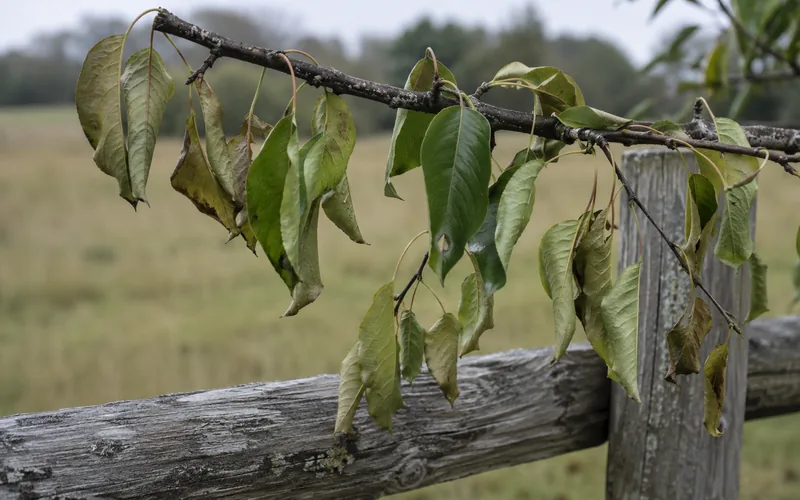
Cherry tops that list, and peaches and plums work the same way, because all three belong to the Prunus genus. The Merck Veterinary Manual groups all three as cyanogenic glycoside plants, because their wilted leaves release cyanide.
What this means for you: the release happens fast, and so does the poisoning.
Symptoms appear within 10 to 60 minutes. The Pet Poison Helpline lists bright red gums, staggering, seizures, and respiratory failure among them.
The poison itself is hydrogen cyanide, and wilted leaves often smell faintly of bitter almonds.
Azaleas and Rhododendron cause harm by a different route. Both carry grayanotoxins, which affect the heart and nervous system rather than the blood’s oxygen supply.
Coffee senna is a legume, not a tree, but it spreads through southern pastures and damages muscle tissue in ruminants.
Several grow in the same yards as gum trees. Red maple, black walnut, chinaberry, and yew all deserve fencing, and the full list of plants poisonous to goats runs longer than most owners expect.
What to do if your goat ate gum tree leaves
Start by identifying the tree. A star-shaped leaf means no action at all.
Otherwise, work out roughly how much went in. One stripped branch is a different situation than an emptied pile of clippings.
Then move the goat off the source and offer clean water and good hay. Watch for drooling, loose manure, a quiet rumen, or staggering.
Call your veterinarian if any of those appear, or if you know a large amount was eaten. Poisoning from cherry or sugar gum needs a vet within the hour.
The short version: keep activated charcoal in the barn kit. It binds many plant toxins while you reach a vet, and works far better in the first hour than the third.
What kind of tree leaves do goats like to eat?
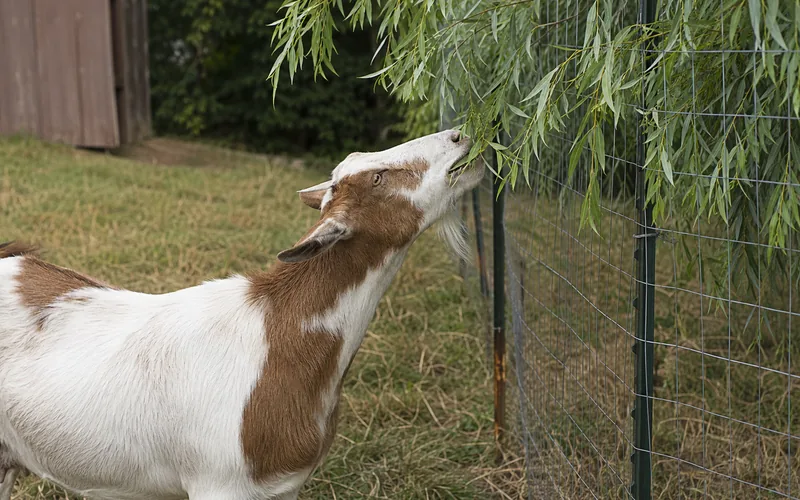
Goats do best on a mix of tree browse, and plenty of trees are safe. Willow, mulberry, honey locust, poplar, and apple leaves all rate highly with most herds.
Mimosa leaves belong on that list too, since they’re safe and fairly high in protein.
Willow is worth singling out. It carries salicin, the compound aspirin came from, and many keepers offer willow branches to sore or stiff animals.
Maple is safe with one exception. Red maple is toxic to horses and best avoided, while other maple leaves are ordinary browse for a goat.
In horses, red maple leaves destroy red blood cells and bring on anemia.
Two trees need portion control rather than a fence. Oak is fine in small amounts and a problem in quantity, so acorns in autumn cause most of the cases.
Cedar needs the same care, and goats love it as winter browse, though cedar in large amounts is hard on pregnant does.
Much of what gets sold as cedar is really juniper, and goats browse both. Ponderosa pine carries a similar warning for pregnant does.
The takeaway for goat owners
Walk your fence line once a season and name what grows along it. Sweet gum is safe browse, eucalyptus needs limits, and sugar gum belongs behind a fence.
Frequently Asked Questions
Eucalyptus leaves are mildly toxic to goats in quantity, not deadly in a nibble. The ASPCA names eucalyptol, an essential oil, as the toxic principle, and lists salivation, diarrhea, depression, and weakness as the clinical signs. Goats cannot vomit, so an overdose shows up as drooling, a quiet rumen, and loose manure instead. Most goats with good hay take a few leaves and walk away, because the smell is strong and the leaves are tough.
Wilted cherry leaves are the most dangerous common tree leaf, along with peaches and plums, because all three release cyanide as they wilt. Yew, red maple, black walnut, and chinaberry are the other trees worth fencing off. Rhododendron and azaleas are shrubs rather than trees, but they cause just as many poisonings. Gum trees do not belong in that group, though sugar gum is the one eucalyptus species that does.
Willow, mulberry, poplar, honey locust, and apple leaves are all safe and popular with most herds. Sweet gum belongs on that list too, and goats browse it freely with no reported problems. Oak and cedar are fine in small amounts but cause trouble in quantity. Tree browse should add variety to a diet built on good hay and free-choice minerals, never replace it.
The Pet Poison Helpline names milkweed, Rhododendron, mountain laurel, azaleas, and wilted wild cherry as the most common goat poisonings. Yew and oleander are the fastest killers, capable of stopping the heart within hours. Coffee senna, bracken fern, and nightshade round out the plants most likely to show up in a pasture. Goats usually avoid these when good forage is available, so most cases involve hungry animals or fresh clippings tossed over a fence.
Sweet gum drops its leaves in autumn, so it stops being a factor by winter. Eucalyptus stays green year-round, which makes it more tempting in a brown pasture and raises the winter risk in California and the Gulf states. Fallen eucalyptus leaves keep their oils as they dry, and sugar gum leaves stay dangerous even when brown and brittle. Keeping good hay in front of the herd all winter is what prevents most cases.