| # | Product | Our Rating | ||
|---|---|---|---|---|
| 1 |  | Best OverallProbios Probiotic Oral Gel for Goats | ★★★★★ | Check Price |
| 2 |  | Manna Pro Goat Electrolyte Powder | ★★★★☆ | Check Price |
| 3 |  | Nutri-Drench Goat & Sheep Supplement (8 oz) | ★★★★☆ | Check Price |
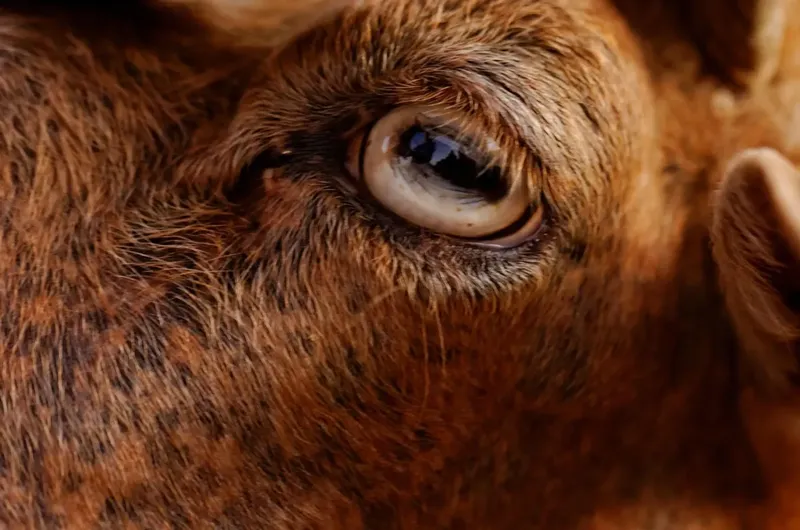
If you’ve ever looked a goat in the eye, you have probably noticed something unusual. Those horizontal, rectangular pupils are unlike anything else in the barnyard.
But those strange-looking eyes are actually one of the most impressive visual systems in the animal kingdom.
Do goats have good eyesight?
Goats have excellent eyesight that’s built for survival. Their rectangular pupils give them a panoramic field of view that stretches between 320 and 340 degrees, which means they can see almost everything around them without turning their heads.
Humans, by comparison, only see about 180 degrees. That wide-angle vision makes it nearly impossible for a predator to sneak up on a goat from any direction.
Their pupils also rotate up to 50 degrees to stay level with the ground, even when the goat tilts its head down to graze. This keeps their panoramic view locked in at all times, whether they’re eating or scanning for danger.
What do goats see when they look around?
Because their eyes sit on the sides of their head, goats have strong peripheral vision but limited depth perception directly in front of them. They can watch for threats from almost any angle while still keeping an eye on what they are eating.
Goats also have a tapetum lucidum, a reflective layer behind the retina that amplifies available light. This gives them solid night vision, which is why they can navigate around the pasture even after dark thanks to a combination of those eyes and their split cloven hooves that grip uneven terrain.
Their color vision is limited compared to ours. Goats can see blues and yellows but likely see reds and greens as muted shades, similar to a person with red-green color blindness.
Are there any benefits to having good eyesight for a goat farmer or pet owner?
Goats with healthy vision are less likely to injure themselves because they can spot obstacles, holes, and fencing before walking into them. A goat that suddenly starts bumping into things or hesitating at gates may have a vision problem worth checking out.
Healthy eyes also mean less stress for the animal. A goat that can see its surroundings clearly feels safer and is less likely to panic or bolt unexpectedly.
For farmers, good vision in the herd translates to fewer vet bills and injuries overall. It’s one of those things you don’t think about until something goes wrong.
How to Protect Your Goat’s Vision
Keep their living area clean and free of dust, cobwebs, and sharp objects at eye level. Eye injuries from protruding nails, wire, or thorny brush are more common than you’d think.
Feed a balanced diet that includes adequate vitamin A, which plays a direct role in eye health. The goat’s four-compartment stomach does an excellent job extracting these nutrients from quality hay, fresh browse, and a good loose mineral supplement.
Have your vet check your goats’ eyes during routine visits, especially as they get older. Catching problems like pinkeye, cataracts, or entropion early makes treatment much easier.
What kind of eye care should be provided for goats, especially as they get older?
Pinkeye is the most common eye issue in goats, caused by bacteria or irritants like dust and flies. Sudden blindness is a different emergency, and it’s a classic sign of goat polio.
If you notice watery, red, or cloudy eyes, isolate the goat and consult your vet since pinkeye spreads fast through a herd.
Older goats can develop cataracts, which show up as a white clouding in the lens. Cataracts can sometimes be surgically removed, but many older goats adapt surprisingly well to reduced vision since they rely on their herd mates for guidance.
Entropion, where the eyelid rolls inward and the lashes scratch the eye, is more common in certain breeds and in newborn kids. It needs veterinary attention quickly to prevent permanent damage to the cornea.
What are some common myths about goats’ vision that you may have heard before?
The biggest myth is that goats are nearly blind. In reality, their vision is far superior to most other livestock, and those rectangular pupils are a highly evolved adaptation for detecting predators.
Another common myth is that goats see only in black and white. They do see colors, just not the full spectrum that humans enjoy.
Blues and yellows come through clearly while reds and greens are more muted.
Some people also believe goats have poor night vision, but the opposite is true. That reflective tapetum lucidum gives them much better low-light vision than humans have.
Good night vision helps goats spot predators after dark, but they still need a secure barn at night.
Final Thoughts
Goats have remarkable eyesight that’s perfectly designed for their role as prey animals. Those rectangular pupils, panoramic field of view, and solid night vision all work together to keep them safe.
Take care of your goats’ eyes the same way you take care of the rest of their health. Keep their environment clean, feed a good diet, and catch problems early.
Their eyes do a lot of work, and they deserve the attention.
Frequently Asked Questions
Goats have very good eyesight. Their eyes are among the most advanced in the animal kingdom. Goats have horizontal pupils, which gives them a wider field of view than other animals. They can also see in near-darkness and have excellent depth perception.
Goats are quadrupeds, meaning they have four legs. This gives them many vision, allowing them to see almost 360 degrees around them at all times.
For farmers, goats with good eyesight are less likely to accidentally injure themselves. Why? Because they can see obstacles and predators coming, and they're less likely to walk into things.
Keep their living area free of sharp objects at eye level, feed adequate vitamin A through quality hay and minerals, and have your vet check their eyes during routine visits.